

While discussing ways to strengthen the partnership with Egypt, a European divide has emerged over sanctioning the Israeli Defense Minister for his treatment of Gaza flotilla activists. A confrontation is also expected between Trump and the Spanish Prime Minister at the G7 summit.

- Europe and Arabs
- Monday , 15 June 2026 5:18 AM GMT
Brussels: Europe and the Arabs
Under the headline "Israel Sparks New Division in Europe," the Brussels-based website of Playbook Europe reported that renewed efforts to impose sanctions on Israeli National Security Minister Itamar Ben-Gvir for his treatment of Gaza flotilla activists are expected to face opposition from Germany, the Czech Republic, Austria, and other countries at a meeting of foreign ministers in Luxembourg today, according to three EU diplomats.
This clash demonstrates that Israeli policy continues to threaten European unity, despite a rare agreement reached earlier this year to impose sanctions on violent settlers.
The Argument for Action: A senior EU diplomat insisted that Israeli National Security Minister Benjamin Netanyahu should be included on the sanctions list, citing European leaders' condemnation of Ben-Gvir after a video surfaced last month showing him insulting the detained activists and calling them "terrorists." German Foreign Minister Johannes Wadephul was among those who condemned Ben-Gvir’s behavior, calling it “completely unacceptable” and fundamentally at odds with German values. Several countries went even further, imposing travel bans on Ben-Gvir.
But since then, the anger in some capitals appears to have subsided. Berlin is concerned about the precedent of imposing sanctions on a government minister and the possibility that Ben-Gvir, leader of the hardline Otzma Yehudit (Jewish Power) party, might exploit it as a show of strength ahead of the Israeli elections scheduled for October 2026, according to diplomats familiar with the German government’s position.
The opposition is not limited to Berlin. The Czech Republic opposes imposing new sanctions on Israel. Austria, Bulgaria, and Slovakia may also join the ranks of those opposed, according to the same diplomats. Berlin’s stance could prove decisive, as other countries are likely to follow suit. Another development worth watching today is that some countries are calling for trade measures against West Bank settlers, as reported by Playbook on Friday. The European Commission has so far opposed this, arguing that tariffs would constitute sanctions, which require unanimity.
Foreign ministers will hear conflicting legal opinions: the European Council, representing the EU capitals, has argued that trade measures are appropriate and can be approved by a qualified majority of member states. The European Commission is expected to send a letter to the foreign ministers today opposing this view.
In short, Europe experienced a brief moment of unity on Israel after the Hungarian elections, when a consensus was reached on sanctions targeting violent settlers in the West Bank. But this moment appears to be an anomaly.
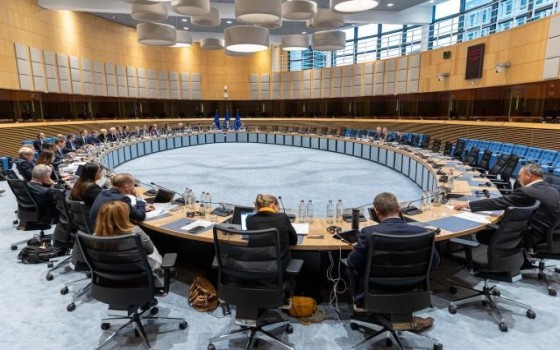
Meanwhile, the EU-Egypt Association Council is holding its eleventh meeting on Monday, June 15, in Luxembourg. According to a statement issued by the European Union institutions in Brussels, building on the results of the first EU-Egypt Summit held in October 2025, the Association Council will review the implementation of the Comprehensive Strategic Partnership between the EU and Egypt, launched in March 2024, and discuss ways to enhance bilateral cooperation.
The two sides are expected to assess progress on the six pillars of the partnership: political relations, economic stability, trade and investment, migration and mobility, security, and demographics and human capital.
This exchange will also provide an opportunity to discuss global issues of common interest and the regional situation, including developments in the Middle East and North Africa and their implications for EU-Egypt cooperation.
In other news, Playbook magazine, under the headline "What's Worth Watching," reported that Ukraine and Moldova will take their first official steps toward EU membership by opening their first negotiating group, which is scheduled to be approved at an intergovernmental conference held immediately after the meeting of the Foreign Affairs Committee. It will be dubbed "Super Monday" because it will undoubtedly be the best day for EU enlargement since Croatia's accession in 2013, according to statements published on the Playbook website.
Breaking News
Trump casts a shadow over the G7 summit: The G7 summit kicks off today in Evian-les-Bains, France, where French President Emmanuel Macron will try to capture Donald Trump's attention... EU leaders will seek common ground on China... and Ukrainian President Volodymyr Zelensky will do his utmost to keep Washington engaged in the war against Russia.
Spain seeks a painful victory: Spanish Prime Minister Pedro Sánchez has become a fierce opponent of Trump in Europe, which, according to his supporters, makes winning the World Cup all the sweeter.
NATO escalates hybrid warfare: Private companies and military assets are being used in the war against Russian aggression.
Ukraine under bombardment: Overnight Russian airstrikes killed five people in Kharkiv, injured at least 20 in Kyiv, left tens of thousands without power, and set fire to one of Ukraine's most important religious sites. Prime Minister Yulia Sverdenko described the damage to the Kyiv-Pechersk Lavra as "a brutal attack on our people and our heritage."


No Comments Found