

A potential confrontation looms between Trump and the Europeans over digital taxes, while OpenAI accuses Apple of stealing trade secrets—following a similar lawsuit filed by the company behind ChatGPT.

- Europe and Arabs
- Sunday , 29 November 2026 6:7 AM GMT
Brussels–Washington: Europe and the Arabs
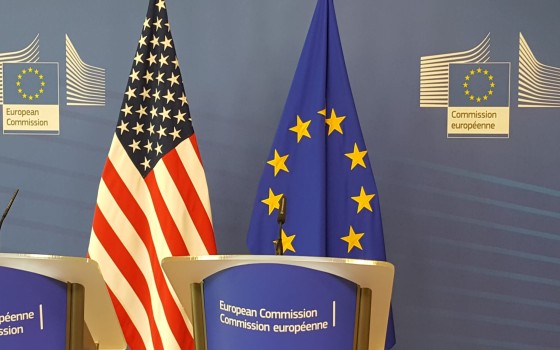
European leaders are bracing for potential confrontations with Donald Trump over issues such as digital taxes, defense procurement, and funding for Ukraine, according to various observers in Brussels. This comes as the United States has announced its opposition to a European proposal to impose a tax on major technology companies operating within the European Union—a move Washington argues could discriminate against American firms and harm consumer interests, as reported by *Playbook*, the European edition of the American outlet *Politico*.
A U.S. State Department spokesperson, speaking to Agence France-Presse (AFP), confirmed that Washington is entirely opposed to the European proposal. This stance aligns with its rejection of other digital services taxes, which the U.S. contends specifically target American companies and negatively impact consumers.
The European Union is currently exploring new revenue sources for its budget. The proposal to tax the world’s largest digital technology companies is part of the EU’s broader effort to secure new funding, a process complicated by internal divisions among member states regarding spending plans and the mechanisms for generating financial resources.
The proposal lacks consensus among European nations; notably, Ireland—which hosts the European headquarters of many global technology firms—has declared its opposition to the implementation of a digital tax. Irish Prime Minister Warns of Repercussions of a Digital Tax
In this context, Irish Prime Minister Micheál Martin, upon arriving for talks in the Belgian capital, stated that imposing a digital tax sends the wrong message and could reflect an inconsistency in policies aimed at fostering economic competitiveness.
The positions taken by the United States and Ireland highlight ongoing disagreements regarding the future of digital taxation in Europe—a time when the European Union is seeking to diversify its funding sources, amid concerns about the potential impact of new tax measures on investments, the business environment, and the technology sector.
Last June, in response to threats from U.S. President Donald Trump regarding digital taxes, the European Commission asserted that the European Union and its member states possess the sovereign right to regulate economic activity.
A spokesperson for the Commission explained that any taxes imposed would be non-discriminatory by nature, applying equally to all major companies, regardless of their country of origin.
The spokesperson added that while the European Union would respond promptly to any unilateral and unjustified measures, it remains open to reaching a global solution consistent with agreements reached within the G7.
Previously, U.S. President Donald Trump stated that he would impose 100% tariffs on imports from any country that implements a digital services tax targeting American companies. This escalation comes at a time of growing debate in Europe regarding digital taxation, with the European Union and several member states having discussed the imposition or expansion of taxes on digital services—a move primarily targeting major technology companies, most notably those based in the United States.
Meanwhile, following a lawsuit filed by Apple over the summer, OpenAI has responded with a countersuit, accusing Apple of stealing trade secrets. This was reported on Sunday morning by the Brussels-based European news network, Euronews.
OpenAI, the provider of the "ChatGPT" service, alleges that Apple attempted to misappropriate trade secrets through a former employee, while simultaneously pressuring shared suppliers to hinder OpenAI’s entry into the market for connected devices.
OpenAI filed the countersuit on Friday in a federal court in San Jose, California.
Apple denounced the filing, describing it as a "transparent attempt to distract from the core" of the lawsuit it had initiated in July against OpenAI and two former Apple employees.




No Comments Found