

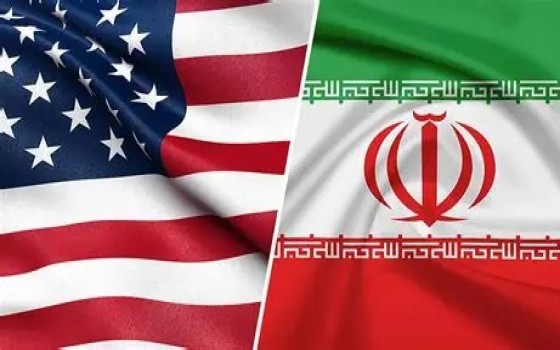
Last chance to stop the war before Trump's deadline expires... Negotiations to halt the fighting for a month and a half, with key points including the Strait of Hormuz and uranium... Tehran fears a repeat of the Gaza and Lebanon scenarios... Concerns about a nuclear accident

- Europe and Arabs
- Monday , 6 April 2026 7:13 AM GMT
Tehran – Washington: Europe and the Arabs
The Axios website, citing American, Israeli, and regional sources, revealed that negotiations are underway between Washington and Tehran regarding a potential 45-day truce. These efforts come at a time when sources described the chances of reaching a partial agreement within the next 48 hours as "slim," but considered it the "last chance" to avoid a dangerous escalation of the war.
The same sources warned that the failure of this endeavor could lead to an unprecedented military escalation, including large-scale American strikes targeting civilian infrastructure in Iran, followed by an Iranian response targeting energy and water facilities in the Gulf states. According to the European news network Euronews in Brussels, under the headline "Trump Extends Deadline and Sets New Deadline":
The ten-day deadline given by US President Donald Trump to Iran was expected to expire Monday evening, but he extended it by an additional 20 hours on Sunday, setting a new deadline of 8:00 PM Eastern Time on Tuesday evening. He announced this via a post on the Truth Social platform.
Threat to Destroy Iran
Trump told Axios on Sunday that the United States is "engaged in deep negotiations" with Iran, expressing the possibility of reaching an agreement before the deadline and asserting that "there is a good chance." However, he added threateningly: "If they don't make a deal, I will destroy everything there." Trump had previously threatened to target vital civilian infrastructure in Iran, which would be considered a war crime under international law.
The Republican leader wrote on his platform: "Tuesday will be Power Plant Day and Bridge Day, all in one package, in Iran. There will never be anything like it!!!" He added, "Open the damned strait, you crazy bastards, or you will live in hell."
Iranian Counter-Warning
In response, Iranian forces warned that "if attacks on civilian targets are repeated, the next phases of our offensive and retaliatory operations will be more destructive and widespread." Meanwhile, Parliament Speaker Mohammad Bagher Ghalibaf threatened that "the entire region will burn" because of Trump's "reckless" actions, asserting that Trump is determined "to follow the orders of Israeli Prime Minister Benjamin Netanyahu."
Meanwhile, the Emirates News Agency reported on Monday that authorities in the Emirate of Fujairah were responding to an incident involving an Iranian drone targeting a telecommunications company building. The Saudi Ministry of Defense announced earlier that day that it had intercepted and destroyed two drones in the past few hours.
The UAE Ministry of Defense announced on Sunday that its air defenses had intercepted “missile and drone attacks coming from Iran,” before reporting fires at the Borouge petrochemical plant in Abu Dhabi.
Meanwhile, Bahrain’s state-owned Bapco Energies announced a fire in one of its fuel tanks following an Iranian drone attack, confirming that it was “fully under control.”
In contrast, the official Iranian news agency IRNA quoted Iranian forces as saying they had targeted aluminum plants in the UAE, as well as US military sites in Kuwait.
The Islamic Republic had threatened to target water and energy facilities in Israel and the Gulf states in retaliation for US and Israeli strikes on a petrochemical plant in southwestern Iran, according to the Fars news agency.
Axios, citing two sources, reported that an operational plan for a large-scale US-Israeli bombing campaign targeting Iranian energy facilities was ready. However, the extension of the deadline was intended to give diplomacy a final chance. Negotiations are being conducted through mediators from Pakistan, Egypt, and Turkey, in addition to an exchange of text messages between Trump's envoy, Steve Wittkopf, and his Iranian counterpart, Abbas Araqchi.
Meanwhile, the Omani News Agency reported that Muscat and Tehran are holding a meeting "to discuss possible options for ensuring the smooth flow of traffic through the Strait of Hormuz during these circumstances in the region."
A Two-Stage Agreement and a Temporary Truce
According to the report, Iran has previously rejected White House proposals, and mediators are currently discussing a two-stage agreement:
- First: A 45-day truce during which negotiations will take place for a permanent end to the war, with the possibility of extension.
- Second: Reaching a final agreement to end the war completely.
Key Negotiating Points: The Strait of Hormuz and Uranium
Sources believe that the full reopening of the Strait of Hormuz and finding a solution for Iran's stockpile of highly enriched uranium (either by removing it from the country or diluting it) will only be achieved within a final agreement. Mediators are working on confidence-building measures that Iran might take regarding these two issues, which are considered Tehran's most important bargaining chips.
In this context, two sources confirmed that Iran will not agree to completely abandon these two issues in exchange for a temporary 45-day truce. Therefore, mediators are currently exploring the possibility of Tehran taking partial steps on these issues during the initial phase, in conjunction with US measures that would provide guarantees against a resumption of hostilities after the truce.
Iranian Concerns About a Repeat of the Gaza and Lebanon Scenarios
Iranian officials have informed mediators of their rejection of a repeat of the Gaza or Lebanon scenarios, where a truce exists only "on paper," and the US and Israel can resume attacks at any time. Mediators are working on formulating additional US confidence-building measures that address some of Iran's demands.
In the same vein, according to the UN Daily News, the Director General of the International Atomic Energy Agency (IAEA), Rafael Mariano Grossi, expressed deep concern about the incident of a projectile falling near the Bushehr nuclear power plant, which Iran reported to the agency.
The agency said in a post on its X platform that this was the fourth such incident in recent weeks, and that Iran had informed the agency that a member of the site's physical protection team was killed by shrapnel, and that a building within the site was damaged by blast waves and shrapnel.
The agency clarified that no increase in radiation levels had been reported.
Grossi stressed that nuclear power plant sites or their surrounding areas must never be targeted, noting that buildings adjacent to the site may contain equipment vital to ensuring safety.
The IAEA Director General reiterated his call for maximum military restraint to avoid the risk of a nuclear accident. He again emphasized the paramount importance of adhering to the seven principles of nuclear safety and security in times of conflict.



No Comments Found