

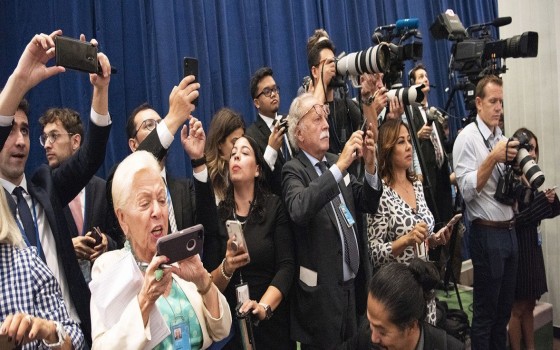
A Significant Rise in Online Violence Against Women Journalists: Latest Report Released for World Press Freedom Day

- Europe and Arabs
- Saturday , 2 May 2026 5:33 AM GMT
New York: Europe and the Arabs
A new report has highlighted the alarming rise and increasing complexity of online violence against women active in the public sphere, particularly journalists and media workers, according to the UN News Daily. The report, prepared by UN Women, TheNerve, and their partners, was released ahead of World Press Freedom Day on May 3.
Twelve percent of women human rights defenders, activists, journalists, media workers, and other public communicators reported having personal photos shared without their consent, including intimate or sexually explicit content.
Six percent said they had fallen victim to deepfake technology, while nearly one in three women received unwanted sexual harassment via digital messages. The report revealed that this type of abuse is often deliberate and coordinated, designed to silence women involved in public life while simultaneously undermining their professional credibility and personal reputation.
This strategy has already begun to have a tangible impact; 41 percent of the women surveyed stated that they practice self-censorship on social media to avoid abuse, while 19 percent reported practicing self-censorship in their professional work as a result of online violence.
The Recourse to Self-Censorship
For female journalists and media workers, the picture is even more alarming; 45 percent of this group reported practicing self-censorship on social media in 2025—a 50 percent increase compared to 2020—while nearly 22 percent reported practicing self-censorship in their professional work.
Other notable trends point to a rise in legal action and reports filed with law enforcement by women journalists and media workers. In 2025, they were more than double the likelihood of reporting online violence to the police (up 22 percent) compared to 2020. Nearly 14 percent are now initiating legal proceedings against perpetrators, accomplices, or their employers—a significant increase from 8 percent in 2020, reflecting a growing awareness and a stronger commitment to accountability.
Serious harm to women’s health and well-being
The report warned that this violence inflicts serious harm on women’s health and well-being, revealing that nearly a quarter of the women journalists and media workers surveyed (24.7 percent) had been diagnosed with anxiety or depression related to the online violence they experienced; and approximately 13 percent reported being diagnosed with post-traumatic stress disorder.
In this regard, Kalliope Mingero, Chief of the Elimination of Violence against Women section at UN Women, said: “Artificial intelligence is making abuse easier and more lethal, fueling the erosion of long-sought rights in a context of democratic backsliding and online misogyny. Our responsibility is to ensure that systems, laws, and platforms respond to this crisis with the urgency it demands.”
The report noted that significant gaps remain in legal protections against online violence. As the World Bank highlighted last year, fewer than 40 percent of countries have laws in place to protect women from online harassment or stalking. As a result, 44 percent of women and girls worldwide—nearly 1.8 billion people—remain without access to legal protection.
No Comments Found