

Eurozone: Expectations that the Middle East crisis would quickly return to normal have not materialized. This is the harsh reality we face.

- Europe and Arabs
- Tuesday , 5 May 2026 4:43 AM GMT
Brussels: Europe and the Arabs
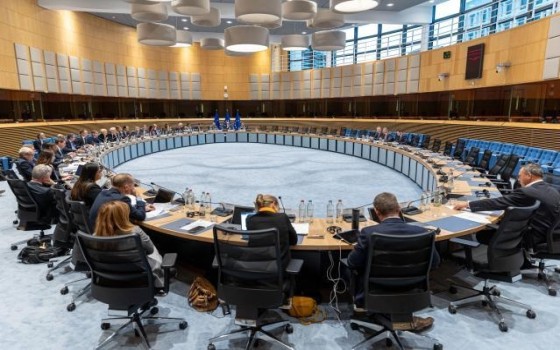
Expectations that the crisis in the Middle East would quickly return to normal have not materialized. This is the harsh reality we face, and we must deal with it realistically and responsibly. According to statements made by Eurogroup President Kyriakos Perakakis following a meeting of Eurogroup finance ministers, and included in a statement issued in Brussels on Monday evening, "The situation remains uncertain. Developments are already impacting the European economy – energy prices, inflation, and growth. Citizens are feeling the pressure in their daily lives, particularly the most vulnerable. The same applies to businesses striving to operate in a highly competitive environment. Our responsibility to them is to prepare for even the most challenging scenarios, such as a prolonged disruption to shipping in the Strait of Hormuz, which could further increase the pressure and slow economic activity. We are addressing this issue as European governments in close coordination, including with our non-eurogroup colleagues, based on recent Eurogroup discussions, and will continue to monitor it systematically. European coordination on such vital issues is essential. Despite the challenges, Europe is starting from a strong position. The eurozone has demonstrated its resilience, inflation was close to the target level before this latest shock, and our labor market remains strong, with historically low unemployment rates. This is our foundation. On this foundation, we are building, through planning." Consistency and accountability.
Member countries have already taken measures to support citizens and businesses. We are working in a coordinated manner, according to a common standard, as defined by the Commission: these measures must be targeted and temporary, consistent with the fiscal rules we have agreed upon, and also aligned with the goals of the green transition. In the face of successive crises, maintaining this balance is not easy, but it is absolutely essential.
In this context, we had a substantive discussion with Oya Silason, Deputy Director of the European Department at the IMF. The IMF acknowledges Europe’s positive start but emphasizes that the effects of the crisis are not evenly distributed. It is clear that net energy importers and economies with limited fiscal space are under greater pressure. This requires us to act prudently, with well-designed and targeted policies.
It was therefore striking to learn from the IMF that around 70% of the total cost of the measures we took in 2022 were either not properly targeted or distorted prices, or both. Even worse, with regard to the current energy shock, The IMF, in its assessment, points out that, without targeted measures, 33% of electricity subsidies could go to the richest 20% of the population, compared to only 11% for the poorest 20%. This gap is even more pronounced with regard to transport fuel subsidies: 34% could go to the wealthiest households, while only 9% would reach the poorest, also without targeted measures.
The IMF also reminded us that improved energy efficiency and a cleaner energy mix have made Europe more resilient. European household costs have fallen by 12% thanks to increased efficiency and the shift towards renewable energy sources over the past five years.
The EU and its Member States are working decisively to strengthen our strategy for energy self-sufficiency. In recent years, we have reduced our dependence on fossil fuels. However, current developments show that this process needs to be accelerated. We are investing in electricity grid interconnection, clean energy sources, and the European grid. In this context, the European Commission’s AccelerateEU plan is an important step forward.
At the same time, stability remains Our financial system is of paramount importance. During the hearing with Claudia Boch, Chair of the Supervisory Board of the Single Supervisory Mechanism (SSM), and the update provided by Dominique Laborix, Chair of the Single Solution Board (SRB), the resilience of the European banking sector was underscored.
However, there is no room for complacency. Banks must be prepared for an increasingly uncertain and rapidly changing technological environment. For this reason, we decided to initiate a discussion on artificial intelligence (AI) at today's meeting. Leading AI models are evolving rapidly and may soon pose systemic challenges. We must ensure a framework that supports both stability and competitiveness.
We also addressed the issue of cross-border banking, with input from Slawomir Krupa, President of the European Banking Federation. The consolidation of the European banking sector is essential for strengthening its resilience, as it can lead to better allocation of capital and liquidity, enhanced risk diversification, and economies of scale. These economies of scale will incentivize EU banks to catch up with their international counterparts in investing in new technologies.
I believe that banking consolidation will lead to greater stability, enhanced competitiveness, and wider choice. For citizens. We will continue this effort, including building on the European Commission’s forthcoming report.
The same logic—improving competitiveness and increasing choice for citizens—applies to the Capital Markets Union. During our meeting with Jörg Kukies, former German Finance Minister, and Christian Noyer, former Governor of the Bank of France, we discussed the recommendations of their report on financing innovative companies.
Improving access to private capital, reforming supplementary pension schemes, and establishing a “System 28” for company law are essential for fostering growth and innovation in Europe. We will revisit the progress made on these initiatives in October.
The Eurogroup is also continuing its work on digital finance. We reviewed the technical progress made in recent months and agreed on the next steps, with the aim of adopting a unified European political position in July.
Europe is operating in a challenging and complex environment. Our response must be coherent, consistent, and decisive: through responsible fiscal policy, accelerating the energy transition, deepening financial integration, and investing in innovation and the digital economy.
The resilience we have built is fundamental. The next step is to transform it into strength—into growth and competitiveness—for Europe and its citizens.


No Comments Found