

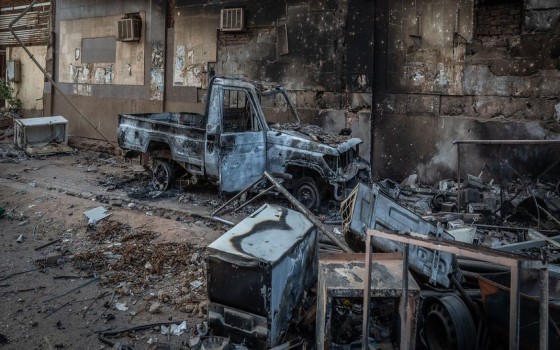
For the first time in months, the Sudanese army repelled a drone attack by the Rapid Support Forces on Khartoum airport. The United Nations warned that the escalating drone attacks threaten civilians and disrupt aid efforts.

- Europe and Arabs
- Tuesday , 5 May 2026 5:27 AM GMT
Khartoum - New York: Europe and the Arabs
The Sudanese army announced that it had repelled attacks carried out by the Rapid Support Forces on Monday, using drones that targeted various areas of the capital, Khartoum, including the vicinity of Khartoum International Airport.
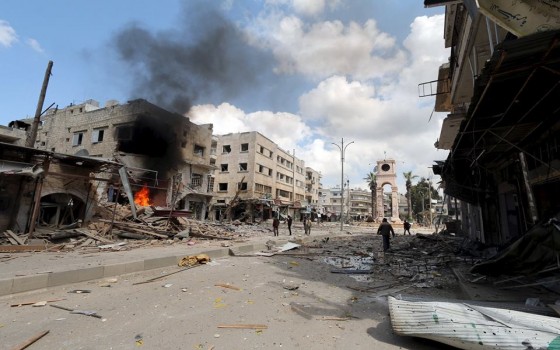
Sources inside the airport reported that three projectiles landed in its vicinity, while witnesses reported a drone crashing into a house in the Imtidad Nasser neighborhood east of the airport, coinciding with the sound of explosions in the area. Plumes of smoke were also seen rising from nearby neighborhoods, including the Al-Safa neighborhood, according to consistent reports. This was reported by the European news network Euronews in Brussels.
For its part, the Ministry of Culture, Information, Antiquities, and Tourism confirmed that one of the areas of Khartoum Airport was targeted by a drone, without any casualties or material damage. The ministry indicated that the necessary technical and security measures had been taken and announced that air traffic would resume normally as soon as these measures were completed. This attack is the fourth of its kind in about ten days on Khartoum State, which has been under the control of the army forces led by Abdel Fattah al-Burhan for over a year.
Later, the office announced that air traffic at Khartoum Airport would resume normally immediately after the completion of these routine procedures, confirming that the situation was under control.
It also stressed that the safety of citizens and the protection of facilities are top priorities, with full coordination continuing between the relevant authorities to ensure the continued stability of the situation.
The Sudanese Civil Aviation Authority had announced the resumption of domestic flights at Khartoum International Airport starting October 22nd, after the airport had been completely shut down following the outbreak of war and suffered extensive damage before being repaired and recently reopened.
In addition, the sounds of anti-aircraft fire were heard in the eastern Khartoum neighborhoods of Arkawit, Burri, and Riyadh, coinciding with the sounds of loud explosions.
Simultaneously, a drone targeted Wadi Sayyidna military base north of Omdurman, where it was intercepted by air defenses, according to a military source. The attacks also extended to White Nile State, where an ethanol plant in Kenana was bombed by drones, causing significant damage, according to a government source.
These attacks come after a period of relative calm in the capital, Khartoum, reigniting tensions at a time when fighting continues in other parts of the country, particularly in Kordofan and Blue Nile states.
Last week, the Rapid Support Forces carried out similar attacks targeting a hospital in Jabal Awliya and a vehicle in southern Omdurman, resulting in the deaths of five civilians.
Since the Sudanese army regained control of Khartoum in March 2015, following a large-scale military operation, the city has witnessed a gradual return to normalcy, with the return of large numbers of displaced people and the resumption of some activities, despite the continued shortage of basic services.
In contrast, fighting is currently concentrated in the Darfur region, where the army has lost significant ground, and in Kordofan, where there is conflict over strategic routes. Additionally, tensions are escalating in Blue Nile State near the Ethiopian border, raising concerns about a wider conflict. Drones have become a key tool in this conflict, with both sides increasingly relying on them. According to UN estimates, drone strikes since the beginning of the year have killed hundreds of people.
In a related incident, a drone strike in Gezira State last week killed nine members of the family of a commander of a faction allied with the army. The attack targeted the home of Abu Aqla Kikil, commander of the Sudan Shield Forces, who had previously defected from the Rapid Support Forces.
The years-long war has resulted in tens of thousands of deaths, with estimates suggesting the number could exceed 200,000. Millions have also been displaced within Sudan and abroad, making it one of the world's worst humanitarian crises.
The UN has expressed grave concern over the escalating drone attacks, which continue to endanger civilians. A wave of strikes has been reported in several Sudanese states in recent days. According to the UN Daily News Bulletin, a drone was reportedly shot down over Khartoum International Airport on Monday, leading to flight cancellations, according to UN Spokesperson Stéphane Dujarric. He noted that the airport is a vital lifeline for ensuring the delivery of humanitarian aid.
In Gezira State, local sources reported that five members of a single family, including women and children, were killed on Saturday. In White Nile State, a fuel station and a fuel tanker were struck near Kosti. In North Kordofan State, the state television building in El Obeid, the state capital, was damaged.
Drone attacks have also intensified in Darfur. Strikes were reported today in West Darfur State, while a strike two days ago in Nyala, South Darfur State, injured at least five people and damaged buildings near humanitarian offices.
Stéphane Dujarric said that the insecurity is forcing people to flee their homes. Over the past week, more than 2,600 people were displaced in North Kordofan State and nearly 1,000 in South Kordofan State, according to the International Organization for Migration.
Currently, it is estimated that nearly 9 million people are internally displaced within Sudan, while some 4.5 million others have fled to neighboring countries since the outbreak of war more than three years ago.
The United Nations reiterated the need for all warring parties to respect international humanitarian law at all times and to protect civilians and civilian infrastructure. It also stressed the importance of allowing continuous and unimpeded humanitarian access to those in dire need.






No Comments Found