

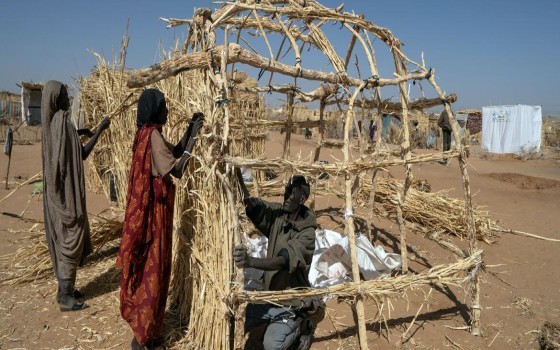
Straw Tents... Millions of Sudanese Return Despite Ongoing War and Widespread Service Collapse: A Glimmer of Hope, But...

- Europe and Arabs
- Wednesday , 13 May 2026 7:33 AM GMT
Khartoum: Europe and the Arabs
Despite the ongoing war and widespread collapse of services, Sudan is witnessing a growing return of internally displaced persons (IDPs) and refugees to their areas of origin. The International Organization for Migration (IOM) described this as a "ray of hope" amidst one of the world's largest displacement crises, with approximately 4.1 million people having returned to various parts of the country. This information was included in the UN Daily News bulletin, a copy of which was received Wednesday morning.
The bulletin added that, in an interview with UN News, the head of the IOM mission in Sudan, Mohamed Rifaat, affirmed that "the continued increase in the number of returnees – both from within Sudan and from abroad – represents a glimmer of hope that continues to illuminate the Sudanese situation."
Speaking via video link from Khartoum, Rifaat added that the vast majority of returnees – over 80% – have returned from within Sudan to nine major states, primarily Khartoum, Gezira, and Sennar. He noted that the number of internally displaced persons has decreased by 23% compared to the peak recorded in January 2015, when the number of displaced persons reached nearly 12 million. Mr. Rifaat explained that the increased rates of voluntary return "demonstrate that the Sudanese people are holding onto their land and clinging to hope, even with the slight improvement in the security situation."
Harsh Conditions in Return Areas
Despite this widespread return, the UN official warned that the majority of returnees face harsh conditions in their areas of origin, where widespread destruction and the collapse of basic services have occurred.
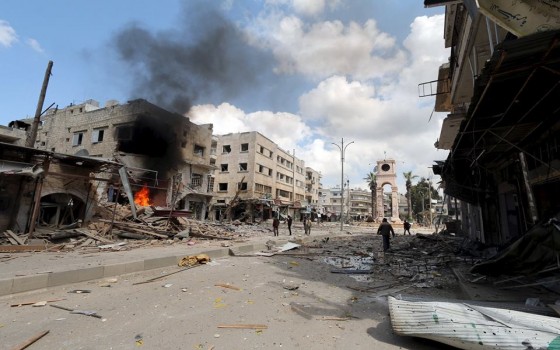
He said that most returning families consist of women and children, and that they are returning to cities that have been "systematically sabotaged and destroyed," especially Khartoum, which endured "a two-year siege and the systematic destruction of services."
He noted that about 70% of the homes to which residents are returning in Khartoum are partially or completely destroyed, while the areas of return suffer from a near-total absence of electricity, water, health, and education services.
Mohammed Rifaat said, "Most of the people returning suffer from a severe lack of services, but they prefer to return even if they will be living in ruined homes, hoping to find job opportunities and continue rebuilding their lives." The scale of the destruction far exceeds the capacity to respond.
The UN official added that humanitarian and UN organizations tried last year to improve water, health, and education services, but "the scale of the destruction far exceeds the currently available funding capacity."
He pointed out that the weakness of humanitarian funding represents one of the biggest challenges facing the response to the Sudanese crisis. He said that the level of funding for humanitarian work in 2025 was far below what was required, explaining that the funding rate, which exceeded 35% last year, was among the highest rates globally, meaning that the actual needs are still much greater than the available resources.
He explained that the decline in funding has directly affected the basic services provided to internally displaced persons and returnees, especially in the health, education, and protection sectors, stressing that this has influenced the decisions of the population "whether to return or remain in areas of displacement."
Rifaat indicated that the International Organization for Migration is currently focusing on three main areas:
Improving services in areas of return and displacement,
Providing job opportunities and a secure income for the most vulnerable families,
Supporting the integration of returnees with host communities to prevent renewed displacement.
Which sectors are most affected by the funding shortage? Regarding humanitarian intervention priorities, Rifaat explained that the organization relies on the Displacement Tracking Matrix (DTM) to assess needs in more than 1,500 locations across Sudan’s 18 states, including high-risk areas.
He said that funding shortages are forcing humanitarian organizations to “prioritize based on need rather than categorizing people as returnees, internally displaced persons, or host families.”
The UN official warned that the health, protection, and education sectors are the most affected by funding shortfalls—particularly protection services for women and children who have experienced gender-based violence, which he described as “one of the most defining features of the conflict in Sudan.” A tent is more than just a shelter.
As for the work of the International Organization for Migration (IOM), Mohamed Rifaat said that the shelter and non-food items sector is among the “most underfunded sectors in 2025.” He pointed out that the crisis worsened after the attacks in El Fasher, which displaced hundreds of thousands. He explained that more than 500,000 people are currently living in Tawila and the surrounding areas, and that more than 85% of them are suffering from a severe lack of shelter.
He said, "The tent today is no longer just a shelter; it has become a means of protection for women and children living in isolated areas after losing their homes and basic services."
Hope and Concern
Rifaat confirmed that the International Organization for Migration (IOM) continues its work in all Sudanese states, including the most affected areas such as Darfur, Kordofan, and Blue Nile, where it manages projects within camps, distributes tents, and provides shelter services to newly displaced people.
Rifaat expressed his concern about the continuation of the war and the lack of progress towards a ceasefire, warning that any new escalation could lead to new waves of massive displacement. But he emphasized that what gives the most hope is "the Sudanese people's attachment to their land and their desire to work and rebuild their lives." He added, "When you see children walking three or four kilometers to reach their schools despite the lack of electricity and services, you realize that the Sudanese people are still clinging to hope and their future." In the same vein, a UN official said he saw in Chad shocking evidence of the immense pressures that conflict, displacement, and chronic underinvestment place on inherently fragile systems. However, he also noted encouraging progress in promoting the health and rights of women and girls.
Andrew Saperton, Deputy Executive Director for Management at the United Nations Population Fund (UNFPA), was speaking to reporters at UN Headquarters in New York about his week-long visit to Chad to "assess the health and protection situation of women and girls and to listen directly to the affected communities."
In the Adré region on the border with Sudan, Saperton visited a center supported by UNFPA, where women and girls who had fled Sudan spoke about the dangers they face daily.
He said that "with firewood dwindling around the camps, women are forced to move further into isolated areas, exposing them to harassment, assault, and gender-based violence."
He explained that despite all the hardships these women and girls endure, he witnessed "resilience," adding that the center helps women rebuild their lives by providing psychosocial support, vocational training, and small income-generating projects, restoring their dignity and giving them a degree of independence.






No Comments Found