

Developments in the Middle East: Erdogan Calls for Reopening of the Strait of Hormuz... Hezbollah Accuses Netanyahu of Escalating the War for Political Gains... Hamas Leader in Cairo... and Iran Acknowledges Worsening Economic Crisis

- Europe and Arabs
- Sunday , 16 August 2026 7:32 AM GMT
Tehran – Beirut: Europe and the Arabs
Iranian state media announced the resumption of scheduled flights at Bandar Abbas Airport on the country's southern coast, following repeated disruptions to air traffic during the war, amidst disruptions affecting the operation of several airports and air routes in the region.
This came after the commander of U.S. Central Command (CENTCOM), General Brad Cooper, concluded a ten-day tour of six Middle Eastern countries, which also included a visit to a U.S. aircraft carrier in the Arabian Sea.
For his part, Turkish President Recep Tayyip Erdoğan stated that the continued closure of the Strait of Hormuz represents a major crisis for global trade, calling for its reopening as soon as possible. He affirmed that Turkey and Iran support ending the restrictions imposed on maritime traffic, allowing for the resumption of oil shipments through the strait. In Tehran, Iranian President Masoud Pezeshkian met with the heads of the three branches of government in a meeting broadcast on state television. Pezeshkian acknowledged on Saturday that his country's economic crisis had worsened in the aftermath of the war with the United States and Israel, pointing to declining oil revenues and damage to a number of factories. According to a report published by the European news network Euronews in Brussels on Sunday,
This escalation comes as the deadline stipulated in the memorandum of understanding signed by Washington and Tehran last June enters its final days, officially expiring on Monday amidst continued deadlock in negotiations between the two sides.
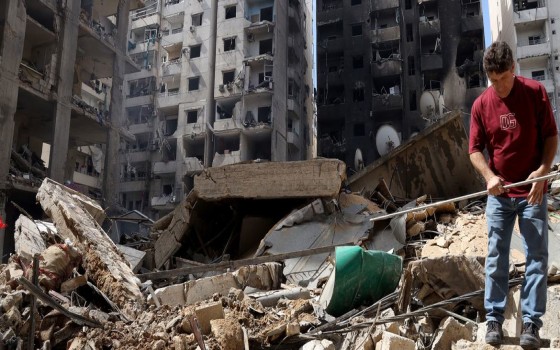
The Israeli army announced on Sunday that the airstrike on the Deir Zahrani area in southern Lebanon targeted Abu Hassan Alaa, whom it described as a senior commander in Hezbollah's Badr Brigade.
The office of Israeli Prime Minister Benjamin Netanyahu justified the escalation as a response to what it called Hezbollah's violation of the ceasefire, claiming that the group targeted Israeli forces with a drone, resulting in serious injuries to three soldiers.
Meanwhile, a spokesperson for Netanyahu announced that Tel Aviv is looking forward to opening "new and more ambitious negotiations" with Lebanon, under American auspices. Hezbollah accused Israeli Prime Minister Benjamin Netanyahu of seeking to escalate the military confrontation in southern Lebanon, despite the ceasefire agreement. The party indicated that the recent Israeli attacks reflect Netanyahu's desire to bolster his domestic political standing and serve his electoral objectives.
In a statement, Hezbollah said that the Israeli army's continued raids and attacks on areas in southern Lebanon constitute a persistent violation of the truce. The party asserted that the escalation is not solely related to the security considerations Israel claims to cite, but also serves the Israeli government's domestic political calculations.
Accusations Against Netanyahu of Exploiting Military Escalation
According to Hezbollah, Netanyahu is attempting to portray himself as a leader capable of handling security threats by raising the level of military operations, at a time when he is facing political pressure and domestic criticism regarding his management of the war and security matters.
The party added that the Israeli prime minister is trying to exploit the confrontations in Lebanon to strengthen his position within the Israeli political arena, linking this to what it described as Netanyahu's "electoral goals," without providing further details about the nature of these goals or the intended electoral timetable. These accusations come as Israel continues to justify its operations in southern Lebanon by claiming they target Hezbollah military sites and infrastructure, or are a response to attacks carried out by the group against Israeli forces deployed near the border.
Meanwhile, Hamas political leader Khalil al-Hayya traveled to Cairo on Saturday evening for talks with Egyptian intelligence chief Hassan Rashad. This was confirmed to AFP by a source within the Palestinian movement. US envoy Jared Kushner is scheduled to visit the region next week.
Kushner, son-in-law of US President Donald Trump, will visit both Israel and Egypt in hopes of advancing the peace plan spearheaded by Trump's Middle East Peace Council. This plan, which calls for an Israeli withdrawal and the disarmament of Hamas, has been widely publicized and has received Hamas's approval. However, Israel has rejected it, stating that withdrawal from Gaza is contingent upon Hamas's "effective" disarmament.
According to a representative of the Middle East Peace Council, Kushner hopes to hold "constructive talks" during his visit. The agenda for Azerbaijani Prime Minister Mohammad Ali Hayya's visit remains unclear. Hamas announced on Friday that it is still waiting for the United States and mediators to pressure Israel to abide by the peace plan.
The first phase of Trump's peace plan was the ceasefire announced in October. Since then, Israeli attacks on the Gaza Strip have decreased in intensity, but have not ceased entirely.






No Comments Found