

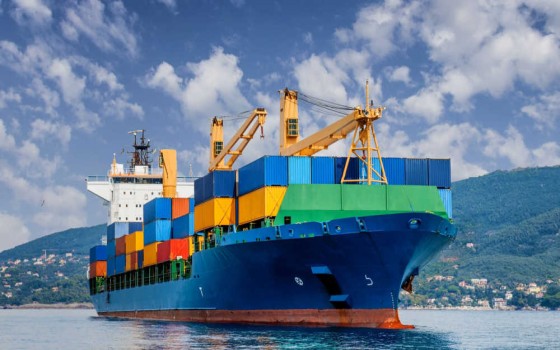
The European Union relies on maritime transport for 90% of its merchandise trade. The most important ports are Rotterdam in the Netherlands and Antwerp in Belgium. Shipping encompasses oceans, the Mediterranean, the Balkans, and the Black Sea.

- Europe and Arabs
- Monday , 7 September 2026 5:47 AM GMT
Brussels: Europe and the Arabs
Maritime transport in Europe ensures the arrival of food, fuel, and other supplies, but the disruptions to shipping routes caused by the war in Iran this year have brought it into sharp focus. In a report published Tuesday morning, the Brussels-based news network Euronews highlighted the busiest European ports in terms of cargo volume.
Maritime transport plays a crucial role in the movement of goods.
Globally, approximately 13 billion tons of goods were traded by sea in 2024. In the European Union, ports handled around 3.4 billion tons of goods, representing 26% of the global total.
According to the EU Blue Economy Observatory, nearly 90% of the EU's external trade in goods is also transported by sea.
So, which are the busiest ports in the European Union, and which countries handle the largest volumes of goods?
Maritime shipping is primarily comprised of two types: short-sea and long-sea transport. Short-sea shipping refers to the transport of goods over relatively short distances by sea, while long-sea shipping covers longer routes between continents across oceans.
For the European Union, short-sea shipping is not limited to vessels within the bloc; it also includes candidate countries, Iceland, Norway, the Baltic Sea region, the Mediterranean region, and the Black Sea region.
Rotterdam and Antwerp-Bruges are the EU's busiest ports.
As of 2024, according to Eurostat, two cities in the EU had the busiest ports by a significant margin when measured by total maritime traffic. The port of Rotterdam in the Netherlands was the most active, handling 397.3 million tons of cargo.
The port of Antwerp-Bruges in Belgium followed Rotterdam, handling 243.7 million tons of cargo. The Port of Hamburg ranks third among the busiest ports, but its cargo volume is significantly lower than the top two, handling 97 million tons.
After the first two ports, the total weight of cargo handled gradually decreases, and the differences between cities become relatively small.
The Port of Algeciras in Spain is the fourth busiest, with 81.5 million tons. The Port of Amsterdam, another Dutch port, completes the top five with 78.8 million tons of cargo.
The busiest port in France ranks sixth in the European Union. The Haropa port (Le Havre and Rouen) handled 76.6 million tons of cargo in 2024. It is closely followed by the Polish port of Gdansk with 71 million tons.
Another French port, Marseille, also makes the top ten with 66 million tons. The port of Valencia is also among the busiest, handling 64.5 million tons.
The port of Constanta in Romania is among the top ten.
One Romanian port, Constanta, appears in the top ten, handling 57.6 million tons of cargo.
Among the ports ranked 11th to 20th, the total weight of cargo handled ranges from 36.8 million tons at Dunkirk, France, to 55.5 million tons at Barcelona, Spain.
The port of Trieste is the busiest in Italy with 53.5 million tons, followed by Genoa with 47.4 million tons.
The port of Sines in Portugal is also among the top 20 busiest ports in the European Union with 44.1 million tons, followed by the port of Piraeus in Greece with 43.7 million tons. Aside from Hamburg, the German port of Bremerhaven is also a busy port, handling 42.5 million tons.
The Swedish port of Gothenburg is also among the top 20, with 38.5 million tons.
The ports of Zeeland, another Dutch port, contribute to the Netherlands' strong position within the European Union.
Dutch ports handle the largest volumes of goods.
When looking at countries by total cargo weight handled across all ports, the Netherlands leads the EU, with its ports handling 538.1 million tons of cargo.
Although Italy has three ports among the top 20, it ranks second in the EU with 488.6 million tons, closely followed by Spain with 486 million tons.
These three countries are significantly ahead of the rest, with Belgium, in fourth place, handling only 274.9 million tons of cargo. France, bordering the Mediterranean Sea, handled 269.8 million tons, slightly less than Germany, whose cargo volume reached 273.9 million tons.
Greece, Sweden, and Poland each handled over 100 million tons of cargo.
Turkey ranks second when candidate countries are included.
When candidate countries for EU membership and members of the European Free Trade Association are included, Turkey ranks second with 524.7 million tons, while Norway ranks eighth with 212.1 million tons.
The European Commission emphasizes that "maritime transport has been a catalyst for economic development and prosperity throughout its history" in Europe.
In March 2026, the Commission adopted two strategies to enhance the competitiveness, sustainability, security, and resilience of the wider EU water transport sector, encompassing ports, shipping, and shipbuilding.




No Comments Found