

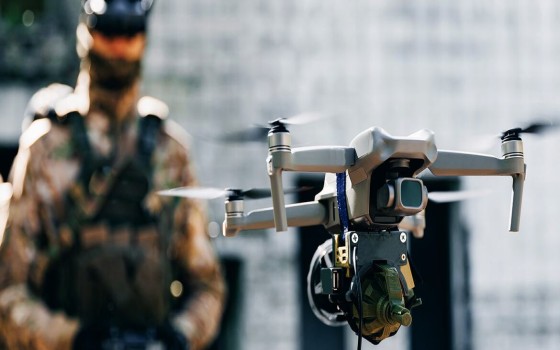
A New Kind of War: Machines Identifying Human Targets and Making Lethal Decisions—Ensuring Artificial Intelligence Does Not Evolve from a Tool for Technological Progress into a Threat to International Peace and Security

- Europe and Arabs
- Wednesday , 21 October 2026 4:31 AM GMT
New York: Europe and the Arabs
Is the world approaching a stage where machines determine human targets and make decisions to kill? And how can we ensure that artificial intelligence does not shift from a tool for technological progress into a threat to international peace and security?
The United Nations Institute for Disarmament Research (UNIDIR) is seeking to address this challenge through new initiatives aimed at strengthening governance, developing rules for responsible conduct, and building common ground among nations—as noted in the UN’s daily news bulletin, a copy of which was received on Wednesday morning.
In a briefing for journalists at the UN headquarters in New York on Tuesday, Dr. Robin Geiss, Director of UNIDIR, outlined the growing risks associated with the use of artificial intelligence in the military sphere.
He announced a series of new initiatives under the Institute’s Centre of Excellence on Artificial Intelligence, Peace and Security—a body established to bolster international governance of these technologies in collaboration with governments, the industrial sector, academia, and civil society.
An "Ethical Red Line"
Dr. Geiss pointed out that the international community is nearing a critical turning point in the development and deployment of military artificial intelligence. "A war of machines is drawing ever closer," he said, noting that the pivotal question facing governments and the international community is: "Will we allow machines to target and kill human beings?" Dr. Robin Geiss explained that the UN Secretary-General has repeatedly warned that the world is dangerously close to crossing a "moral red line." He emphasized that artificial intelligence and autonomous capabilities have already become widespread in military activities—ranging from intelligence analysis and target identification to the use of drones, cyberattacks, and information operations.
He cautioned that AI-driven systems, which often lack transparency, increase the risks of errors, miscalculations, and unintended escalation. Furthermore, the proliferation of AI capabilities lowers the threshold for conducting sophisticated operations, potentially enabling even non-state actors to carry out complex missions using these technologies.
Meanwhile, a small number of states and corporations are shaping security outcomes in ways that existing arms control frameworks were not designed to address—a trend with significant implications for the security of nations worldwide.
Despite these concerns, Geiss noted that international engagement on the issue of military AI remained limited for a long time. However, this is beginning to change, as there is a growing recognition that the international community must take action.
He pointed out that the general debate at the UN General Assembly last September brought artificial intelligence and its associated risks to the forefront of international attention. Geopolitical Competition as an Obstacle to Progress
According to a UN official, geopolitical competition remains a major barrier to progress; however, concerns regarding the impact of artificial intelligence (AI) are increasingly transcending political and strategic divisions.
The official pointed to a proposal put forward by the United States last month to establish an "AI safety hotline" with China, designed to address any AI-related incidents that could threaten national security.
He added that calls by the UN Secretary-General for stricter regulation of military AI—and for a legally binding treaty on lethal autonomous weapons systems—are gaining growing international support.
In this regard, he emphasized the need for international action to confront the challenges posed by military AI, stating: "It is time to unite our efforts and address AI in the military sphere head-on."
He noted that the Centre of Excellence on AI, Peace, and Security aims to ensure sustained international attention to the implications of military AI, and to address these issues in a direct and coordinated manner.
Artificial Intelligence, Peace, and Security
The United Nations Institute for Disarmament Research (UNIDIR) works on critical issues related to disarmament, arms control, and global security in the modern era—with artificial intelligence being one such issue.
The Institute recently launched the Centre of Excellence on AI, Peace, and Security in Geneva. Robin Geiss stated that this center serves as a permanent, neutral platform—the first of its kind within the United Nations system—aimed at providing a coherent approach to addressing the issue of artificial intelligence in the context of international peace and security.
In collaboration with Switzerland and Pakistan, the Institute is set to launch a new forum under the center this Thursday in New York. According to the UN official, this forum aims to establish a multilateral body—the only one of its kind within the UN system—focused on artificial intelligence, international peace and security, and the military domain.
Three Key Initiatives
The center also plans to launch three additional initiatives this week.
The first initiative focuses on promoting responsible conduct within the industry. The Institute is developing a framework that includes practical, voluntary guidelines based on international law and the UN Guiding Principles on Business and Human Rights.
The second initiative, scheduled for launch on Friday, aims to develop a lexicon of AI security terminology. This will help clarify core concepts and document variations in how different states understand terms such as "autonomy," "safety," and "security."
The third initiative addresses the risks of AI misuse by non-state armed groups and "other malicious actors," including terrorist organizations and criminal networks.


No Comments Found