

Threats of unprecedented strikes and an expansion of the conflict—the region faces a dangerous escalation, stretching from Iran to Yemen. Meanwhile, the UN Secretary-General, currently in Cairo, has described Egypt as a pivotal country in any vision for resolving the crisis in the Middle East.

- Europe and Arabs
- Friday , 23 October 2026 6:27 AM GMT
Cairo–New York: Europe and the Arabs
As the UN Secretary-General visits Cairo today, Friday, tensions in the Middle East continue to escalate. The situation is marked by mutual threats between the United States, Israel, and Iran, alongside rapid military developments in Yemen, while Israeli operations persist in the Gaza Strip, the West Bank, and southern Lebanon.
According to a report by the Brussels-based news outlet Euronews, U.S. President Donald Trump has accused Iran of attempting to drive up oil prices ahead of the midterm elections. Meanwhile, Israeli Prime Minister Benjamin Netanyahu has warned that Israel would strike Iran with "unprecedented force" should it attempt to interfere with Israel’s own elections.
In response, Iran’s Islamic Revolutionary Guard Corps (IRGC) warned that if the U.S. military continues its current "approach" in the Strait of Hormuz, the conflict could expand to include U.S. bases in the region.
For his part, the commander of the Iranian Army affirmed his country’s readiness for asymmetric warfare, stating, "Our enemy possesses significant capabilities; we have prepared ourselves for an asymmetric war, as they understand only the language of force."
In Yemen, military developments are intensifying as clashes continue between government forces and the Houthis on several fronts. The Saudi-led coalition announced that it had intercepted and destroyed two drones launched by the group toward the southern region, in addition to a ballistic missile fired toward Najran.
Separately, the death toll from a missile attack targeting the King Fahd International Airport in Dammam has risen to two, with eight others reported injured. Separately, the Israeli army announced on Friday that it had killed two individuals alleged to have participated in a shooting attack near the city of Hebron, in the southern West Bank, which resulted in injuries to several Israelis.
In the Gaza Strip, the Israeli army carried out the demolition of homes east of Gaza City, while several towns in southern Lebanon were subjected to intermittent Israeli artillery fire.
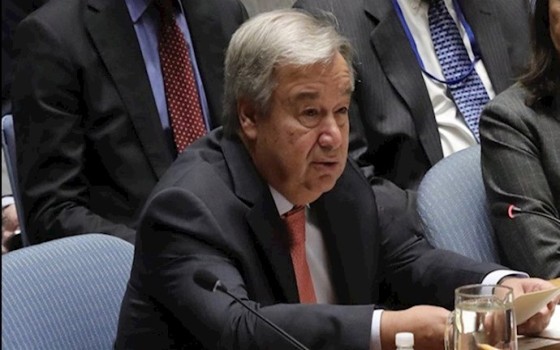
UN Secretary-General António Guterres arrives in Cairo today, Friday, for talks with Egyptian President Abdel Fattah el-Sisi. According to the daily UN news bulletin—a copy of which we received this morning—Guterres, in response to reporters' questions about what he hopes to achieve during his visit to Egypt, stated that Egypt is a crucial country in any perspective for resolving the crisis in the Middle East, particularly regarding the defense of the rights of the Palestinian people.
He noted that Egypt also serves as one of the mediators in the conflict that has emerged between the United States and Iran. He added that he would also discuss the situation in neighboring countries, including Sudan and Libya, with Egyptian officials, expressing his confidence that the visit would be highly productive.
Regarding the consultative meeting held in Geneva on strengthening peace efforts in Sudan, the Secretary-General was asked about the possibility of the conflicting parties reaching an agreement. He emphasized the necessity for all nations—whether neighboring Sudan or located further away—to cease supplying weapons to those who are killing civilians in such a devastating manner. UN Secretary-General António Guterres has warned that the escalation and expansion of conflicts carry far-reaching consequences, compounding human suffering and deepening inequalities across the globe. He emphasized that "the distance between the Strait of Hormuz and a family’s home—or a village marketplace—is shorter than we might imagine."
Speaking to reporters in New York ahead of his departure for Egypt this Friday, Guterres pointed to the frustration felt by people worldwide—including in Europe—amidst the persistent rise in the cost of living and the dwindling opportunities for young people to secure a better future.
"People everywhere want security; they want dignity; and they want governments and international institutions to deliver what is needed," he stated.
While condemning acts of violence and destruction—which he described as "unacceptable"—Guterres stressed that such actions should not obscure the "legitimate and genuine grievances of many peaceful protesters," which are inextricably linked to the broader state of turmoil currently unfolding across the world.
The Storms of War
"In the context of climate," he explained, "we know the 'El Niño' phenomenon—a disturbance in one part of the planet that disrupts weather patterns and upends lives thousands of kilometers away. Today, we are witnessing an 'El Niño' of wars. Conflicts fuel one another, and their repercussions spread further and faster than ever before." The Secretary-General pointed out that in conflicts ranging from the Middle East to Ukraine and Sudan, "there appear to be no restraints," with homes, hospitals, schools, airports, and energy infrastructure coming under constant attack.
While calling for an end to these violations, Guterres emphasized that the repercussions of these wars have extended to global energy markets, supply chains, and financial systems—exacerbating the cost-of-living crisis and reinforcing the reality of "a world already marked by profound inequality."
He stated: "War does not create all these inequalities, but it fuels and exploits them. It also exposes the fundamental injustice of an economic system that forces those who have the least to bear the greatest shocks. The answer cannot be an ever-widening cycle of confrontation—including in the Middle East."
Yemen
Guterres expressed concern over the escalation of hostilities in the vicinity of Taiz, Yemen, as well as continued Houthi attacks on civilian targets in Saudi Arabia—actions that cause "immense civilian suffering and heighten regional tensions." He called for restraint and the creation of a political horizon in Yemen, noting the United Nations' ongoing efforts in this regard.
He added: "Fighting must stop everywhere. International law must be respected, civilians must be protected, the rights and freedoms of international navigation must be upheld, and space must be provided for diplomacy to succeed."
Occupied Palestinian Territory
The Secretary-General also addressed the situation in Gaza, where Israel continues to impose strict restrictions on the entry of essential aid as winter approaches, amid "contrived difficulties" hindering the implementation of the comprehensive plan to end the conflict—a plan endorsed by the Security Council.
He noted that Palestinians in the West Bank are subjected to daily attacks by Israeli settlers, with "the clear objective of driving communities off their land."
Against this backdrop, he pointed out that humanitarian funding remains well below what is required. The World Food Programme, for instance, needs $450 million to provide food to the populations in Gaza and the West Bank over the next six months—an amount "equivalent to what the world spends on its militaries in about 90 minutes."
He appealed to donors to increase their support, while reiterating his call for establishing a credible political path toward a lasting peace, ending the occupation, and achieving a two-state solution.
Guterres explained that his visit to Egypt takes place in the context of all these issues, emphasizing that his message will be clear: "We must halt the expansion of the war, protect civilians, and create the political space necessary for diplomacy and peace."



No Comments Found