

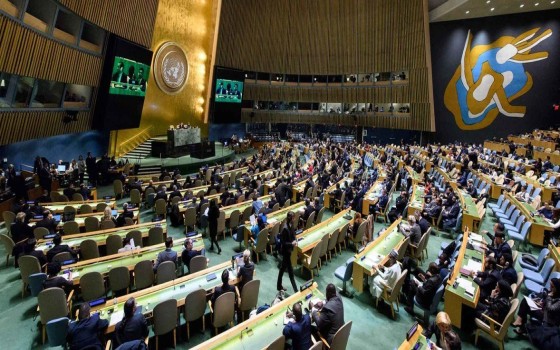
Resolving disputes through diplomacy rather than arms, and eradicating poverty and hunger—this is the call on United Nations Day. Meanwhile, the Security Council is addressing issues such as missing persons between Iraq and Kuwait, the impact of armed conflict on children, maritime security.

- Europe and Arabs
- Sunday , 25 October 2026 7:3 AM GMT
New York – Europe and the Arab World
On the 81st anniversary of the founding of the United Nations, Secretary-General António Guterres has called on all nations to renew their commitment to the shared values and obligations upon which the organization is built. He urged them to remain steadfast in their resolve to uphold the UN Charter and international law, and to work toward strengthening the organization so that it may best serve humanity and address the challenges of our time.
According to the United Nations’ daily news bulletin, the UN Charter entered into force on October 24, 1945, marking the establishment of a unique organization—one without parallel—that prioritizes efforts to achieve peace, development, and human rights.
The United Nations possesses a singular capacity to bring together all the world’s nations to discuss common problems and challenges, seeking solutions that benefit all of humanity. This is in addition to its life-saving work in regions affected by conflict, crisis, and disaster.
Each year on October 24, the world celebrates "United Nations Day," which this year marks the 81st anniversary of the organization's founding.
In his message for the occasion, UN Secretary-General António Guterres stated that the future of humanity "depends on our ability to work together to advance peace, development, and human rights."
Over the past 81 years, Guterres noted, the United Nations has embodied this vision by "striving to resolve conflicts—through diplomacy and law, rather than weapons—working to eradicate poverty and hunger, promoting human rights, and delivering life-saving aid to people facing war, disaster, and displacement." Guterres also spoke about the diverse areas of the United Nations' work that keep pace with emerging developments. These include establishing frameworks for transport, trade, and technology; safeguarding the health of both humanity and the planet; advocating for gender equality; expanding opportunities for women and girls; and ensuring that all countries have an equal voice on the global stage.
He emphasized that the United Nations is an essential part of the global fabric and is needed now more than ever. "Our world is shaken by conflicts, burdened by the climate crisis, scarred by deepening inequalities, and being transformed by technologies that are evolving faster than our ability to control them," he stated.
Guterres asserted that it is time to reaffirm the values upon which the United Nations was founded:
Dialogue instead of division.
Cooperation instead of confrontation.
Solidarity instead of fear.
In the same vein, the UN Security Council is preparing for an intensive week of meetings, beginning tomorrow, Monday. The agenda includes discussions on children and armed conflict; the situation between Iraq and Kuwait; women, peace, and security; emerging technologies; and maritime security. Additionally, the Council will vote on extending several UN missions and mandates, which are set to expire on October 31, according to a report published by *Youm7* in Cairo on Sunday morning.
The Council will open the week’s proceedings on Monday morning with a high-level briefing on children and armed conflict, marking the 30th anniversary of the establishment of this mandate within the United Nations. The meeting is expected to be chaired by Greek Foreign Minister George Gerapetritis, as Greece holds the presidency of the Council for the month of October. In the afternoon session, the Council will discuss the file concerning Iraq and Kuwait, specifically regarding missing persons and property issues stemming from the 1990–1991 war. Mary Yamashita, the Senior Coordinator for the implementation of Resolution 2792, will provide a briefing on efforts to repatriate the remains of missing Kuwaitis and nationals of third countries, as well as the recovery of missing Kuwaiti property.
Next Tuesday, the Council will hold its annual open debate on Women, Peace, and Security, focusing on the implementation of the Women, Peace, and Security agenda a quarter-century after its inception. Secretary-General António Guterres and UN Women Executive Director Sima Bahous are expected to participate.
On Wednesday, Council members will hold a special meeting with the President of the International Court of Justice, Judge Yuji Iwasawa, as part of the annual closed-door meeting between the Security Council and the Court’s President.
Thursday will feature one of the week’s most significant sessions: a high-level meeting on emerging technologies and their impact on international security, with a specific focus on maritime security. The session is expected to be chaired by Greek Prime Minister Kyriakos Mitsotakis, marking the second major event organized by Athens during its presidency of the Council this month. The Council will conclude its week next Friday with a series of votes and meetings. It is expected to vote on extending the mandate of the United Nations Verification Mission in Colombia, as well as to discuss Bosnia and Herzegovina and vote on renewing the mandate of the EU-led multinational stabilization force, EUFOR Althea, before its current authorization expires on October 31.
The Council is also scheduled to vote on extending the mandates of the United Nations Support Mission in Libya (UNSMIL) and the United Nations Mission for the Referendum in Western Sahara (MINURSO)—both of which expire on October 31—before holding a final session to conclude the Council’s work at 4:00 p.m.
These meetings take place during the final week of Greece’s presidency of the Security Council for the month of October, coinciding with several deadlines for the renewal of various UN missions and operations before the end of the month.



No Comments Found