

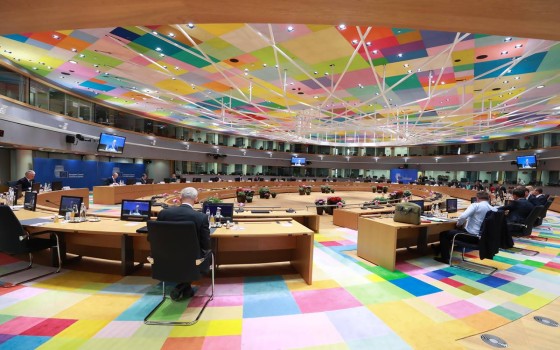
Brussels meeting aims to resolve divisions over the EU’s multiannual budget; key issues include a digital tax, support for the agricultural sector, and additional funding for Ukraine.

- Europe and Arabs
- Monday , 23 November 2026 6:16 AM GMT
Brussels: Europe and the Arabs
Paris emerges as the biggest beneficiary of the latest round of negotiations regarding the European Union’s long-term budget, according to four European diplomats who spoke to the "Playbook" newsletter over the weekend. The proposal presented by European Council President António Costa includes guarantees to support the agricultural sector, as well as the introduction of a digital tax—both of which are policies backed by Paris. In a segment titled "Hopes and Aspirations," the Brussels-based *Playbook* (the European edition of the American outlet *Politico*) noted that, regarding the potential for an agreement on the "Multiannual Financial Framework" (covering a seven-year period), German Chancellor Friedrich Merz—referred to in the context of the broader German political landscape—cautiously welcomed the proposal, which reduces the total budget by €44 billion compared to last month’s draft, describing it as a "first step" toward a more comprehensive deal. EU ambassadors are set to examine the fine details during a meeting of the Committee of Permanent Representatives (Coreper) today, ahead of a summit of EU leaders scheduled for Thursday.
However, there is significant grumbling behind the scenes—even from the French side itself. The Élysée Palace has described the proposal as "highly disappointing" and stated that it "does not constitute a basis for an agreement," citing, in part, a failure to provide sufficient guarantees for farmers' incomes.
Conversely, the so-called "frugal" states—which have been pushing for a smaller budget—find this stance ironic. A diplomat from one of the EU’s net-contributor states remarked: "French criticism of Costa’s efforts to achieve a cost-effective budget is quite surprising. Has Paris even decided yet who will foot the bill for its own contribution to the EU budget? Will it be the European Stability Mechanism (ESM) or the European Central Bank (ECB)?"
The implication: Given the state of its public finances, France is in no position to dictate terms. A stinging blow!
Another area to watch is the "digital tax" file. The proposal revives an initiative—spearheaded by France in 2018—to tax tech giants like Google and Meta. That earlier attempt failed due to opposition from the United States and other pro-tech nations, such as Ireland. There is little sign that this dynamic has shifted; Irish Prime Minister Micheál Martin has voiced his opposition, while Sweden’s Minister for European Affairs, Jessica Rosencrantz, stated last week that any new EU-wide tax "would not solve the fiscal equation." Another European diplomat noted that the proposal risks "opening Pandora’s box," given the potential reaction from U.S. President Donald Trump.
Meanwhile, tech companies are expressing strong opposition. Daniel Friedlaender, head of the Brussels office of the Computer & Communications Industry Association (CCIA), states that "a digital tax must be excluded from any agreement regarding the Multiannual Financial Framework (MFF)," adding that imposing such a tax "would drive companies to seek other destinations."
Then there is the issue of Ukraine; Costa’s proposal allocates €100 billion to the country, specifying that interest payments on existing and future loans to Kyiv will not be deducted from this amount. However, a European official noted that this leaves open questions regarding how such interest will be paid—including the potential creation of a separate mechanism dedicated exclusively to Ukraine.




No Comments Found