

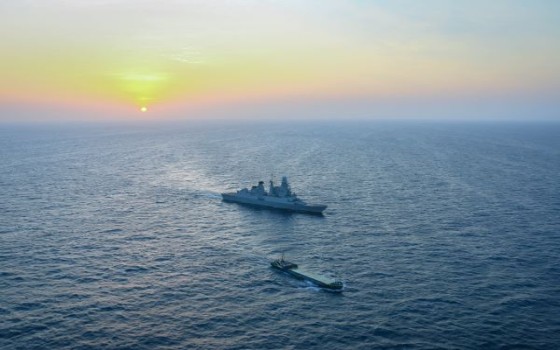
No Deployment of Military Forces in the Strait of Hormuz as Long as the US-Israeli War in Iran Continues: The Most Important Outcome of the International Coalition Meeting on How to Deal with the Energy Crisis

- Europe and Arabs
- Friday , 3 April 2026 6:24 AM GMT
Brussels: Europe and the Arabs
If there was one conclusion to be drawn from the UK-led meeting of 41 nations on how to respond to the looming energy crisis, it was this: there is no appetite for deploying military forces in the Strait of Hormuz as long as the US-Israeli war with Iran continues. This has set the tone for what is to come. Under the headline "Grave Risks," the website of Playbook, the European edition of Politico, stated: "Participants left no doubt about the seriousness of the situation. They were informed that traffic through the strait had plummeted from around 150 oil tankers per day to just 10 to 20." The virtual meeting also took place against the backdrop of US President Donald Trump's recent suggestion that allies should "take the lead" and send warships to help address the global energy shock caused by Iranian retaliatory attacks.
The leaders categorically rejected this proposal, concluding that all military options were off the table until a ceasefire was reached. The 90-minute call ended with an agreement to continue coordinating, with the first meeting scheduled for Tuesday to discuss post-conflict plans. A senior European official told my colleague Victor Jacques, “Working together is important, but we also have to be realistic about what we can deliver.”
Another senior European government official, who was on the call, told Politico’s chief reporter Tim Ross, “It was a good meeting, but it’s still early days.” The official also praised the UK’s role in organizing the meeting.
A British statement said the countries agreed to increase pressure—including through the UN—to ensure freedom of navigation through the Strait of Hormuz and to reject any Iranian attempt to impose fees on ships. But nothing was discussed about emulating initiatives like the UN-brokered Black Sea Grain Initiative, although there might be “lessons learned” from it, according to the official.
Trump has a simpler view. He told Politico’s Diana Nerouzzi, “They should have the courage to go in. Send your ships in there and enjoy.” But French President Emmanuel Macron responded, calling military action “unrealistic” and warning that it would take too long and expose oil tankers to missile attacks.
Trump used a vulgar term: He also attacked NATO. “I have no opinion on NATO,” he told Diana. “I’m disappointed in them. I’m not frustrated. I don’t care at all.” This is not a good time, as NATO Secretary General Mark Rutte and Trump’s adviser are due to visit Washington next week.
On France’s advice, Bahrain is working on a UN resolution that would authorize the use of force to reopen the Strait of Hormuz. But reports last night indicate the resolution has been watered down amid opposition from China and Russia. The Security Council is now expected to vote on the resolution on Saturday. The biggest risk: The future of the alliance remains uncertain – and Trump is the central variable in each of the five collapse scenarios previously outlined by the magazine.
According to a report by the Brussels-based European news network Euronews, more than 40 countries announced on Thursday the formation of an international coalition to secure freedom of navigation in the Strait of Hormuz, one of the world's most important maritime energy routes, amid the repercussions of closing this vital artery on the global economy.
The coalition's first meeting was held virtually, chaired by British Foreign Secretary Yvette Cooper, at a time when US President Donald Trump is escalating pressure on European allies to contribute to reopening the strait, where thousands of ships remain stranded.
In her opening remarks, Cooper stated that "Iran has taken an international shipping route hostage, threatening the global economy," warning of disruptions that could affect gas, jet fuel, fertilizer, and the cost of living.
She affirmed that the coalition will work to "collectively mobilize all our diplomatic and economic tools" to ensure the "safe and sustainable opening" of the strait, which is currently subject to a toll system imposed by Tehran, noting that among the options being considered is imposing new economic sanctions on the Iranian regime. In the same context, she noted that military planners would consider strengthening defense capabilities, including mine clearance and ship escorts, "once the conflict subsides."
Representatives from Italy, the Netherlands, and the UAE called for the establishment of a "humanitarian corridor" to secure the transport of fertilizers and avert a potential food crisis, according to the Italian Foreign Ministry.
The EU High Representative for Foreign Affairs, Kaja Kallas, also participated in the meeting, emphasizing that restoring safe and toll-free navigation in the Strait is a pressing priority and supporting diplomatic efforts to achieve this.
The meeting focused on assessing the situation and coordinating positions without making any executive decisions, and no joint statement was issued. Meanwhile, Bahrain is preparing to submit a draft resolution to the UN Security Council to protect commercial shipping, a move that could pave the way for intervention during the current phase of the conflict.
According to Reuters, the revised text did not include a binding implementation mechanism, merely calling for states to be authorized, individually or collectively, to use "all necessary means in accordance with the circumstances" to ensure safe passage. US Pressure on Europe
The Strait of Hormuz is a strategic waterway through which approximately one-fifth of the world's oil, gas, and jet fuel supplies pass. Ships attempting to transit the strait face numerous risks, leading owners and insurance companies to hesitate in covering them amid escalating security threats.
Securing navigation in the strait has long been a demand of US President Donald Trump, who believes that protecting this vital waterway should be the responsibility of the countries that benefit from Middle Eastern oil and gas, not the United States.
Trump criticized NATO allies for refusing to send warships to the conflict zone, despite Europe being affected by rising energy prices, even if it is not heavily reliant on imports from the region. In a televised address, he urged countries to show "belated courage" and restore freedom of navigation, saying that the beneficiary nations should "go to the Strait, control it, protect it, and use it."
He added that Iran had been "significantly weakened," asserting that "the hardest part is over" and that controlling the Strait should be a simple task.
Despite this pressure, the United States did not participate in the virtual meeting held on Thursday. US Secretary of State Marco Rubio had joined a G7 statement emphasizing the "absolute necessity" of restoring freedom of navigation in the Strait, without offering any clear commitments.
While Rubio described reopening the waterway as a "post-conflict necessity," Trump contradicted this stance, calling on allies to "learn to fight on their own" without relying on US support. In contrast, French President Emmanuel Macron rejected the American proposal, deeming securing the Strait of Hormuz by military force "unrealistic," and warning that it would take a long time and expose navigation to risks from the Revolutionary Guard and ballistic missiles. He added: "This is not a show of force... We are talking about war and peace, so let's be serious."



No Comments Found