

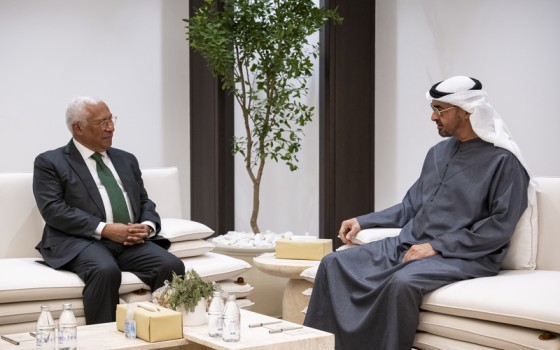
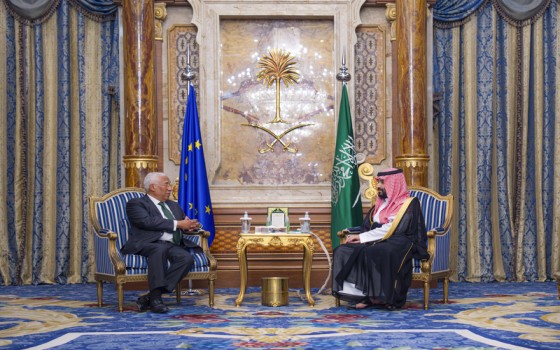
EU President: Iran's attacks violated the sovereignty and territorial integrity of the Gulf states, and we will remain a reliable partner. We discussed achieving a lasting ceasefire that paves the way for a sustainable peace and the restoration of freedom of navigation in the Strait of Hormuz.

- Europe and Arabs
- Thursday , 16 April 2026 4:49 AM GMT
Brussels: Europe and the Arabs
Following two days of meetings with the leaders of the United Arab Emirates, Saudi Arabia, and Qatar, European Council President António Costa stated that the visit came at a critical juncture, amidst a fragile ceasefire and the unjustified attacks suffered by these countries.
The European Union declared its full solidarity with the Gulf states and their people. “Iran’s attacks have violated their sovereignty and territorial integrity, and this is unacceptable,” Costa said in a statement issued by his office in Brussels. “We also highly appreciate the efforts of our Gulf partners to ensure the safety of the many European citizens residing in the region. During my discussions, I reiterated that the European Union is a reliable partner for the Gulf States, one they can count on now and in the future.
The purpose of my visit was simple: to listen to the leaders, to understand their assessment of the current situation, and to offer the EU’s support, with two main priorities in mind:
Working towards a stable and lasting ceasefire that paves the way for sustainable peace in the region;
Restoring freedom of navigation in the Strait of Hormuz.
Since the beginning of this conflict, the EU has consistently called for de-escalation and negotiations in full respect of international law. It is essential that all parties capitalize on the momentum created by the recent ceasefire between the United States and Iran, brokered by Pakistan, to address the international community’s concerns about Iran. This includes, of course, its nuclear program, its ballistic missile program, and its support for proxies.” They are destabilizing the region and blockading international shipping lanes. The Strait of Hormuz and the Red Sea are vital arteries for the global economy, supply chains, and international trade.
This war has already had devastating consequences felt worldwide, and the situation will only worsen with each passing day without a resolution to this conflict. Restoring freedom of navigation in the Strait of Hormuz is crucial and urgent. Europe is committed to helping ensure the safe and unimpeded passage of ships. This is the objective of the coalition formed by France and the United Kingdom, in cooperation with partners from around the world.
Before concluding, allow me to speak briefly about the situation in Lebanon. Hezbollah poses an existential threat to Lebanon and is a serious destabilizing factor for international peace and security. The European Union commends President Aoun's historic decision to ban Hezbollah's military activities. The EU will continue to support Lebanon. Enabling the authorities to disarm Hezbollah is the only sustainable solution for restoring Lebanon's international stability. The negotiations held yesterday between Israel and Lebanon in Washington are a welcome step. It is vital that these talks continue and yield results. Tangible, for the people, and for the prospects of peace.
I conclude by emphasizing that the European Union is a reliable and dependable partner for the Gulf States. We are here to support the stability and security of the region. We want to deepen and strengthen our cooperation. This is the message I heard from all the leaders I met this week. A week ago, EU foreign policy chief Kaja Kallas toured the Gulf region and held talks with leaders there. European Commission President Ursula von der Leyen addressed the latest developments last Monday in Brussels, following a European meeting that included preliminary discussions, largely focused on the economic impact of the Middle East crisis on the European Union. She said, “The Middle East has been engulfed in war for 44 days. The past six weeks have reminded us that peace is not a given. In recent days, a truce seemed to be on the horizon, as a ceasefire was announced, and you all witnessed it. Let me thank Pakistan for its important role in bringing us to this point. But we also know that negotiations have now stalled, and we must wait and see how things unfold. Any agreement must address the concerns raised by Iran’s nuclear and ballistic missile programs, and its actions that disrupt navigation through the Strait of Hormuz. The continued closure of the Strait of Hormuz is causing immense damage, and restoring freedom of navigation through it is of paramount importance to us. We are also concerned that the continued attacks on Lebanon threaten to undermine the entire process. We are mobilizing ReliefEU stockpiles to provide immediate assistance to the Lebanese people, but no amount of aid can replace a lasting peace. One of the most important lessons of the past few weeks is that security is indivisible. Stability in the Middle East and the Gulf cannot be achieved without a lasting peace.” While Lebanon is ablaze, we call on all parties to respect Lebanon's sovereignty and implement a full ceasefire. As we monitor the current fragile ceasefire, and despite the uncertainty, I would like us to draw lessons. This is the main objective of our briefing. This was not the first meeting in this crisis, but it certainly comes now with a fresh perspective on the situation. To summarize, since the start of the conflict – 44 days ago – our fossil fuel import bill has increased by more than €22 billion. 44 days, €22 billion – with virtually no increase. This demonstrates the enormous impact of this crisis on our economy. Even if hostilities were to cease immediately, the disruption of energy supplies from the Gulf would persist for some time. Therefore, we also discussed a series of measures that we will present to leaders at the upcoming informal meeting of the European Energy Council in Cyprus next week.



No Comments Found