

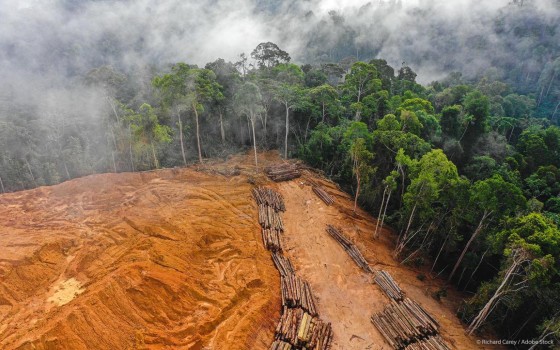
For the sake of humanity's future, a UN forum calls for forest protection and a halt to deforestation. At least 33 million jobs—supporting the livelihoods of 1.6 billion people—are linked to the forestry sector.

- Europe and Arabs
- Tuesday , 12 May 2026 7:20 AM GMT
New York: Europe and the Arabs
The United Nations Forum on Forests opened at UN Headquarters in New York, bringing together stakeholders to discuss ways to strengthen policy guidance and accelerate the implementation of agreed forest commitments.
In its 21st session, the Forum brings together Member States, experts, international and regional organizations, major groups, civil society, indigenous peoples, local communities, scientists, and the private sector to exchange knowledge, build trust, and forge partnerships.
The policy session is scheduled to run from Monday to Friday and will culminate in the adoption of a concise, action-oriented resolution by the Economic and Social Council. According to the UN daily news bulletin, a copy of which we received this morning, Tuesday,
In her statement to the Forum, Björg Sandkjær, Assistant Secretary-General for Policy Coordination in the Department of Economic and Social Affairs, said that the Forum is being held amidst "a profound state of global uncertainty and crisis," as the international community continues to confront interconnected and mutually reinforcing challenges, "including the worsening impacts of climate change, biodiversity loss, desertification, poverty, and growing socio-economic vulnerabilities," while progress towards achieving the Sustainable Development Goals remains uneven and insufficient.
She noted that forests are not only ecosystems of immense value, but also "indispensable natural assets for achieving sustainable development," as they contribute directly to climate change mitigation and adaptation, biodiversity conservation, water resource management, land restoration, food security, livelihoods, access to energy, and the building of resilient economies.
Sandkjær said that the UN Forum on Forests remains a vital platform for dialogue, coordination, and collective ambition, "given its unique role and essential work." She added: “The urgency of the challenges we face requires us to move decisively from acknowledgment and commitment to actual implementation. This necessitates strengthening political commitment, establishing effective partnerships, and providing sustained support to the institutions and processes that help translate global goals into concrete actions on the ground.”
For her part, General Assembly President Annalena Baerbock noted that we have all learned from a young age that “without trees and forests, we literally couldn’t breathe.”
She pointed out that more than half of the world’s GDP depends on nature, and that at least 33 million jobs—supporting the livelihoods of 1.6 billion people—are linked to the forestry sector, which is proof that “it is in our vital interest to do everything we can to protect this resource, yet today we are still doing the opposite and destroying it.”
Baerbock said that the debate surrounding forest conservation is being treated “as a zero-sum game, a choice between environmental protection on the one hand and economic growth on the other,” when in reality they are “two sides of the same coin.” She emphasized the need to embrace the leadership of Indigenous Peoples and to value the knowledge possessed by these communities, who "manage or protect approximately 80% of the world's biodiversity," as well as to support their proven efforts using modern technologies, considering this a valuable first step.
She added that agreements must also be translated into tangible results, "because declaring international years and international decades for forest protection is a noble gesture, but it will remain just that unless it is accompanied by meaningful follow-up actions at the national level through legislation." In this context, she highlighted the importance of mobilizing resources and strengthening partnerships to achieve this goal.
Global Forest Goals Report
Coinciding with the opening of the forum, the United Nations launched its latest report on the Global Forest Goals, which revealed that while progress has been made, it has not yet reached the pace or scale required to achieve the six goals outlined in the Strategic Forest Plan 2017–2030—which includes 26 sub-targets—nor the 2030 Agenda for Sustainable Development.
According to the report, the global forest area decreased by more than 40 million hectares between 2015 and 2025, while funding for sustainable forest management remains significantly below estimated needs.
Meanwhile, countries are moving forward with implementing reforms, scaling up forest restoration efforts, strengthening forest sector governance, and expanding cooperation opportunities. The report identified pathways to accelerate action, including halting deforestation, restoring degraded lands, expanding protected and sustainably managed forests, strengthening forest governance, bridging the financing gap for sustainable forest management, and promoting innovative financing mechanisms.
Among the report's findings:
Progress has been uneven, with gains in protected areas, long-term forest management plans, and forest monitoring systems.
Seven of the 26 targets have been largely achieved, 17 have been partially achieved, and two—halving forest loss and eradicating extreme poverty among forest-dependent populations—are off track.
Pressures from land-use change, climate impacts, wildfires, pests, and illegal activities continue to pose a persistent threat to forests in many regions.
Innovative financing, strong institutions, and multi-sectoral collaboration are essential for scaling up the plan's implementation. National leadership and community-led solutions demonstrate that progress can be accelerated when ambition is matched with action.




No Comments Found