

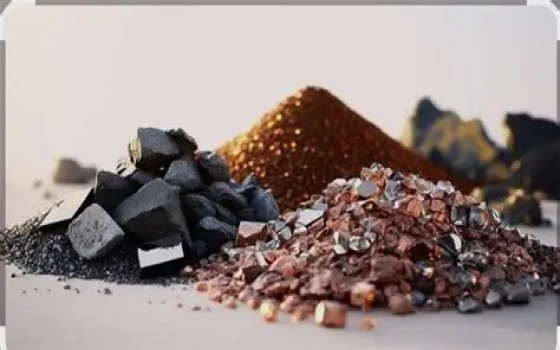
Will the rising global demand for critical minerals escalate geopolitical tensions, or could it become an engine for peace and development? The UN Security Council is called upon to answer this question.

- Europe and Arabs
- Wednesday , 22 July 2026 8:21 AM GMT
New York: Europe and the Arabs
Every electric car, every wind turbine, every solar panel, and every smartphone relies on minerals extracted from the earth.
As the global shift toward clean energy sources, independent of fossil fuels, accelerates, demand for minerals such as lithium, cobalt, nickel, copper, and graphite is rapidly increasing.
This presents an unprecedented economic opportunity for many countries.
However, competition for these resources has, in some regions, fueled conflicts, spread corruption, damaged the environment, and led to human rights abuses.
Therefore, the UN Security Council is posing a pivotal question this week: Can the minerals that underpin the transition to green energy also become the foundation for peace and sustainable development? According to the UN Daily News, a copy of which we received Wednesday morning, the article, titled "Where are these minerals found?", states:
Significant reserves of these critical minerals exist in Africa, Latin America, and parts of Asia.
For many producing countries, these resources represent a major opportunity to create jobs, diversify economies, and increase public revenues. However, realizing these gains depends on how these resources are managed.
Why is the demand for them increasing so rapidly?
The world is undergoing a rapid energy transformation.
Electric cars require about six times more minerals than conventional cars.
Offshore wind farms require about 13 times more mineral resources than gas-fired power plants.
Demand for many critical minerals is expected to triple by 2030. Many analysts believe that the strategic importance of these minerals is now comparable to that of oil in the 20th century.
Aren't mining activities harmful to the environment?
Mining is essential, but it can have serious environmental impacts if not managed properly.
Unregulated mining can lead to:
Deforestation.
Water pollution.
Biodiversity loss.
Soil degradation.
Increased greenhouse gas emissions.
Many mineral deposits are located near indigenous communities and sensitive ecosystems. The challenge is not whether mining should occur, but how to do it responsibly.
Why is the Security Council discussing this?
Natural resources have long played a role in fueling conflict.
The Security Council is discussing concerns related to:
Armed groups controlling valuable mineral deposits.
Illegal mining financing conflicts.
Criminal networks profiting from mineral smuggling.
Weak governance contributing to instability.
The broader question remains: Will increasing global demand for critical minerals exacerbate geopolitical tensions, or can it become an engine for peace and development?
Key takeaways from the UN:
UN Secretary-General António Guterres stated, "A world reliant on renewable energy sources is a world where the demand for critical minerals is growing."


No Comments Found