

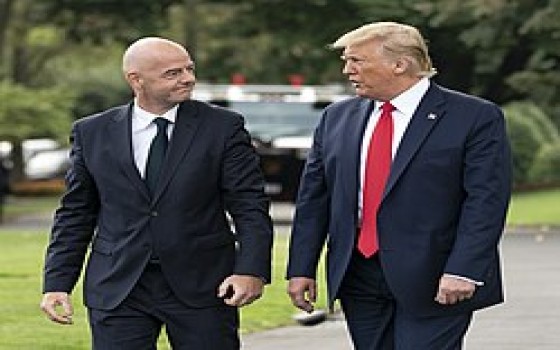
Between Trump and Infantino: A “Red Card” Shakes FIFA’s Throne and Opens the Door to a European Revolt

- Europe and Arabs
- Tuesday , 8 September 2026 6:52 AM GMT
Brussels – Yahya Yahyaoui
Gianni Infantino’s announcement of his candidacy for another term as president of FIFA was not just another election in the history of one of the world’s most powerful sporting organizations. This time, the race for the FIFA presidency seems to intersect with political and institutional questions that extend beyond the football pitch, reaching the very heart of the relationship between sport, influence, transparency, and governance.
Amid this landscape, the Belgian position has emerged as one of the most noteworthy in Europe, after Brussels chose to raise its voice against what it considers legitimate questions about the way the international football organization is run and its relationship with centers of political power.
The story, then, is not simply a personal relationship between Donald Trump and Gianni Infantino, nor a passing disagreement between officials. It reflects a broader struggle over the nature of global football governance and who has the right to set the rules of the game outside the pitch.
From the Pitch to the Corridors of Politics
In recent years, FIFA has become increasingly prominent on the international political and economic stage. Hosting major tournaments, distributing investments, funding programs, and relationships with governments and continental federations are all factors that have made FIFA an institution with influence that extends far beyond sports.
With the upcoming elections approaching, questions about transparency and decision-making mechanisms are becoming increasingly important, especially given the growing calls in Europe to strengthen governance within international sports organizations.
This is where the Belgian position becomes crucial. Despite its limited geographical size, Belgium occupies an exceptional institutional position within Europe, as it is the headquarters of the European Union and home to numerous international organizations.
From Brussels, a specific political or institutional message can quickly transform into a broader European debate.
“No support without transparency.” The Belgian position presents a clear equation: trust in international sports institutions cannot be separated from the principles of governance, accountability, and transparency.
This stance does not necessarily mean that Europe is heading towards an open confrontation with Infantino or forming a united front against his continued leadership of FIFA. However, the mere fact that the debate has shifted from the realm of sporting disputes to an institutional and political level is of considerable significance.
Elections at FIFA are not decided solely by a candidate's popularity or record in managing the federation, but also by a vast network of relationships and power balances between continental and national confederations.
Therefore, any European objection, however limited it may initially seem, can become influential if it coalesces into a unified stance.
Trump and Infantino: A Relationship Beyond Football
On the other side of the picture, the relationship between Donald Trump and Gianni Infantino is prominent, especially given the role the United States plays in hosting major football events.
However, the relationship between the two men cannot be understood in isolation from the broader political and economic context. In recent years, sports have become a tool of soft power, and major tournaments have transformed into platforms for asserting influence and building international relations.
Thus, global football is no longer merely a sporting competition. It is also an arena where economic, diplomatic, and political interests intersect.
Has a European “red card” been issued?
The most important question now is not simply whether Belgium opposes Infantino, but rather: Could the Belgian stance spark a broader European debate about the future of FIFA governance?
So far, it is too early to speak of a full-blown “European rebellion.” European federations are not necessarily united, and the relationship between UEFA and FIFA is governed by complex sporting and institutional considerations.
However, the political and institutional indicators warrant close attention.
If the debate shifts from a national stance to a convergence of positions among several European federations, governance could become a central issue in the discussions surrounding the upcoming FIFA elections.
If the objections remain isolated and limited, the matter may be addressed through institutional or regulatory channels without significantly impacting the balance of power within FIFA.
The Battle for Trust
Ultimately, the real battle facing FIFA today may be a battle for trust.
Major decisions concerning global football require institutions that enjoy the confidence of federations, players, and the public. The more questions arise about transparency and decision-making mechanisms, the greater the need for clear and convincing answers.
This is where the importance of the message coming from Brussels lies: transparency is not an administrative detail, but a fundamental element of the legitimacy of international sports institutions.
The question remains: will the circle of European objections expand to become a transnational institutional issue, or will it remain within the framework of national positions, investigations, and regulatory discussions?
The answer will become clearer as the upcoming elections approach.
But what is certain is that the FIFA presidential race is no longer a purely sporting matter. In a world where football has become a global industry, a soft power, and a tool for international influence, those who govern the game do not just manage the stadiums, but also a vast network of interests, relationships, and influence.
From Brussels, a symbolic red card is beginning to loom.
The question remains: will it be merely a warning, or the beginning of a broader review of the rules governing global football?
Yahya Yahyaoui
Brussels






No Comments Found