

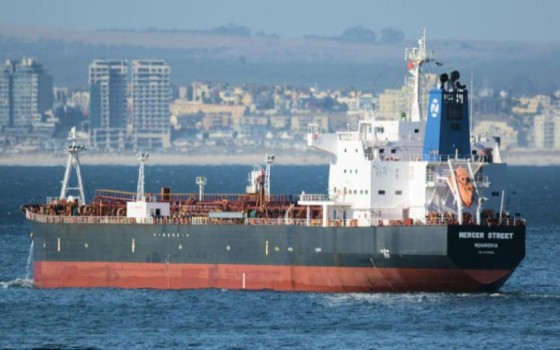
The top European importers of oil are the Netherlands, Germany, Spain, and France. The price of a barrel has surpassed $100. The United Nations has warned of escalation in the Strait of Hormuz and emphasized the need to restore freedom of navigation.

- Europe and Arabs
- Thursday , 10 September 2026 5:18 AM GMT
Brussels – Europe and the Arabs
UN Secretary-General António Guterres expressed deep concern regarding reports of further escalation in and around the Strait of Hormuz over the past few days, including attacks on commercial vessels and threats to take additional actions against maritime infrastructure and energy facilities.
The Secretary-General emphasized the need to fully restore and respect the rights and freedom of navigation in and around the Strait of Hormuz, in accordance with international law, according to the UN daily news bulletin received on Thursday morning.
UN Spokesperson Stéphane Dujarric reiterated the Secretary-General’s call for all concerned parties to exercise maximum restraint and refrain from actions or rhetoric that could further inflame an already tense situation.
He warned against any further escalation that could pose grave risks to civilians, regional stability, international peace and security, and the global economy. The Secretary-General urged the parties to make full use of diplomatic channels and to resolve issues through dialogue and negotiations.
He affirmed that the UN Secretariat stands ready to support all credible efforts aimed at de-escalation and achieving a comprehensive and lasting settlement.
According to the Brussels-based news network "Euronews," Brent crude prices rose above $100 per barrel on Wednesday and remained stable on Thursday morning following renewed attacks on vessels near the Strait of Hormuz. Prices have hovered above $70 per barrel for about seven months—rising 65.7% compared to the end of 2020, when the year closed at $60.85. This is no longer merely a story about the energy market; the rising cost of crude oil directly impacts the prices of diesel, gasoline, and jet fuel, subsequently rippling through transportation networks and supply chains to ultimately affect consumer prices. For Europe, this comes at a particularly inopportune moment: Eurozone inflation hit 3.3% in August—its highest level since September 2023—with energy prices alone surging 14.3% year-on-year. This trend is prompting the European Central Bank to raise its deposit interest rate by a quarter-point to 2.50% this Thursday, while US futures markets indicate a nearly 60% probability of a Federal Reserve rate hike on September 16. But which European nations are most vulnerable to an oil price shock?
Europe’s Near-Total Reliance on Foreign Oil
Europe’s fundamental vulnerability regarding fossil fuels is starkly evident; in 2024, the European Union imported 471.3 million tonnes of crude oil against a domestic output of just 15.5 million tonnes. According to Eurostat, this resulted in an oil import dependency rate of 96.6%, meaning that virtually every additional barrel consumed within the bloc originates abroad. The United States, Kazakhstan, and Norway were the top three suppliers—each accounting for between 12% and 15% of imports—followed by Libya (over 9%), Saudi Arabia (6.8%), and Nigeria and Iraq (5.8% each). According to the Council of the European Union, the share of Gulf Cooperation Council (GCC) countries in total European crude oil imports did not exceed approximately 7% in 2025. This indicates that Europe is less directly dependent on Gulf producers than several Asian economies; however, it remains affected because oil is traded on a global market. Consequently, any disruption in the Strait of Hormuz drives up the prices of US or Norwegian oil just as it does those of Middle Eastern crude.
Which European countries import the largest quantities?
In terms of volume, the Netherlands imports far more oil than any other European country. Eurostat data for 2024—the most recent year for which complete figures are available—show that the Netherlands imported 138.3 million tonnes of oil and petroleum products. It was followed by Germany (117.8 million tonnes), Spain (85.8 million tonnes), France (82.4 million tonnes), Italy (73.3 million tonnes), and Belgium (56.7 million tonnes). However, these figures require context: the Port of Rotterdam is one of the world’s major energy hubs, and a significant portion of the crude oil entering Dutch ports is subsequently refined or transported to other European countries. Indeed, the Netherlands exported 101.1 million tonnes of the 138.3 million tonnes it imported, while Belgium re-exported more than half of its own imports. In reality, Germany is the primary importer due to the size of its industrial economy, transport networks, and refining sector, while Spain, France, and Italy also import large quantities to meet domestic consumption and supply major refineries. Eurostat data indicates that Germany accounted for 20.1% of the EU's final consumption of oil and petroleum products in 2024, followed by France at 15.3%, while Italy and Spain each accounted for 11.1%; together, these four economies consumed nearly 58% of the Union's total consumption.
Smaller economies may face the greatest relative impact.
While import volumes reveal the largest buyers, they do not indicate which economies suffer the most damage; a more useful measure of vulnerability compares net energy imports to the size and structure of the domestic economy. Eurostat calculates the energy trade balance as a percentage of GDP; in 2025, Malta recorded the bloc's largest deficit—equivalent to 5.4% of its GDP—followed by Bulgaria (3.5%), Croatia (3.4%), Hungary (2.9%), Belgium (2.6%), Luxembourg (2.5%), and Cyprus (2.4%). Major economies were closer to the average: Italy’s energy trade deficit stood at 1.9% of GDP, followed by Spain and Poland at 1.7%, while Germany and France each recorded a deficit of 1.5%. The lowest deficit levels were seen in Denmark (0.1% of GDP), followed by Sweden (0.5%) and the Netherlands (0.6%); Denmark benefits from domestic oil and gas production, whereas the Netherlands' position reflects its role as a major hub for refining and re-exporting.


No Comments Found