

A Powder Keg for Europe: Unrest in France and Other Nations Fuels the European Debate on Migration—A Political Whirlwind Ahead of Crucial Elections

- Europe and Arabs
- Monday , 19 October 2026 7:28 AM GMT
Brussels: Europe and the Arabs
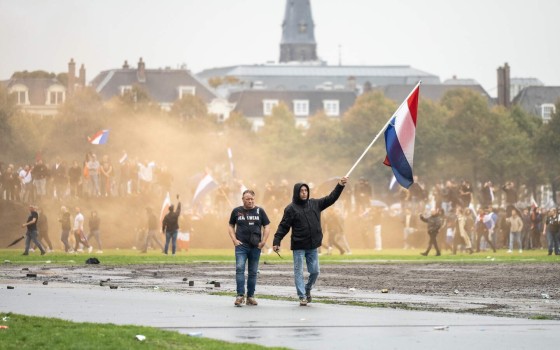
The shocking scenes from the protests that took place in France over the weekend have further fueled the intense European debate over migration. The leaders of Hungary and Poland have argued that this chaos justifies the hardline policies adopted by their respective countries.
Hungarian Prime Minister Péter Magyar wrote on the platform X yesterday that the unrest sweeping through several French cities makes it "clear to everyone why Hungary advocates for the strictest possible approach to migration." Former U.S. President Donald Trump also commented on the events via the platform Truth Social, stating: "Close your borders and take control—before it’s too late!"
Meanwhile, Polish Prime Minister Donald Tusk—without explicitly referencing the situation in France—weighed in on the debate, defending his own hardline stance on migration. He wrote: "Poland will not repeat the mistakes of other European countries, nor will it pay the price for them." According to the Brussels Playbook—the European edition of the American outlet *Politico*—the remarks from these leaders highlight deepening divisions within the European Council, particularly as a critical election year approaches. The statements by Magyar and Tusk follow a discussion on migration that took place during a summit of leaders in Brussels last week—a debate one diplomat described as "horrifying." Two European Union diplomats—who requested anonymity due to the sensitivity of the discussions, which took place behind closed doors—described Friday’s debate on migration as "heated," "ugly," and "extremely blunt"—in a manner "unbefitting of European Council meetings." One of the diplomats suggested that the President of the European Council, António Costa, should have intervened to bring the discussion to an end.
While accounts of exactly what was said vary, the diplomats agreed that Danish Prime Minister Mette Frederiksen and Czech Prime Minister Andrej Babiš used "highly charged language," linking migration policies to the "defense of European civilization." Conversely, a third diplomat characterized the discussions as spirited but remaining within a "political" framework, arguing that they were "necessary to align the debate with the genuine concerns of voters." A Czech spokesperson in Brussels declined to comment on the matter.
Background:
This discussion followed an attempt—led by Denmark, Italy, and Poland—to significantly toughen the language regarding migration in the summit’s concluding statement. According to three diplomats, this initiative was supported by more than a dozen countries, but it ultimately failed after Emmanuel Macron, Luxembourgish Prime Minister Luc Frieden, and Spanish Prime Minister Pedro Sánchez refused to join it. In this context, social media posts shared yesterday by Magyar and Tusk—both of whom have advocated for a tougher approach—have brought these tensions into the open. This comes at a critical time, as EU leaders seek to reach an agreement on the bloc’s long-term budget and funding for Ukraine.
Bottom line:
The issue of migration acts as a "powder keg" for Europe, especially as right-wing and far-right movements—which challenge the leadership in countries like France, Germany, and Spain—become increasingly emboldened. Riots and looting could potentially fuel the rise of these factions to power.
Paris in turmoil:
In an address to the nation last night, Macron called for calm and promised "full transparency" as his government investigates how mass demonstrations—initially sparked by concerns over the cost of living—devolved into arson, looting, and clashes with the police. According to Victor Goury-Laffont, these violent events have ignited a fierce political debate over who is to blame; the far-left has been accused of stoking the unrest, while the Macron administration has faced sharp criticism for losing control of the situation.
For Macron, the repercussions extend beyond France’s borders. Two diplomats told *Playbook* that the weekend’s protests have further weakened the French president’s position at the European Council table. As one of them put it: "It limits his room for maneuver." Major and Urgent Developments
A Storm on the Horizon: Reports by Sebastian Starcevic indicate that Europe is heading toward a political vortex, with elections approaching in Spain, France, and Italy—all against a backdrop of soaring energy prices and a deteriorating economic outlook.



No Comments Found