

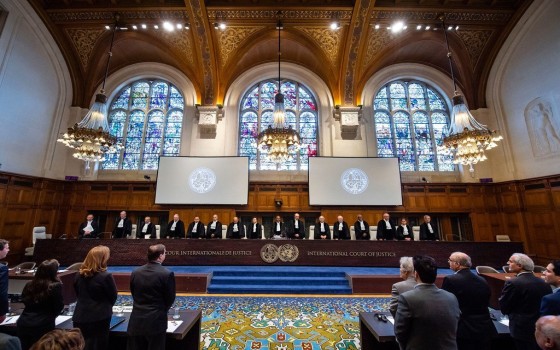
President of the International Court of Justice: A record number of contentious cases are currently before the Court, most notably the case concerning alleged violations of certain international obligations with respect to the Occupied Palestinian Territory.

- Europe and Arabs
- Friday , 30 October 2026 7:59 AM GMT
The Hague – New York: Europe and the Arabs
The President of the International Court of Justice (ICJ) stated that there were 25 cases on the Court’s docket as of August 2025, noting that the caseload has remained at a record high, with 24 contentious cases currently under consideration.
Yuji Iwasawa explained that the disputes between states encompass a wide range of legal issues, including land and maritime boundaries, border demarcation, human rights, economic relations, and immunities, as well as the interpretation and application of treaties covering diverse subjects.
Briefing the United Nations General Assembly on the ICJ’s annual report, Iwasawa noted that since August 1, 2025, "the Court has held hearings in five cases, delivered one judgment on intervention, and issued two advisory opinions," in addition to an order regarding a request for provisional measures and another concerning the admissibility of counter-claims.
He added that the Court is currently examining the merits of two cases, including the consideration of preliminary objections raised in the case concerning alleged violations of certain international obligations in relation to the Occupied Palestinian Territory—specifically, the case of Nicaragua v. Germany.
The President of the Court provided a summary of the judgments and advisory opinions delivered, as well as substantive orders issued during the reporting period. This included an advisory opinion affirming that the right of workers to strike is protected under the Freedom of Association and Protection of the Right to Organise Convention of 1948 (also known as Convention No. 87). He also recalled the summary he presented last year regarding the advisory opinion issued by the Court last October concerning "the obligations of Israel with respect to the presence and activities of the United Nations, other international organizations, and third states in, and in relation to, the Occupied Palestinian Territory."
Iwasawa spoke about the various events held this year to mark the 80th anniversary of the Court’s inaugural session.
He further highlighted the "Judicial Fellowship Programme Alumni Association"—an initiative launched by the Court that offers 15 to 16 talented young law graduates from universities around the world the opportunity to refine their knowledge and skills at the Court’s headquarters.
"This is how justice becomes a living force."
In his address to the assembly, General Assembly President Khalil-ur-Rahman emphasized that, amidst escalating conflicts and eroding trust, "the Court provides a path from confrontation to judicial settlement through independent and impartial proceedings."
He added that the Court "clarifies rights and obligations, enhances legal certainty, and gives practical effect to the principle of the sovereign equality of states before the law—for it is the strength of the argument that must be the primary standard, not the power of the one who makes it."
He noted that the Court’s report underscores both the breadth of its jurisdiction and the trust placed in it, with 88 states having participated—to varying degrees—in contentious or advisory proceedings during the reporting period. Khalil-ur-Rahman cited the theme of the Assembly’s current session—"Restoring Trust and Managing Transition"—emphasizing that "restoring trust requires institutions capable of delivering results, and member states that fulfill their obligations toward international justice." With regard to the Court, this entails three key requirements:
Safeguarding the Court’s independence.
Aligning the Court’s responsibilities with the resources available to it.
Translating legal obligations into action.
In his concluding remarks, the President of the General Assembly stated: "The measure of our commitment lies not in the words of praise we offer here, but in the obligations we fulfill outside this hall. That is how justice becomes a living force."



No Comments Found