

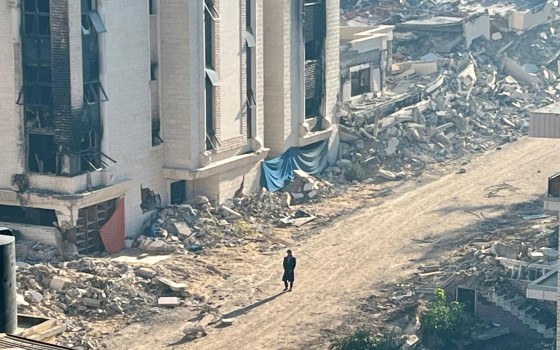
The Arab region's losses from the current war are approaching $200 billion, exceeding its total GDP growth achieved last year.

- Europe and Arabs
- Tuesday , 31 March 2026 8:8 AM GMT
Geneva: Europe and the Arabs
The United Nations Development Programme (UNDP) warned that military escalation in the Middle East could inflict a staggering loss on Arab economies, ranging from $120 billion to $194 billion, exceeding the region's total GDP growth projected for 2025. In a new report published Tuesday, the UNDP explained that this loss would be accompanied by a rise in unemployment rates estimated at approximately 4 percentage points, equivalent to the loss of 3.6 million jobs – a number exceeding the total number of jobs created in the region during 2025. The report also indicated that these economic repercussions would push 4 million people in the region into poverty.
Commenting on the report, Abdullah Al-Dardari, Director of the UNDP Regional Bureau for Arab States, said: "This crisis is a wake-up call for countries in the region to fundamentally reassess their strategic options related to fiscal, economic, and social policies. This crisis represents a significant turning point in the region's development trajectory." The UN official stressed the urgent need to strengthen regional cooperation to diversify economies beyond reliance on hydrocarbon-based growth, expand the productive base, secure trade and logistics systems, and broaden economic partnerships to reduce vulnerability to shocks and conflicts.
Which regions are most affected?
The UNDP estimates that the greatest macroeconomic losses are concentrated in the Gulf Cooperation Council (GCC) and Levant regions, where high exposure to trade disruptions and energy market volatility is leading to significant declines in output, investment, and trade. These regions are projected to lose 5.2–8.5 percent and 5.2–8.7 percent of GDP, respectively.
Increases in poverty rates are concentrated in the Levant and the least developed Arab countries, where underlying fragility is at its highest, and where shocks are more severely impacted on social welfare. In North Africa, the repercussions remain moderate, although still significant in absolute terms. In the Mashreq region, the crisis is expected to increase poverty rates by 5 percent, pushing an additional 2.85 to 3.30 million people into poverty. This represents more than 75 percent of the total increase in poverty across the Arab region as a whole.
Across the region, human development is projected to decline by approximately 0.2 to 0.4 percent, equivalent to a setback of roughly half a year to a full year of progress in human development.
The United Nations Development Programme (UNDP) is the leading UN agency for sustainable development, working to eradicate poverty, promote equality, and protect the environment in more than 170 countries.
Established on November 22, 1965, UNDP serves as the UN's global development network, supporting change and connecting countries with knowledge, experience, and resources to help people build better lives. The program focuses on eradicating poverty, reducing inequality, addressing climate change, and promoting sustainable development through integrated and lasting solutions.
The UNDP office in Geneva serves as an integrated partnership office, operating across programmatic and representational functions. It identifies, builds, and develops UNDP's institutional capacity to foster strategic partnerships across a wide range of partners, particularly with program recipient and donor countries, the UN system, NGOs and civil society organizations, the private sector, intergovernmental organizations, international financial institutions, regional banks, academia, and foundations, as well as partners involved in the UN's decentralized cooperation campaign.






No Comments Found