

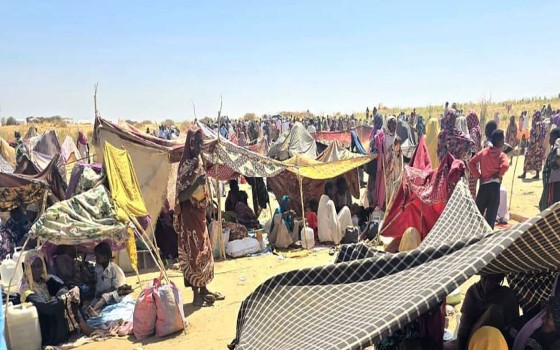
Sudan, three years into the war: The world's largest displacement crisis worsens with no end in sight... It has also been affected by the ongoing turmoil in the Middle East.

- Europe and Arabs
- Saturday , 11 April 2026 5:32 AM GMT
Khartoum – Geneva: Europe and the Arabs
As the crisis in Sudan enters its fourth year, fighting continues to rage across large parts of the country, causing new waves of displacement and prolonging the daily tragedy for millions of people, with no end in sight.
This was confirmed by the UNHCR Representative in Sudan, Marie-Hélène Verney, speaking via video link from Khartoum to journalists in Geneva on Friday.
She noted that Sudan is experiencing the world's largest displacement crisis and one of the worst protection emergencies – amidst a severe global funding crisis.
Among the points she addressed:
Since the outbreak of war in April 2023, some 14 million people have been forced to flee; 9 million remain internally displaced within Sudan, while 4.4 million have crossed borders into neighboring countries. Today, one in four Sudanese is displaced.
Violence continues in large parts of Darfur, the Kordofan region, and Blue Nile State. The recent increase in the use of airstrikes and drones has forced even more people to flee.
Human rights violations continue, including conflict-related sexual violence, forced recruitment, arbitrary arrests, massacres, and many others.
Women and girls continue to face heightened risks of sexual violence, exploitation, and abuse, particularly while moving through unsafe areas.
Survivors of gender-based violence face significant obstacles to reporting incidents and accessing medical, psychosocial, and legal services, which in turn perpetuates the cycle of violence and underreporting.
The collapse of health systems, law enforcement agencies, and justice mechanisms has created a climate of widespread impunity.
Millions of children have now spent three years of their childhood displaced, with far-reaching consequences for their future. Most of these children have had very limited access to education or have been denied it altogether. More than 58,000 children have arrived in neighboring countries unaccompanied by their families, often injured and deeply traumatized.
The neighboring countries hosting the vast majority of Sudanese refugees—particularly Chad, Egypt, and South Sudan—have reached their breaking point. The influx of people from Darfur into Chad continues, while South Sudan struggles to support Sudanese refugees, in addition to the nearly one million South Sudanese who have returned to the country since April 2023, amidst a worsening crisis within South Sudan itself. The UNHCR has warned that dwindling aid and limited opportunities in all host countries are leaving many with impossible choices.
The number of Sudanese undertaking the perilous journey through Libya to Europe is increasing. More than 14,000 Sudanese arrived in Europe between 2024 and 2025, a 232 percent increase since the start of the conflict. The UNHCR emphasized that these movements are not a matter of choice or choice, but rather a reaction to the lack of peace prospects and the failure to meet basic needs both within Sudan and across its borders.
The UN official stressed the urgent need for peace—or at least increased funding for humanitarian and development responses—to enable Sudanese people to live in dignity wherever they may be.
The Impact of the Conflict in the Middle East
At the same press conference, the Food and Agriculture Organization of the United Nations (FAO) Representative in Sudan, Hongjie Yang, expressed grave concern about the impact of the ongoing conflict in the Middle East, which is expected to further reduce food supplies by late 2026, "while the risk of famine remains in some hotspots" in Sudan.
Yang noted that this concern is heightened by the limited access to essential agricultural inputs for the populations most affected by food insecurity and violence in Sudan. He added that the latest crop and food security assessment mission reported a 22% drop in cereal production compared to 2024, a worrying trend given the severe food insecurity.
Yang said that with the main planting season approaching, the FAO urgently called for immediate funding for emergency seed distribution in Sudan, warning that time is running out, as "more than 21 million Sudanese are currently facing severe food insecurity, including 6.3 million in the most dire circumstances."
He added: "This is an emergency and a disaster. The situation remains catastrophic for rural households, particularly in conflict areas such as Darfur and Kordofan."
Destruction of Production and Laboratories
The FAO representative in Sudan noted that Khartoum was the second largest producer of vegetables and fruits, and many fattening farms and slaughterhouses were located there before the war, but these have been destroyed.
He said, "The most devastating destruction is the destruction of the main veterinary laboratory, which means that it is no longer possible to produce livestock vaccines locally." He warned that funding shortfalls threaten to undermine gains made in local food production and deepen the need for costly food aid in the second half of the year.
He added that delays or gaps in seed provision risk pushing millions deeper into the crisis, especially given the soaring costs of agricultural inputs and continued restrictions on market access.
More than 200 attacks on healthcare
The World Health Organization's representative in Sudan, Dr. Shibl Sahbani, stated that the organization has documented more than 200 attacks on healthcare facilities during the three years of conflict in Sudan, resulting in 2,052 deaths.
Speaking via video link from Port Sudan at a press conference in Geneva, he added, "This year alone, specifically during the first quarter, we have recorded and verified 16 attacks targeting healthcare facilities, resulting in nearly 200 deaths and more than 300 injuries."
The UN official also addressed the impact of the escalation in the Middle East on the humanitarian response in Sudan.
He said, "The main logistical hub for most agencies, including the WHO, is located in the United Arab Emirates. Given the current events, this situation is significantly impacting our ability to respond, both in terms of time and cost." He explained that the organization had some supplies stored within Sudan, which enabled them to respond immediately, but warned that "the problem is that we are now using up our current stock, and we urgently need additional supplies."
Hope and Collapsed Services
Dr. Sahbani spoke about the situation in Khartoum, which he visited a few days prior, where he personally witnessed "the shortcomings in basic services," which were unable to meet the needs of the population who remained in the city or those returning to their homes.
He said that although the people he spoke with were hopeful of rebuilding their lives, they faced collapsed infrastructure, including health services. Hospitals were overcrowded with patients yet operating below capacity, while medical warehouses had been destroyed.
He also noted that the number of health personnel was insufficient to meet the burden of the number of patients, "and the needs remain enormous."
He said that despite the efforts of the World Health Organization and its partners, they could not respond to all of these needs.






No Comments Found