

An international conference chaired by the European Union is being held today in Berlin on the situation in Sudan, the world's largest humanitarian crisis: another year of failing to pass the test.

- Europe and Arabs
- Wednesday , 15 April 2026 6:56 AM GMT
Berlin-Geneva: Europe and the Arabs
The Sudan Conference opens today in Berlin. According to the "Playbook" newsletter, the annual Sudan Conference, focusing on the country's political future after three years of civil war, begins today in Berlin. Kaja Kallas, the EU's top diplomat, will co-chair the conference, along with the Commissioner for Crisis Management, Hadja Habib, who will chair the humanitarian committee. Playbook, the European edition of Politico, reported, "This is the third conference the EU has co-hosted since the start of the conflict, and another attempt to shape the response to what two European officials have described as a man-made humanitarian catastrophe. The structure is familiar: pushing for a ceasefire, mobilizing new aid (with new pledges expected), and preserving the possibility of a civilian transition after the war. 'We support efforts to protect civilians and seek accountability,' one official said." Keeping the spotlight: A key objective is to refocus international attention as the conflict enters its fourth year. 'With the world's focus on the Strait of Hormuz, we cannot ignore what is arguably the world's worst humanitarian crisis,' an EU official told Playbook. What to watch: Sudan is expected to be on the agenda of the Foreign Affairs Council next week, giving Callas further cause for concern. Lahbib is expected to announce a new pledge from 'Team Europe.' More broadly, the conference is supposed to produce a final document, the 'Berlin Principles for Sudan,' outlining a framework supported by... The European Union calls for a peaceful solution.
The world's largest humanitarian crisis: Another year of failing the Sudan test.
The UN Emergency Relief Coordinator, Tom Fletcher, said Wednesday marked a "grim anniversary, with painful lessons," as another year passed in which "the world failed the Sudan test."
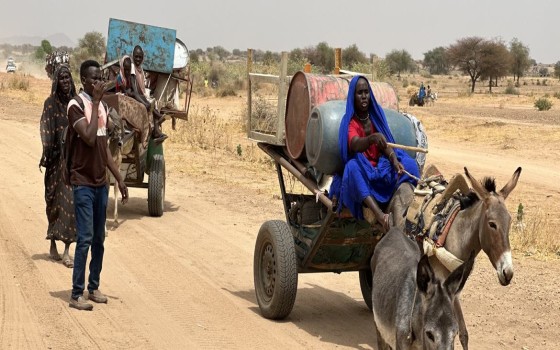
Three years into the war, nearly 34 million people – almost two out of every three people in Sudan – are in need of humanitarian assistance, making it the world's largest humanitarian crisis.
Mr. Fletcher explained that hunger is intensifying as the lean season approaches, children are suffering from acute malnutrition and are being denied education, while women and girls face systematic and brutal sexual violence, and millions have been displaced from their homes.
"We need immediate action now," Tom Fletcher said in a press statement. To stop the violence, protect civilians, ensure access to the most vulnerable communities, and fund response efforts.” “Don’t let it be a forgotten crisis.” Fletcher’s statement came on the eve of an international conference in Berlin—hosted by Germany, the African Union, the European Union, France, the United Kingdom, and the United States—which is expected to draw a large international and UN delegation.
For his part, Ross Smith, director of the World Food Programme’s Emergency Preparedness and Response Division, said the crisis in Sudan is worsening “with no end in sight,” noting that parts of the country have experienced two years of famine, which is “absolutely unacceptable in this day and age.” Speaking to reporters in Geneva via video link from Rome, Smith said: “Millions of Sudanese are trapped in a bitter daily struggle for food, safety, and a modicum of human dignity. Families have exhausted all their coping mechanisms and resilience.” Parents are depriving themselves of meals so their children can eat, while the children go to bed hungry. He added that humanitarian workers are being targeted by parties to the conflict, yet they continue their work. This year, the program has reached 3.5 million people monthly with food and nutrition assistance – two-thirds of the beneficiaries being in Darfur and Kordofan, where famine has been confirmed and the fiercest fighting is taking place. Ross noted that the crisis in Sudan is not occurring in isolation from its regional and international context, but is “dangerously exacerbated by broader global instability and the recent escalation of conflict in the Middle East.” He said: “It is clear that political will and funding have not kept pace with the realities on the ground in Sudan. Our message is simple and urgent: Do not let Sudan become a forgotten emergency.” Do not allow global crises elsewhere to overshadow the suffering of millions of Sudanese families.” Women’s Courage and Leadership
Speaking from Berlin, Anna Motavati, UN Women Regional Director for Eastern and Southern Africa, said the conflict in Sudan is “at its core a war on women and girls,” who are facing “widespread killings, mass displacement, and, most specifically and dangerously, the use of sexual violence has become an integral part of the basic blueprint of this war.” She emphasized that there is no safety under conditions of displacement, which has made women and girls even more vulnerable to violence, including rape, abduction, and murder. She warned that the rate of sexual violence continues to rise within the country.
“Sexual violence is being used as a tactic of war to terrorize, humiliate, and inflict pain on women and girls, to control them, and to target and oppress entire communities,” she said. There are documented cases of rape committed in front of family members, often accompanied by other forms of severe physical abuse, as well as violence against those who tried to intervene. Mutafati noted that many women and girls live in conditions that are "increasingly unfit for survival," lacking access to food, shelter, and medical care.
A humanitarian worker in West Kordofan was quoted as saying, “In the Babanusa area, we have a medical center consisting of only two rooms; one for childbirth and the other for medical consultations. However, most women arrive at the center already dead due to the distance and difficulty of access.”
Despite this dire situation, she emphasized that Sudanese women are on the front lines providing life-saving support to other women in their communities. She said that women-led organizations run community kitchens, provide support to survivors, and help displaced families find shelter, while simultaneously spearheading local peace efforts and countering hate speech. However, she noted that these efforts are under severe strain due to a critical lack of funding. Mutafati concluded by saying that it must be clear to everyone that no recovery is possible as long as “women remain forgotten and excluded, and suffer from a lack of funding to support them. Therefore, the international community must act now to raise its response to match the courage and leadership shown by women in Sudan.”
Amount equivalent to a child’s life
For her part, Eva Hinds, UNICEF’s Chief of Communications in Sudan, said that as the war enters its fourth year, the reality for children “is getting darker by the hour.” Speaking from Port Sudan, she stated that 245 children had been killed in the first three months of this year – most of them in Darfur and Kordofan – a sharp increase compared to the same period last year.
Hinds noted that hunger and disease are worsening and spreading among children, with 4.2 million children across Sudan expected to face acute malnutrition, including 825,000 who will suffer from severe acute malnutrition, a condition that can be fatal without urgent treatment.
Furthermore, half of all school buildings are out of service—many having been converted into shelters for displaced families or occupied by armed groups—leaving 8 million children without access to education.
Hinds said UNICEF needs $962.9 million this year to reach 7.9 million children across Sudan with life-saving assistance, but the organization has received only 16 percent of that amount so far.
"If that number seems large, consider this: it's about $120 per child," she added. "In the current climate, it might be helpful to compare that to the cost of filling a car's fuel tank just once; in Sudan, that's a child's life." The UNICEF official stressed that protecting children in Sudan is not an option and requires respect for international humanitarian law, ensuring safe and sustained humanitarian access, and providing the necessary funding. She said, "The cost of failure is already bitterly clear, and it is the children who are paying the price."






No Comments Found