

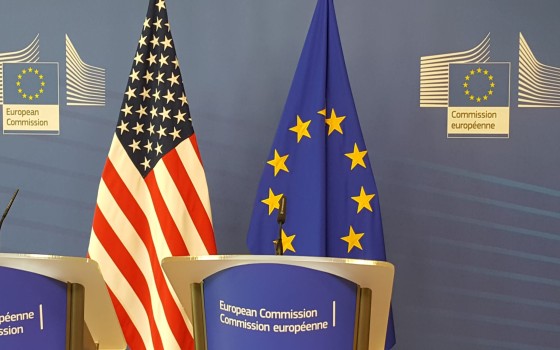
To avert Trump's threats, Brussels agrees to a deal to eliminate tariffs on US industrial and some agricultural products in exchange for a 15% tariff cap on most European exports.

- Europe and Arabs
- Wednesday , 20 May 2026 5:42 AM GMT
Brussels: Europe and the Arabs
The European Union reached a compromise overnight to activate the trade agreement that European Commission President Ursula von der Leyen concluded with US President Donald Trump in Turnpi last summer, thus averting Trump's threat to impose hefty tariffs to punish any further delays.
After negotiations lasting more than five hours, negotiators from the European Parliament, the Council of the European Union, and the European Commission agreed on the key terms of the agreement, under which the EU will eliminate tariffs on US industrial products and some agricultural products, while Washington will cap tariffs on most European exports at 15%. A European statement released early Wednesday in Brussels, titled "EU-US Trade: Council and Parliament Reach Agreement on Tariff Provisions of Joint Statement," announced that the Presidency of the Council and the European Parliament had reached an agreement in principle on two regulations aimed at implementing the tariff-related aspects of the EU-US Joint Statement of August 21, 2025.
This agreement represents a significant step towards fulfilling the commitments outlined in the EU-US Joint Statement. It aims to foster a stable and predictable transatlantic trade relationship, while ensuring strong safeguards and maintaining the necessary flexibility to protect the EU's economic interests when needed.
The Joint Statement is expected to serve as a platform for continued dialogue with the US on tariff reductions and close cooperation in addressing shared challenges. "The European Union and the United States enjoy the largest and most integrated economic relationship in the world. Maintaining a stable, balanced, and predictable transatlantic partnership is in the interest of both parties. Today, the EU is fulfilling its commitments. We are, and will remain, a reliable partner in global trade. Our agreement includes strong safeguards to protect European interests, businesses, and workers," the statement quoted from the current EU Presidency, held by Cyprus, represented by Michael Damianou, Minister of Energy, Commerce, and Industry of the Republic of Cyprus.
The statement added: "The first (main) regime eliminates remaining tariffs on US industrial goods and grants them preferential market access, including through tariff quotas (TRQs) and tariff reductions on certain US seafood and non-sensitive agricultural products. The second regime focuses on extending the suspension of tariffs on lobster imports, including processed lobster." Key elements of the agreement
To ensure the effective implementation of the Joint Declaration and to protect the interests of the European Union, legislators agreed to strengthen the main regulation by establishing a robust safeguards mechanism, reinforcing the provisions of the suspension clause, and introducing an expiration clause, among other things. Some of these elements are reflected in Regulation 2 on lobster imports.
Strong safeguards mechanism
The agreement includes a dedicated safeguards mechanism that enables the EU to address any potential significant increases in imports from the USA that could cause or threaten to cause serious harm to domestic producers.
In particular, at the request of, or on the initiative of, three or more Member States, or the EU industry or trade unions, the Commission will conduct an investigation to assess whether the increase in imports has caused or threatens to cause serious harm to EU producers. If sufficient evidence exists, the Commission may suspend the application of the regulation in whole or in part.
Strengthening Suspension Provisions
Furthermore, the agreement strengthens the conditions under which the Commission can suspend the application of the regulation, in whole or in part, through implementing legislation. This may be done if the United States fails to comply with its commitments under the Joint Declaration, undermines the objectives of the Joint Declaration, or obstructs trade and investment relations with the European Union, including by discriminating against or targeting EU economic entities. The suspension mechanism may also be activated if there are sufficient indications that such actions are likely to occur in the future.
In addition, the Commission is authorized to suspend the preferential treatment granted to the United States regarding steel and aluminum products if, until December 31, 2026, the United States continues to apply tariffs exceeding 15% on steel and aluminum derivatives imported from the European Union.
Term Application
The legislators agreed to include an expiration clause, under which the regulation will cease to apply at the end of 2029 unless further action is taken. Monitoring the Impact of Measures
The agreement provides for regular monitoring of the economic effects of the trade liberalization measures on the EU economy. Six months after the regulation enters into force, and every three months thereafter, the Commission must inform the participating legislators of changes in the volumes and values of US exports to the EU of goods covered by the regulation (the Regulation).
Six months before the expiry date of the Regulation, the Commission will submit a comprehensive assessment addressing, among other things, the impact of the Regulation on EU-US trade flows, trade patterns, and tariff revenues, and more specifically, its impact on small and medium-sized enterprises (SMEs). Where appropriate, this assessment will be accompanied by a legislative proposal to extend the application of the Regulation.
After the technical drafting of the texts is completed, the two institutions must formally approve and adopt the provisional agreement on both regimes before its publication in the Official Journal. The regimes will enter into force the day after their publication. The second regime, concerning lobster imports, will apply retroactively from August 1, 2025. The European Union and the United States enjoy the largest bilateral trade and investment relationship and the most integrated economic relationship in the world, together representing nearly 30% of global trade in goods and services and 43% of global GDP. Trade between the EU and the US in goods and services has more than doubled over the past decade, reaching approximately €1.7 trillion in 2024. This deep and comprehensive partnership is based on mutual investment: in 2023, European and American companies invested more than €4.7 trillion in each other's markets.
The two regulations proposed by the European Commission on 28 August 2025 will implement the EU tariff reductions set out in paragraph 1 of the joint EU-US statement of 21 August 2025.


No Comments Found