

European Parliament: Member states urged to increase contributions to Operation ASPIDES in the Red Sea and the Strait of Hormuz; the two-state solution is becoming impossible to implement given the situation in the West Bank and the issue of settlements.

- Europe and Arabs
- Wednesday , 16 September 2026 5:51 AM GMT
Brussels: Europe and the Arabs
Addressing Members of the European Parliament during a session held on Tuesday in Strasbourg, Kaja Kallas, the EU’s foreign and security policy chief, spoke about the current escalation in the Middle East: "Yes, this characterization describes recent trends to some extent. For instance, the Houthis have now expanded their control along the vital Yemeni coast, potentially strangling another strategic strait—the Bab al-Mandab—with dire consequences for the global economy.
This is why—at least in part—today’s discussion is both important and necessary.
However, the title of the discussion is also misleading; what we are witnessing now—whether in Yemen or elsewhere, such as Iran and the West Bank—is part of the same instability that has plagued the region for far too long.
The Houthi attacks in the Red Sea and their threats to freedom of navigation—while unlawful—were a predictable development.
For this reason, the European Union has maintained a consistent stance in its messaging to the parties to the conflict, calling for:
de-escalation;
restraint;
the protection of civilians and civilian infrastructure;
an end to Iran’s indiscriminate attacks;
full support for regional states affected by these attacks;
and respect for international law, including freedom of navigation in the Straits of Hormuz and Bab al-Mandab.
The EU is also working with international partners to mitigate these repercussions:
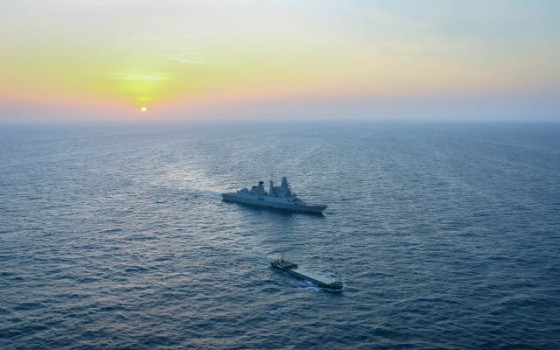
our naval operation 'ASPIDES' continues to escort vessels in the Red Sea;
and we will strengthen our coordination with the multinational maritime coalition recently launched by Saudi Arabia.
But we need to do more..." ...efforts, particularly to support the Yemeni government and combat smuggling.
Honorable Members,
Regarding Iran, repression is widespread, and the number of executions of young Iranians is rising at an alarming rate.
For this reason, we have imposed new sanctions and sent clear messages to the Iranian authorities that such behavior will have consequences. We will continue to respond using all tools at our disposal, including increased support for Iranian civil society.
At the same time, the Iranian nuclear issue remains an ongoing challenge, and the European Union’s position has not changed: Iran must never possess a nuclear weapon, and it must comply with its binding legal obligations regarding nuclear safeguards under the Non-Proliferation Treaty. Honorable Members of Parliament,
The West Bank is witnessing an increase in the expansion of settlements and outposts, accompanied by further forced displacements and record levels of settler violence. In addition to the three sanctions packages imposed on extremist settlers, discussions are currently underway within the Council regarding the possibility of further sanctions; accountability is a prerequisite for curbing violent settlers.
Meanwhile, it is crucial that the European Union maintains a consistent and coherent position, collectively calling for respect for international law. This means reiterating our calls—together with our international partners, including the United Kingdom—to halt settlement expansion, including the "E1" project, which gravely threatens the viability of the two-state solution.
As for Gaza, the already dire humanitarian situation is deteriorating further. With winter approaching, sites housing displaced persons are facing... ...overcrowded areas, facing risks of flooding and disease outbreaks. Furthermore, the ceasefire remains nothing more than words on paper, as people continue to be killed and injured.
The conditions required to implement the peace plan for Gaza remain unchanged. To achieve any progress, the international community must continue to demand:
the permanent disarmament of Hamas and all other non-state armed groups;
and the withdrawal of Israeli forces from the Gaza Strip.
The European Union continues to play its part in implementing UN Security Council Resolution 2803, utilizing all tools at its disposal:
enhancing security through Common Security and Defence Policy (CSDP) missions, the EU Border Assistance Mission in Rafah (EUBAM Rafah), and the EU Police Mission for the Palestinian Territories (EUPOL COPPS);
supporting the Palestinian Authority and strengthening its governance and reform efforts;
and assisting with early recovery and reconstruction efforts.
The donor group for Palestine—convened by the European Commission last July—launched the "Team Gaza" initiative in cooperation with 15 international partners, initially raising €900 million to fund early recovery.
The Israeli elections next month and the Palestinian legislative elections scheduled for November could mark significant turning points. We stand ready to provide assistance through all available means, particularly regarding the Palestinian elections.
Honourable Members of Parliament,
In a region where war and conflict dominate every aspect of life—whether in Yemen, Iran, or the West Bank—our only chance to break the cycle of violence lies in intensifying our support for the rule of law and continuing to seize every opportunity... Accessible diplomacy and support for democracy.
Distinguished members,
I thank you for this discussion; the matter is truly critical, especially given the renewed escalation of the situation. Our position is grounded in international law, human rights, and the urgent need for peace.
First, regarding the situation in the Red Sea and the Strait of Hormuz: we have Operation Aspides in place. I also call upon Member States to provide more naval vessels—as we currently see the Bab al-Mandab Strait effectively closed. Operation Aspides—which I visited personally—escorts ships through that area, but we need more vessels to act as a credible force; a point that some of you have also raised here. We are working to strengthen our relations with Gulf states, and an upcoming Gulf Cooperation Council (GCC) summit is on the horizon. However, if we wish to be an effective and credible actor in ensuring regional security, we urgently need to reinforce the two operations currently underway: Operation Aspides and Operation Atalanta, the latter of which combats piracy in the region.
Regarding Israel and Palestine, we remain fully committed to achieving a comprehensive, just, and lasting peace based on the two-state solution. Nevertheless, I share the view that—given the situation in the West Bank and the issue of settlements—implementing the two-state solution is becoming increasingly difficult, as parts of the territory are being gradually carved away. For this reason, we have been discussing various options; unfortunately, however, there is no consensus among all member states to move forward and send a clear message that we do not accept this situation.



No Comments Found