

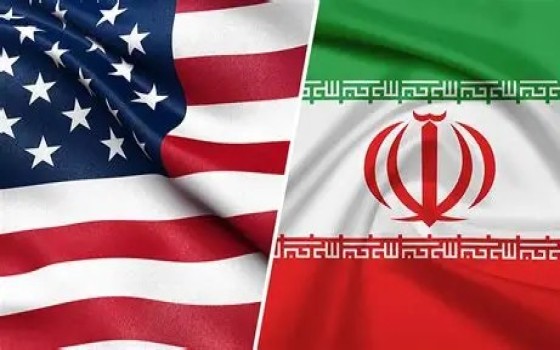
Iran stands firm on conditions for opening the Strait of Hormuz despite Trump rejecting its proposals; the UN expands its blacklist of companies linked to Israeli settlements; Hamas rejects linking the fate of Palestinians to elections in Tel Aviv.

- Europe and Arabs
- Sunday , 27 September 2026 5:5 AM GMT
Washington – Tehran – Gaza: Europe and the Arabs
Developments continue across the Middle East, concerning both the crisis in the Strait of Hormuz and the situation in the occupied Palestinian territories. Regarding the former, Iran insists on maintaining its conditions for reopening the Strait of Hormuz, despite US President Donald Trump’s rejection of an Iranian proposal. Iranian Foreign Minister Abbas Araghchi stated on state television on Sunday: "Our conditions are clear, and we will not back down from them," according to European media reports from Brussels.
Iran had proposed on Friday to reopen the Strait within seven days of the proposal's acceptance. However, Trump rejected the proposal on Saturday, stating that Iran is "suffering massive losses"—following his earlier posting of a map labeling the waterway the "Trump Strait." Nevertheless, the door remains partially open; Araghchi noted that Iran is awaiting the final US position via intermediaries, after which a decision will be made.
The Strait of Hormuz lies at the heart of the conflict ignited by the United States and Israel in late February through their attacks on Iran. According to *The Wall Street Journal*, Trump is considering bombing Iran again following the midterm elections on November 3.
Iran Awaits Official Response via Intermediaries Following Trump’s Initial Reaction to the Proposal
Iranian Foreign Minister Abbas Araghchi stated on Sunday that Tehran has already noted US President Donald Trump’s initial reaction to its proposal but has not yet received an official response through intermediaries. According to Araghchi, Iran is awaiting the delivery of the final US position by mediators, after which the country will make a decision based on that information.
This comes as the repercussions of restrictions imposed on Iranian flights in the region continue; Tehran maintains that it is pursuing efforts to have these restrictions lifted through negotiation while simultaneously considering non-military countermeasures should the need arise.
In this context, the General Secretariat of Iran’s Supreme National Security Council issued a statement denying reports suggesting that Iran might resort to a military response regarding the recent airspace restrictions.
It explained that inaccurate interpretations and misquotations of the Council Secretary’s remarks concerning air travel had raised questions about Iran’s stance. It emphasized that negotiations with the relevant countries to lift what it described as illegal airspace restrictions are ongoing and being pursued seriously.
The statement noted the existence of several non-military options for reciprocal action that could be taken against specific airports if necessary, while expressing hope that matters would not reach that stage. It did not specify the nature of the potential measures or the airports that might be affected.
**UN Expands Blacklist of Companies Linked to Israeli Settlements to Include 214 Firms**
The UN Office of the High Commissioner for Human Rights has added 61 companies to its blacklist of firms with business ties to Israeli settlements in the occupied West Bank, bringing the total number of listed companies to 214. Most of these companies are Israeli, and five firms that had been included last year were removed from the list. The list dates back to 2020 and is the result of a vote by the UN Human Rights Council; while the Council lacks the authority to compel companies to take action, it aims to confront them through public shaming.
UN High Commissioner for Human Rights Volker Türk stated that the report reminds companies of their responsibility to exercise due diligence. Israel "categorically" rejects the publication of the list, describing it as a "despicable attempt" to tarnish the reputations of Israeli companies that have committed no wrongdoing. The UN office maintains that it notified the companies in advance and granted them the right to respond. This publication comes as Britain, France, and Canada have recently announced trade restrictions regarding the settlements.
UN High Commissioner for Human Rights Volker Türk stated that the report reminds companies of their responsibility to exercise due diligence.
Hamas: "Regardless of the election outcome in Israel, the fate of the Palestinians will remain unchanged."
The leader of the Palestinian movement Hamas expects nothing from Israel's upcoming parliamentary elections, stating that the Palestinian people have suffered under every party that has held power in Israel.
"Whether this person or that comes to power—from this party or another—our people have suffered under all Israeli parties," Khalil al-Hayya said on Saturday in an interview with the Qatari channel Al-Araby. He added emphatically that he refuses to allow Palestinian blood, suffering, and cause to be exploited as fuel for these elections. These elections mark the first time Israelis head to the polls since Hamas’s unprecedented October 7, 2023 attack, which claimed the lives of 1,221 people. The war Israel launched in response has claimed the lives of over 73,000 Palestinians, according to the Gaza Health Ministry—which operates under Hamas authority and whose figures are considered reliable by the United Nations. The October 27 elections are expected to be a tight contest for Prime Minister Benjamin Netanyahu, who has vowed not to withdraw Israeli forces from Gaza and rejected a US-proposed peace deal—which Hamas had accepted—due to doubts regarding the Islamist movement's seriousness about disarming.
Al-Hayya also commented on the parliamentary elections the Palestinian Authority plans to hold on November 28. If they do take place, they will be the first in twenty years. The last elections were held in 2006, when Hamas defeated the Fatah movement led by Mahmoud Abbas, which had dominated Palestinian political life until then. Abbas, now 90 years old, has ruled the Palestinian Authority by decree ever since; the parliament has not convened since 2007, when Hamas took control of Gaza.


No Comments Found