


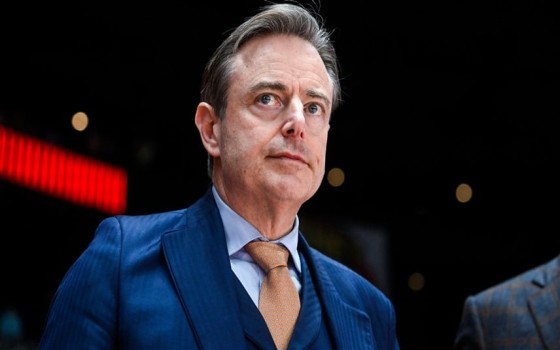
Belgium faces the risk of a prolonged period of political instability due to disputes within the governing coalition regarding the new budget—specifically concerning the need to raise ten billion euros—as well as issues surrounding Value Added Tax (VAT) and the admission of Palestinian students.

- Europe and Arabs
- Sunday , 11 October 2026 6:49 AM GMT
Brussels – Europe and the Arabs
Belgian Prime Minister-designate Bart De Wever faced a volatile situation; what exactly transpired within the government yesterday? When Prime Minister De Wever (of the New Flemish Alliance—N-VA) presented the new budget proposal yesterday, he met with a flat rejection from Deputy Prime Minister David Clarinval (of the Reformist Movement—MR). What exactly happened during this turbulent meeting?
In a report published on Sunday, the Belgian daily *Het Nieuwsblad* asked: "Are we looking to the future? Rolling up our sleeves? Working to build a better future? Saying yes to the new budget?"
"The biggest problem in this country is not VAT, nor income tax. It is perhaps monetary policy," *Het Nieuwsblad* quoted Georges-Louis Bouchez—leader of the Walloon liberal Reformist Movement (MR)—as saying.
Deputy Prime Minister Maxime Prévot (of Les Engagés) was already outlining the direction of the debate before the cameras. Inside, Prime Minister-designate Bart De Wever (N-VA) was supposed to discuss the revised budget plan. However, the invited Deputy Prime Ministers already knew which way the wind was blowing. In his quest to raise €10 billion, De Wever views a VAT hike as an easy way to generate substantial revenue. Yet, Bouchez adamantly opposes this, having clearly stated his position in Parliament on Thursday: "I support 'added value,' not the VAT tax itself."
Nevertheless, De Wever put the VAT issue back on the agenda. It comprises several items, including healthcare cost savings and interventions concerning patients with chronic conditions—and, consequently, a specific provision regarding consumption. During the meeting, De Wever asked, "Can we at least reach an agreement on these points, without setting specific figures?" He then gauged the views of the deputy prime ministers. Maxime Prévot (Les Engagés), Jan Jambon (N-VA), and Vincent Van Peteghem (CD&V) all agreed, albeit with some reservations. De Wever then turned to Deputy Prime Minister Clarinval (MR), who replied: "No—no to the VAT." A Scapegoat.
The mood among the Democrats soured. One attendee remarked, "De Wever was extremely volatile. We, too, face difficulties regarding certain savings or structural measures, but we don't rule out discussing a specific topic. Clarinval, however, simply declares the VAT non-negotiable. They refuse to accept a single euro of new revenue from VAT." This stance is causing frustration, even among the other parties. Before the meeting, Prévot had told the press that they did not want to start the match trailing 0–2 simply because a sensitive issue for the MR party was off the table. Within the N-VA, the behavior is being openly described as "irresponsible." "Everyone knows we have to do something about VAT, especially if we want to ease the burden on workers. The counter-proposals from the Reformist Movement (MR) are simply not serious."
This illustrates the atmosphere: Clarinval also addressed the cameras afterward. He spoke candidly about the €4 billion in new taxes reportedly on the government's negotiating table. He stated: "The coalition agreement stipulates that part of the budget might come from new revenue. This memo includes contributions from the broadest possible base and a VAT hike. That is out of the question." Elsewhere within the MR, there is talk of a "tax memo," with claims that the upcoming year's budget centers largely on taxation. "De Wever is trying to pin the blame on us this way. No problem; we would be happy to go to Flanders and explain our opposition to tax hikes directly to De Wever's own voters"—a somewhat provocative tone.
Meanwhile, tensions between the New Flemish Alliance (N-VA) and the MR have completely subsided, replaced by an atmosphere of mutual, open derision. This may mask the fact that Vooruit was not on board with the submitted memo either. After all, Deputy Prime Minister Frank Vandenbroucke had to appear after Clarinval. He handled the situation shrewdly; he did not reject the proposal or its core elements, but rather accepted it as a starting point—albeit with numerous caveats. "You can sense that the Socialists don't agree either, but it suits them well to let the MR shoulder the brunt of the backlash." After about three hours of meetings, the core group parted ways without reaching an agreement to use the proposed framework as a basis. "We are effectively back to square one," one attendee remarked.
13 Students from Gaza
Another issue clearly demonstrated that the parties were no longer willing to make concessions to one another: the case of the thirteen students from Gaza permitted to come and study at Belgian universities for a year. This matter was discussed for half an hour yesterday at the start of the core cabinet meeting, which began at 3:00 PM. Foreign Minister Reynders was pleased to present an agreement he had reached the previous day with Migration Minister Annelies Verlinden (of the N-VA party). The thirteen students would be brought to Belgium on the condition that they did not apply for asylum and would actually return to Palestine upon completion of their studies. In exchange, Reynders agreed to the formation of a task force to work on...
This move would have paved the way for a stricter return policy. The Prime Minister was aware of the compromise. However, regarding the fundamental issue, Clarinval flatly refused. "We used to have 'Ms. No' (Joëlle Milquet), and now we have 'Mr. No'," one negotiator observed. In the wake of this, the "Les Engagés" party issued a strongly worded press release. Prévot was quoted as saying: "This impasse is a humanitarian scandal and politically regrettable." When Clarinval linked additional immigration measures to the file, Prévot exploded in anger: "I refuse to use people's fates as leverage to force through other decisions." With the academic year already three weeks underway, he abandoned the file; the students would not be coming to Belgium. A party source stated: "If the Reformist Movement (MR) cannot even make the effort to approve a file involving thirteen people from Gaza, we will show no goodwill toward their files either." Consequently, the relationship between the MR and Les Engagés is more deeply damaged than that between the New Flemish Alliance (N-VA) and the MR. This did not soften Prévot’s stance on the budget item, even though the discussions were separate. The resistance from Bouchez and Clarinval poses a major problem, particularly for De Wever. "It has turned into a war of attrition," one source remarked. The MR and the Deputy Prime Minister have backed themselves into a corner; they cannot make any concessions regarding the VAT. "For us, it is almost impossible to walk away without VAT reform," said one Deputy Prime Minister. "Otherwise, we would be caving in to Bouchez's blackmail." The idea of summoning party leaders for immediate negotiations is being floated here and there. As one source puts it: "But this would also amount to capitulating to what Boucher actually wants." So, De Wever finds himself in a bind as well.
It is hardly surprising that he is resorting to bilateral meetings with the deputy prime ministers; they are arriving one by one today. Afterward, De Wever will decide whether to meet again or if the effort is no longer worthwhile. "The situation is completely paralyzed right now," they say, "and it is a very dangerous state of affairs." In any case, no one currently believes an agreement will be reached before Tuesday. We may, therefore, be facing a prolonged period of political instability.




No Comments Found