


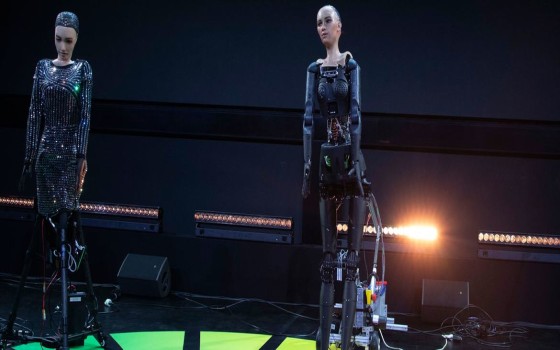
Artificial intelligence is changing the way we think. The current situation represents a shift from a "fear of missing out" on AI to something akin to a "hangover" from overusing it.

- Europe and Arabs
- Saturday , 31 October 2026 8:8 AM GMT
New York: Europe and the Arabs
Artificial intelligence promises to make our lives easier; with the press of a button, it can draft emails, summarize reports, generate ideas, and answer complex questions in a matter of seconds. For many, this represents a technological leap as significant as the advent of the internet itself.
However, according to neuroscientist David Rock, the most critical question is not what artificial intelligence can do for us, but rather what it might do to us—a point highlighted in a recent edition of the United Nations’ daily news bulletin.
In an interview with UN News, Rock noted: "In some respects, technology does not change us at all." Human brains continue to make decisions, solve problems, and respond to challenges in the same way they have for thousands of years. Yet, history teaches us that major events and long-term pressures can leave lasting imprints on the brain, shaping behavior for years or even generations.
The Great Paradox of Artificial Intelligence
The technological revolution we are witnessing today may well be one of those defining, transformative moments.
Rock points out that the key difference lies in the fact that technology increasingly provides us with a sense of control over almost everything. If you need transportation, you simply press a button; if you want to order dinner, another button press brings the meal to your door; and if you seek information, it is made available to you instantly. This growing sense of autonomy can be liberating, yet it simultaneously sets a hidden trap—especially given the ability of artificial intelligence systems to perform tasks that once demanded significant mental effort.
"Keep your mind active."
The real problem lies not in the increasing power of AI, but in the growing human willingness to abandon the very process of thinking.
Rock describes the current situation as a shift from "AI FOMO" (the fear of missing out on AI) to something akin to an "AI hangover." Organizations rushed to adopt generative AI tools—often before fully grasping their long-term implications—and now, the consequences are becoming increasingly apparent.
What Rock sees concerns him.
Only a small fraction of individuals—perhaps 5% to 10%—use AI as it should be used: to delegate routine tasks and free up mental capacity for more demanding work. The vast majority, however, do the exact opposite.
"The brain is naturally inclined to conserve energy," Rock explains. "It is, therefore, highly tempting to spare your mind the effort of thinking altogether."
He warns that the result is a gradual erosion of one’s capacity for judgment. When individuals delegate not only routine tasks but also analysis, evaluation, and decision-making to AI, they risk losing their ability to distinguish between good ideas and bad ones. Artificial intelligence may provide answers quickly, but speed is not the same as wisdom. On this point, it is noted: "Keep your mind present and engaged; when your mind ceases to participate actively, those skills will be lost very quickly."
The Attention Crisis
The rise of artificial intelligence comes at a time when many already struggle to focus.
Rock argues that the greatest challenge facing individuals today is not a lack of information, but rather an overwhelming abundance that exceeds our capacity to absorb it.
He likens the current situation to the advent of email, which brought a massive increase in the volume of information individuals had to process. Today, the scale is far greater; people are confronted with a deluge of messages, updates, notifications, and AI-generated summaries—quantities that often surpass what the human mind can realistically handle.
"Our minds have real limits," he emphasizes. Computers can process thousands of decisions in an instant, a capability humans do not possess. Yet, many organizations continue to operate as if humans have an infinite capacity for attention and decision-making.
Rock believes that society is still in an "adjustment phase" regarding artificial intelligence—much like the early days of the automobile, before the establishment of traffic laws and speed limits. This technology has arrived at a pace that has outstripped the development of the social norms and safeguards necessary for its responsible use. Technology That Seeks to Be Your Friend
Unlike previous technological leaps, artificial intelligence may be altering something far more fundamental than just the nature of work. "It tinkers with the very mechanisms of human connection," says Rock.
While television, books, and smartphones once vied for our attention, artificial intelligence now competes for our personal relationships. Increasingly, people are turning to "chatbots"—not merely to obtain information, but in search of conversation, companionship, and advice.
This trend is a cause for concern.
Research suggests that individuals who spend significant time interacting with AI "companions" may end up feeling lonelier, rather than finding relief from loneliness. Other studies point to a link between heavy reliance on chatbots and an increasing withdrawal from real-world social interactions.
The human mind evolved to be centered on relationships with other human beings. Replacing a substantial portion of such interaction with machines may carry a psychological cost—one whose full dimensions society is only just beginning to grasp.
As artificial intelligence continues to evolve—converging with robotics, ultra-fast computing, and future generations of the internet—these questions are likely to become increasingly urgent.
Why might human connection become even more valuable?
Ironically, as the capabilities of machines increase, the value of human relationships grows as well.
Rock believes that the future will place paramount importance on trust and genuine human connection. In a world where machines can generate content, analyze data, and simulate conversations, those qualities unique to humans may become even more valuable.
"The human experience," he adds, "will take on far greater value." Rather than replacing humans, artificial intelligence may ultimately serve to enhance the significance of human networks, deep relationships, and meaningful collaboration.
This future is not guaranteed, but it represents a potential response to a world experiencing an acceleration in technological change—an acceleration that Rock anticipates, noting: "The world has never seen such a pace of change, and change will never be this slow again."
The Most Crucial Skill
So, how can humans adapt? Rock’s answer boils down to a single concept: "metacognition"—or thinking about one's own thinking.
He argues that instead of allowing artificial intelligence to take control, humans should remain in the driver’s seat, using these systems to challenge their own perspectives and broaden their horizons, rather than letting them replace their own thought processes.
Artificial intelligence can help humans consider viewpoints they might otherwise overlook, test their assumptions, and explore alternative explanations; however, the responsibility for making judgments must remain with humans.
Rock calls this approach "human-led." He emphasizes that technology functions best when it helps deepen human thought, rather than supplanting it. As artificial intelligence becomes increasingly embedded in the details of our daily lives, this distinction may prove to be of critical importance. While machines continue to grow smarter and faster, the challenge for humanity remains ensuring that our own minds stay present and engaged.
This is because the future may not depend solely on how advanced artificial intelligence becomes, but rather on the extent to which we continue to exercise and apply the intelligence we already possess.
Dr. David Rock, who coined the term "neuroleadership," is the co-founder and CEO of the NeuroLeadership Institute—a global consultancy that applies neuroscience to the fields of leadership and organizational performance. He is the author of several books, including the bestseller *Your Brain at Work*. He is also a keynote speaker at the "UN Skills Fest 2026" event, held at the United Nations headquarters.


No Comments Found