

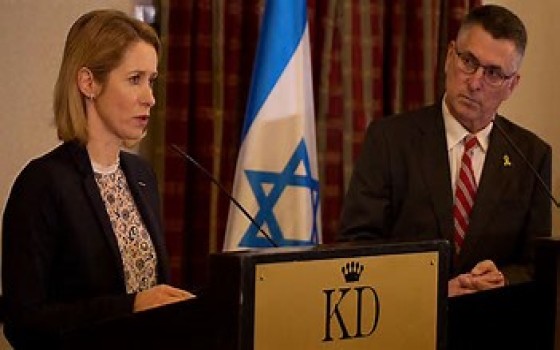
Israel punishes the European Union by freezing communications with its foreign policy chief, following her characterization of practices in Gaza as "apartheid." Meanwhile, Brussels has opened a new channel of communication with Tel Aviv.

- Europe and Arabs
- Thursday , 19 November 2026 5:53 AM GMT
Brussels: Europe and the Arabs
The European Commission has begun to play a more prominent role in the European Union’s diplomacy toward the Middle East, as the direct line of communication between the EU’s foreign policy chief, Kaja Kallas, and Israel remains frozen. This raises a broader question regarding who is authorized to speak on behalf of the European Union on the international stage. According to a report by the Brussels edition of *Playbook*—the European counterpart to the American *Politico*—European Commission President Ursula von der Leyen and Commissioner for the Mediterranean, Dubravka Šuica, are traveling to Syria and Jordan this week, while Kaja Kallas is hosting a forum on Mediterranean security in Brussels.
Šuica has met or spoken by phone with Israeli Foreign Minister Gideon Sa'ar at least four times this year; in February, she also participated as an observer in the "Peace for Gaza" council proposed by U.S. President Donald Trump. In contrast, Kallas has faced a freeze in relations from the Israeli side since last June.
This rupture followed reports that Kallas had compared Israel’s treatment of Palestinians to the apartheid regime that once existed in South Africa. Sa'ar stated that he would sever "all forms of communication" with the EU’s top diplomat unless she issued an apology. A spokesperson for Sa'ar clarified that the decision to cut ties "concerns Kallas alone," emphasizing that Israel continues to engage with other EU officials, institutions, and member states.
Better days: Previously, the two sides were in constant contact—at times exchanging WhatsApp messages several times a day—according to an individual familiar with their correspondence who requested anonymity due to the sensitive nature of these private communications. One EU diplomat remarked, "It is problematic that the Israelis do not wish to speak." Barry Andrews, a Liberal Member of the European Parliament and chair of the Committee on Development, argues that this friction surrounding EU diplomacy serves to "undermine the EU’s standing as a credible global actor."
For its part, a European Commission spokesperson emphasized that Kallas is "open to dialogue and prepared to engage with the incoming Israeli government," adding that she "remains in contact with politicians from across the political spectrum."
EU officials maintain that neither Kallas nor the European External Action Service (EEAS) has been sidelined from work concerning the region, pointing to close cooperation between Kallas and Šuica. The roles of the European Commission and the EEAS in the region overlap: the Commission manages a significant portion of the aid and economic support provided by the EU, while Kallas leads on political and security matters. In this context, one official noted that the EU cannot dictate whom Israel chooses to engage with, remarking, "It comes down to personal preferences."
Entrusting Dubravka Šuica with the task of engaging with Israel places another aspect of EU foreign policy under the direct supervision of Ursula von der Leyen. Last week, European leaders excluded Kaja Kallas from the negotiating team tasked with future peace talks regarding Ukraine, opting instead for national security advisors from five EU member states, alongside representatives from the European Commission and the European Council. A few days ago, the European Union reiterated its grave concern regarding the ongoing and devastating humanitarian crisis in the Gaza Strip. Severe flooding and harsh winter conditions affecting the territory are further deteriorating the living conditions of an already exhausted population, exacerbating insecurity and deepening human suffering. According to a European statement issued in Brussels from the office of Kallas, the statement adds:
"The European Union emphasizes the necessity of respecting international law—including international humanitarian law—at all times. This encompasses the protection of civilians and civilian infrastructure, as well as medical personnel and facilities. The recent airstrike on Nasser Hospital is a matter of grave concern.
Furthermore, obligations regarding humanitarian aid, as set out in the 'comprehensive plan to end the conflict in Gaza,' must be fully implemented in accordance with international law.
We urge Israel to allow immediate and unimpeded access for humanitarian aid and support for early recovery, to ensure its sustained and widespread distribution, and to reopen all border crossings into the Gaza Strip. Israel must also facilitate the work of the United Nations, its agencies, and humanitarian organizations—including non-governmental organizations—and fulfill all its obligations under international law, including international humanitarian law and international human rights law. In this context, we stress that aid must be used exclusively for peaceful purposes and must not be diverted by armed groups.
A year after the announcement of a ceasefire, military strikes continue, and shortages of essential supplies—including adequate shelter, medicine, and medical equipment—persist due to restrictions on access, preventing the existence of acceptable and dignified living conditions.
The European Union reaffirms its commitment to a two-state solution and calls upon all parties to fully implement the provisions of United Nations Security Council Resolution..." 2803 without delay, in line with relevant Security Council resolutions and international political and legal principles—most notably regarding the permanent disarmament of Hamas and other non-state armed groups, the full withdrawal of Israeli forces from the Gaza Strip, and the completion of the transition toward a civil administration in the Strip. Furthermore, Hamas should have no role in the future governance of the Gaza Strip.



No Comments Found