

Negotiations on Western Sahara, Led by the UN and the US, to Resolve the Conflict Between Morocco and the Polisario Front

- Europe and Arabs
- Thursday , 26 February 2026 4:46 AM GMT
New York: Europe and the Arabs
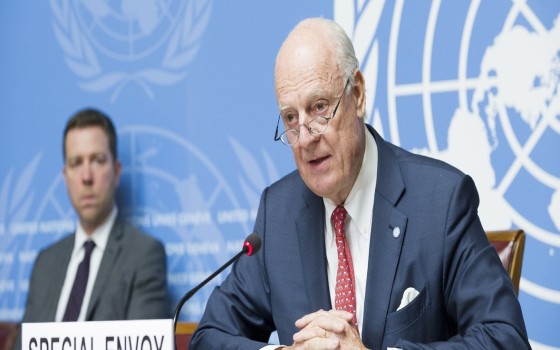
In close partnership with the United States, the Personal Envoy of the UN Secretary-General for Western Sahara, Staffan de Mistura, co-chaired negotiations held in Washington, D.C., on February 23 and 24.
The negotiations were co-chaired by Michael Waltz, the United States Permanent Representative to the United Nations, with support from Massad Boulos, Senior Advisor to the U.S. President on Arab and African Affairs. According to the UN daily news bulletin, a copy of which we received this morning, Thursday, UN Spokesperson Stéphane Dujarric stated that this was the third joint ministerial meeting on Western Sahara since January. He added in his daily press briefing that the negotiations involved in-depth discussions based on Morocco's autonomy proposal, in accordance with Security Council Resolution 2797.
He said this was encouraging, but that much work remains to be done, including on the core issue of the right to self-determination for the people of Western Sahara, in order to reach a mutually agreed solution to the conflict. Last November, Staffan de Mistura, the UN Secretary-General's Personal Envoy for Western Sahara, said that Security Council Resolution 2797 was important and demonstrated "renewed international energy and determination to resolve this 50-year-old conflict."
Speaking via video link from Brussels at a press conference at UN headquarters, de Mistura said he had previously told UN members that the organization's secretariat is sometimes like "a boat; it has the expertise to reach a safe destination, but doing so requires strong and sustained winds, meaning serious engagement from one or more members of the Security Council and beyond."
He added that Security Council Resolution 2797 was the result of very active engagement from the resolution's sponsors, including Dr. Massad Boulos (advisor to the US President), Ambassador Mike Waltz (the US Permanent Representative to the UN), and other Security Council members, including "perhaps those who abstained or did not vote." The Security Council adopted the resolution with 11 votes in favor (out of 15 members) and three abstentions (China, Pakistan, and the Russian Federation). Algeria did not participate in the vote.
Staffan de Mistura stated that the resolution "provides a framework—and I emphasize this word—for negotiations. It does not stipulate an outcome, which, as always, in order to be sustainable, will result from negotiations conducted in good faith."
De Mistura reminded everyone that engaging in negotiations does not automatically mean accepting the outcome, "but what is important is being part of it."
The Personal Envoy of the Secretary-General for Western Sahara expressed his hope to see "from Morocco the content of a comprehensive and updated autonomy plan, as I requested in my address to the Security Council on October 16, 2024, and as His Majesty King Mohammed VI announced in his recent address." Given the strong support and mandate granted to the Secretary-General and his Personal Envoy by Resolution 2797, de Mistura said, “Our plan of action will initially be to invite all parties to submit proposals and suggestions to allow the United Nations to develop a broad agenda for direct or—if necessary—indirect talks on the most important issues.”
He added that, in accordance with the Security Council resolution, he would take the 2007 Moroccan autonomy plan as the basis for these negotiations. “And then soon—hopefully as soon as possible—we will also consider the expanded Moroccan plan as an input, as well as the Polisario Front’s position and other relevant ideas,” he said.
On behalf of the UN Under-Secretary-General for Peace Operations, Jean-Pierre Lacroix, de Mistura expressed satisfaction with the extension of the mandate of the UN Mission for the Referendum in Western Sahara (MINURSO) until October 2026. He said this would certainly help to provide the necessary climate of stability to accompany future negotiations. In concluding his remarks to journalists, de Mistura said that the real work now begins toward a negotiated solution to the 50-year-long conflict. He added that he is counting on the parties and members of the Security Council to engage constructively and continuously in order to maintain the positive momentum.






No Comments Found