

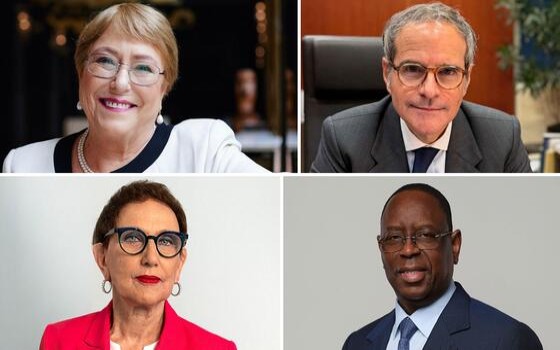
Two women and an African figure among the four candidates vying for the UN Secretary-General post

- Europe and Arabs
- Wednesday , 22 April 2026 5:38 AM GMT
New York: Europe and the Arabs
As part of the ongoing race to become the next Secretary-General of the United Nations, a series of interactive dialogues began this week at UN Headquarters in New York. Each of the four candidates vying for the position will have the opportunity to present their reasons for being the best choice. As of January 1, 2027, a new person will take the reins on the 38th floor of UN Headquarters. After ten years in office, during which he completed the maximum of two terms, António Guterres will step down.
His successor will not only have to navigate deep political and financial challenges but will also be tasked with implementing fundamental reforms to ensure the UN remains capable of meeting the challenges of the future, at a time when the organization and international law are under direct attack.
On Tuesday and Wednesday, the four candidates for the position participated in sessions held by the United Nations General Assembly, where they presented their visions for the future of the UN and answered questions from member states and civil society representatives about their leadership experience and qualifications, the UN reform process, and the three pillars upon which the organization is founded: peace and security, development, and human rights.
Who are the four candidates?
Michelle Bachelet (Chile)
Rafael Grossi (Argentina)
Rebecca Grinspan (Costa Rica)
Macky Sall (Senegal)
"The toughest job in the world"
The interactive dialogues were convened at the invitation of the President of the General Assembly, Annalena Baerbock, who told reporters on Tuesday morning—shortly before the first dialogue session began—that these dialogues represent a crucial step in the selection process, a process that, in her words, comes at a pivotal moment for the United Nations.
“The selection of the Secretary-General has far-reaching consequences that resonate far beyond the walls of this building,” said Baerbock. “Our choice will determine the course of this unique multilateral international organization and will demonstrate whether the United Nations truly represents the more than eight billion people we serve around the world, half of whom are women and girls.”
She described the selection process for the next Secretary-General as not merely an administrative decision, but also a declaration of intent, emphasizing that “it will send a powerful message about the values the United Nations stands for and how it intends to address the challenges of today’s interconnected world.”
The President of the General Assembly continued, “In short, this is one of the most difficult jobs in the world; but it is also one of the most important. The next Secretary-General will not only shape the future of this institution, but, as the strongest defender of the UN Charter, will also shape the future of the rules-based international order.” The selection of the tenth Secretary-General of the United Nations—who will take office in January 2027—will shape global diplomacy and crisis response around the world, and will determine the course of the multilateral system for the next decade.
Why does this matter?
With the process already underway, the following key questions arise:
From which country will the next UN Secretary-General come?
Will a woman be chosen to lead the international organization for the first time in its history?
How will the five permanent members of the Security Council overcome their political differences in an increasingly divided world?
A brief reminder of the role of the Secretary-General:
The Secretary-General is the chief administrative officer and top diplomat of the organization. Their responsibilities include:
Leading the UN Secretariat and overseeing its global operations.
Presenting issues that threaten international peace and security to the Security Council.
Acting as a mediator, advocate, and voice for international public opinion on global crises.
Implementing the decisions of Member States.
When will the next Secretary-General be chosen? The term of the current Secretary-General, António Guterres, ends on 31 December 2026; therefore, the next Secretary-General is expected to take office on 1 January 2027. The selection process is already underway and proceeds through the following stages:
November 2025: Member States are invited to submit their nominations by 1 April 2026.
21-22 April 2026: Interactive televised dialogue sessions are held in the Trusteeship Council Chamber. During these sessions, candidates answer questions from UN Member States and civil society organizations.
Late July 2026: The 15-member Security Council holds closed sessions to discuss and evaluate the candidates.
Late 2026: The UN General Assembly formalizes the appointment.
In practice, the final decision on the appointment is usually made between August and October.
Who are the candidates?
The list of nominees often includes diplomats, prime ministers, and figures from within the United Nations system, as well as high-level international figures.
Mechanism of Action:
Nominees must be nominated by at least one member state of the United Nations.
Each state is entitled to nominate one candidate (either individually or jointly with other states).
Unofficial rules:
The names of citizens of the five permanent members of the Security Council (China, France, Russia, the United Kingdom, and the United States) are not put forward for the position.
There is no official policy of regional rotation regarding the geographic region from which the Secretary-General should come; however, some believe it is now the turn of Latin America, which may explain why three of the candidates announced so far are from that region.
The balance of power in the General Assembly and the Security Council
Each Secretary-General is appointed by the General Assembly—comprising 193 member states—on the recommendation of the Security Council (as stipulated in Article 97 of the UN Charter).
While the Council—which has 15 members, particularly its five permanent members who possess veto power over any candidate—plays a crucial role in formulating the recommendation, the final appointment decision ultimately rests with the General Assembly.
To become Secretary-General, a candidate must:
Support a majority within the Security Council. Avoiding a veto from any of the five permanent members.
Informal "examinations" are conducted among Security Council members to determine whether they support, oppose, or have no opinion on a particular candidate. These examinations continue until a candidate emerges with a majority of support and has not been vetoed even once by any of the five permanent members.
Is it likely that a woman will be elected to this position?
Calls for a woman to be elected are growing, but there are no guarantees.
In the eighty years since the founding of the United Nations, nine people have served as Secretary-General, but none have ever held the position.
Member states are encouraged to nominate women for this post.
However, gender is not an official selection criterion.
The influence of politics on Security Council decisions:
The final decision still largely depends on whether the five permanent members can reach a consensus. The disagreements among these countries and the deadlock in the Security Council over the recent crises in Gaza, Ukraine, and now Iran, have demonstrated the considerable challenges that lie ahead.
The tenth Secretary-General will follow in the footsteps of:
António Guterres (Portugal), who took office in January 2017;
Ban Ki-moon (Republic of Korea), from 2007 to 2016;
Kofi Annan (Ghana), from 1997 to 2006;
Boutros Boutros-Ghali (Egypt), from 1992 to 1996;
Javier Pérez de Cuéllar (Peru), from 1982 to 1991;
Kurt Waldheim (Austria), from 1972 to 1981;
U Thant (Burma, now Myanmar), from 1961 to 1971; Dag Hammarskjöld (Sweden), from 1953 to 1961;
Trygve Halfdan Ley (Norway), from 1946 to 1952.



No Comments Found