

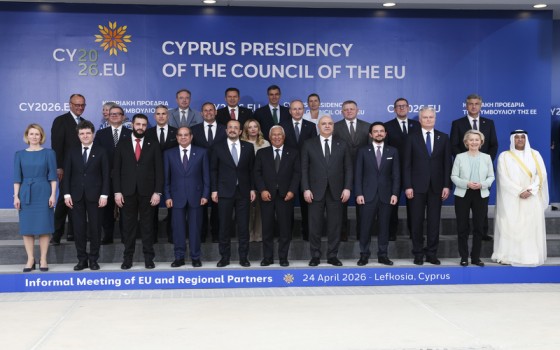
Outcomes of the EU summit with the participation of leaders from Middle Eastern countries: Key priorities identified include restoring freedom of navigation in the Strait of Hormuz and achieving a complete ceasefire to pave the way for lasting peace.

- Europe and Arabs
- Saturday , 25 April 2026 6:55 AM GMT
Brussels: Europe and the Arabs
Europe today faces an extremely challenging security environment, requiring a comprehensive vision for achieving and implementing lasting peace and security, whether in Ukraine or the Middle East. This is what European Council President António Costa said following the conclusion of a two-day summit held in Cyprus. The second day of the summit, held on Friday, was attended by several leaders from the Middle East and Gulf region. According to a European statement distributed in Brussels, Costa added, "Our meeting in Cyprus, in this context, carries significant symbolic weight, as it demonstrates the European Union's unwavering and clear support for the member states most affected by the ongoing conflict in the Middle East. For Cyprus, this situation is not merely theoretical, and therefore it is crucial that we are here today, alongside you, Mr. President Nikos, to send a clear message of European unity and solidarity. Cyprus is a cornerstone of European cooperation and engagement in the region. The security situation in the Middle East and its economic repercussions for Europe and its citizens were among the main topics of our discussions. The recent ceasefire agreements—between the United States and Iran, and Israel and Lebanon—are positive developments. Now, all parties must engage in good faith to achieve peace. The European Union is not a party to the conflict, but it will be part of the solution. While we support diplomatic efforts aimed at reaching a negotiated solution to this conflict, Our principles are clear: genuine peace can only be achieved by upholding international law in a consistent and principled manner.
Our priorities are also clear:
First, restoring freedom of navigation in the Strait of Hormuz;
Second, working towards a stable and lasting ceasefire that paves the way for sustainable peace in the region;
Third and finally, there can be no stable Middle East with a nuclear-armed Iran, and the European Union will continue to contribute to this goal, as it has done in the past.
We met with the leaders of Jordan, Lebanon, Syria, Egypt, and the Gulf Cooperation Council countries. Our partners know they can count on us, and we have been in close contact with them.
A few days after the start of the conflict in the Middle East, President von der Leyen and I convened a videoconference with all the leaders of the region to exchange views on the situation and offer the European Union’s support. Last week, I was in the Gulf region to meet with the leaders of Saudi Arabia, the United Arab Emirates, and Qatar, following the visit of the High Representative.
In parallel, and under the leadership of France, and in cooperation with the United Kingdom, a coalition of more than 50 countries is preparing a multilateral defense mission to restore freedom of navigation in the Strait of Hormuz. The Strait of Hormuz, provided the necessary security conditions are met.
During our meeting, we discussed the EU's readiness to respond to this complex geopolitical and security situation. This includes determining how to more precisely apply the mutual assistance clause in practice. The High Representative briefed us yesterday on the latest developments in the work underway in this regard.
The conflict in the Middle East is having a significant impact on fossil fuel prices, hindering growth and directly affecting the lives of citizens and businesses. In March, European leaders agreed on the need to take measures to respond to this crisis. The statement delivered this week by President von der Leyen includes a significant set of measures and recommendations. Coordination is essential, and we are fully prepared to intensify our response. We will continue to monitor the situation closely and adapt our approach accordingly.
In the long term, Europe has only one option: to accelerate our energy transition and expedite the deployment of domestic clean energy sources. This is the only way to reduce our dependence on other energy sources and ensure our energy security.
This morning, we discussed our next long-term budget (the Multiannual Financial Framework). We have a collective responsibility to reach an agreement by the end of the year. Only in this way can we ensure that the Multiannual Financial Framework (MFF) launches strongly from the beginning of 2028. Securing the necessary resources to achieve our ambitions will be crucial.
Our discussion today confirmed the need for new domestic resources to play a significant role in financing the budget. There is still work to be done. The Commission's proposal on the new domestic resources package will remain the basis for this work, and there was also an openness to considering other proposals, particularly those put forward by the European Parliament. Our discussion provided important guidance for the next steps. We will return to the discussion of the MFF in June, based on a preliminary proposal containing figures prepared by the Cypriot Presidency.
In conclusion, this is how Europe is responding to the changing geopolitical environment:
We support Ukraine in its defense against Russian aggression; we play an active role in achieving lasting peace in the Middle East;
We protect our citizens and businesses from economic shocks;
We pave the way for an ambitious long-term EU budget.,



No Comments Found