


What does the ice in Antarctica conceal? Data reveals the secrets of the White Continent – Dr. Abdel-Moneim Sedky, Professor at the Research Center, Egypt.

- Europe and Arabs
- Friday , 9 October 2026 5:30 AM GMT
Behind walls of ice that can reach heights of tens of meters lies one of the most extraordinary regions on Earth. But what lies beyond these white edges? And does Antarctica still harbor secrets yet to be discovered by humanity?
From a distance, Antarctica appears as an endless white world. Towering ice mountains, frozen plains, and harsh temperatures make accessing vast areas of the continent a formidable challenge. Yet, scientists have not limited themselves to observing the surface; they have employed satellites, radar, and research aircraft to peer beneath the ice—and the results have been astonishing.
A Giant Continent Beneath an Ice Sheet
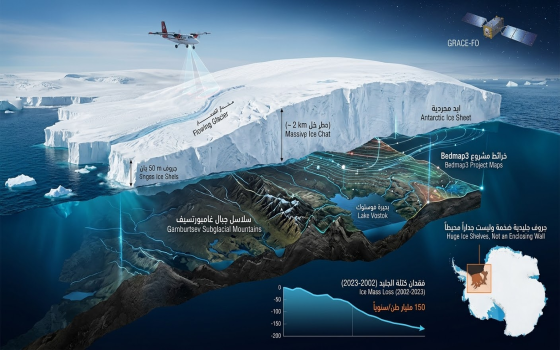
The continent spans approximately 14 million square kilometers, with an ice sheet averaging nearly two kilometers in thickness—and exceeding four kilometers in some areas. Beneath this colossal mass, scientists have discovered mountains, valleys, and deep basins that were invisible from the surface.
In 2025, the "Bedmap3" project provided more detailed maps of the terrain buried beneath the ice, utilizing millions of measurement points alongside aerial and radar survey data. Consequently, parts of this hidden sub-glacial world have become clearer to scientists than ever before.
Is There an Ice Wall Surrounding the World?
Actual imagery reveals massive ice cliffs along the continent's coastlines, which at times resemble white walls rising above the ocean waters. These sights are among the reasons behind the widespread talk of an "ice wall." However, scientific measurements and maps paint a picture that differs from the circulating claims: the continent features diverse coastlines, including floating ice shelves, rocky areas, and various ice formations. There is no credible scientific evidence proving the existence of a continuous wall encircling the Earth or concealing other continents behind it.
Ice is changing… and satellites are recording it all
Most fascinatingly, this white world is not as static as it appears. NASA data shows that, between 2002 and 2023, the continent lost an average of approximately 150 billion tons of ice mass annually. Satellites help scientists track these changes and measure their potential impact on sea levels.
Nevertheless, open scientific questions remain regarding the details of certain regions buried beneath the ice and how glaciers respond to climate change. Yet, the existence of areas not yet studied in detail does not necessarily imply the concealment of an unknown world; rather, it simply means that scientific research is ongoing.
Between fact and fiction
The allure of Antarctica may lie in its blend of otherworldly landscapes and genuine scientific mysteries. Yet, the distinction between scientific discovery and myth remains clear: while an image might spark a question, it is measurement and evidence that lead to the answer.
Ultimately, perhaps the most important question is not "What lies behind the ice wall?" but rather: how many of our planet's secrets are still waiting to be discovered, and what will future scientific measurements reveal to us? Sources for reference and verification: the British Antarctic Survey; the Bedmap3 project (published in the journal *Scientific Data* in 2025); and NASA data on ice mass loss from 2002 to 2023.






No Comments Found