

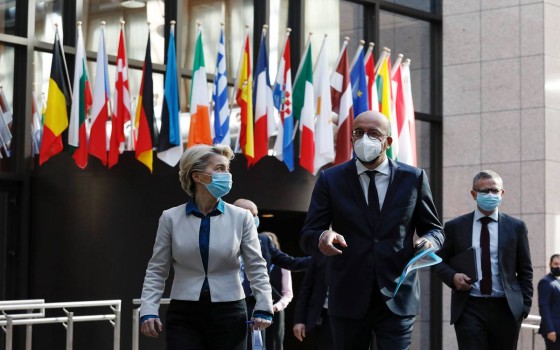
European Union President: There is an energy crisis we are facing, and we will announce new steps at the Brussels summit before the end of this month

- Europe and Arabs
- Saturday , 8 October 2022 15:12 PM GMT
Brussels: Europe and the Arabs
The President of the Council of the European Union, Charles Michel, described the first meeting of the European political group, which was held in Prague, as a historic meeting and for the first time the countries of the European continent, 44 countries on the continent that share the same ambition come together to work together for peace. , prosperity and stability, they had the opportunity to meet in this first edition. The next meetings will be held in Moldova, then in Spain, and then in the United Kingdom. "I think it is a task that was accomplished for the first time because it was an opportunity to really listen to each other, to determine, in each of the challenges we share together, how we can try first and foremost to understand each other," Michel added in his remarks at the conclusion of the summit, which were published in a statement distributed in Brussels. better in in order to be able to initiate more coordination, more practical convergence, with the desire not to institutionalize but to maintain flexibility and agility that allows to act in the most effective way possible.This is the first point that showed unity at a time when you need The European continent and the world truly belong to this unity and this grouping. That is the first topic.
The second topic, at Friday's European Council meeting, we had the opportunity once again to hear from the President of Ukraine, Volodymyr Zelensky. President Zelensky addressed us all and shared Ukraine's priorities. We have reiterated our full support to Ukraine. This is aggression against Ukraine and an unacceptable war, and we are determined to mobilize all possible tools and means at our disposal to support Ukraine financially and militarily, as well as with humanitarian and, of course, political support.
We have taken decisions to tighten sanctions against Russia because we need to increase pressure on the Kremlin. In addition, we emphasized the importance of communication with countries outside the EU to counter the Russian narrative.
We know that this war, initiated by Russia, has serious consequences not only for the European continent, but also for the rest of the world, not least in terms of food security and energy crises. As you know, we are determined to support our partners around the world in addressing the security crisis, and today, we are focused on this as well. With regard to the energy crisis, we are developing strategies to address the energy situation as well as the economic and social consequences of this crisis.
We also had the opportunity to speak, at this informal meeting of the European Council, on this fundamental question of the state of energy. Let's be clear, we all know that, Russia has waged war against the Ukrainian people, who suffer daily from this war and who are bravely fighting for the values we share and for their future, but also for the future of the Ukrainian people. European project and Europe. But surely, Russia also launched an energy missile on the European continent and the world. There is an energy crisis we are facing.
Speaking from Prague, the capital of the Czech Republic, which currently holds the presidency of the European Union, Michel noted that the leaders had the opportunity, in essence, to address three issues "that seem to us very important and for which European action is necessary. On the other hand, the importance of taking measures to reduce consumption and reduce demand. The first decisions were made at the initiative of the European Commission, and thanks to the swift action of the Czech Presidency, we will continue our commitment to ensuring that we can reduce consumption. It is one of the first levers. Each of us has a part, capacity and opportunity to act to ensure that we can meet this challenge together.
The second point is the issue of security of supply. We have been working for a few months already to ensure that stocks are filled as much as possible. It's a good step, it's important. As mentioned, since before the summer, the importance of the gradual creation of platforms for joint procurement of energy resources. We had the opportunity to come back today on this topic and felt more supported to continue moving forward. In particular, for example, to be able to fill the stocks when it is necessary to fill the stocks again. This is one of the examples mentioned, in which the commission, moreover, made proposals in its roadmap.
Then there is the third element, which is the question of prices. It is a painful effect on families, on families. It is also potentially painful for our business and has an economic impact. I would also like to emphasize today that we felt a common desire among European leaders to be mobilized with a common ambition to lower the prices of energy resources and to work with the Council of the Union and the European Commission, so that this Council must be seen today as a strategic stage that leads us on the way to the next European Council. scheduled in Brussels before the end of this month,” which should be an opportunity to take steps forward in terms of taking the necessary measures into account.
According to media reports in Brussels, European Union leaders agreed Friday to provide more financial and military aid to Ukraine, but the day-long talks at a summit of the bloc in Prague (Czech Republic) did not succeed in bringing together positions on the gas price file.
While the French President, Emmanuel Macron, announced the establishment of a fund worth 100 million euros, allowing the Ukrainian side to buy the defense equipment it wants directly from French manufacturers, the president also warned that the winter of 2023-24 will be the most difficult in terms of securing gas supplies.
Macron, who initiated the call for the establishment of the "European Political Group", said that Europe will intensify its talks with gas suppliers and coordinate with Asian partner countries on gas purchase deals, and will also implement mechanisms to ensure that there is financial solidarity among European countries in energy purchase transactions.
internal contrast
Most of the EU countries are calling for a cap on gas prices, but the details are The focus of the dispute. Options include imposing a price cap on all gas, a cap on the price of gas used to generate electricity only, or a cap on the price of Russian gas only.
The bloc has been discussing this dilemma for weeks without a result yet, but the EU countries agreed to other joint steps to help alleviate the severe energy crisis at a time when wild prices threaten to push the bloc towards recession.
"Everyone agrees that we need to lower electricity prices, but there is no agreement on the means by which we can reach that exact end," Polish Prime Minister Mateusz Morawiecki told reporters as talks between the bloc's leaders continued late into the day.
Irish Prime Minister Michael Martin said the European Commission was expected to present to the bloc's next meeting on October 20-21 a broader package including short-term price-cutting measures and longer-term steps to reshape the gas market.
Setting a ceiling on gas prices is one of a set of proposals and initiatives submitted by European countries to live with the decline in gas supplies from Russia, which was providing 40 percent of Europe's needs, as well as the huge rise in prices. Although gas prices have fallen from their peak this year, they are still more than two hundred percent higher than they were at the beginning of September of last year.
Germany, Denmark and the Netherlands oppose a price ceiling, fearing that it would hinder the purchase of gas that their economies need and reduce the impact of any incentive to reduce consumption.
Poland criticizes 'selfishness of Germany'
Morawiecki has criticized Berlin for what he sees as a generous €200 billion ($196 billion) in subsidies to protect consumers and businesses from rising energy costs. "German selfishness must be discarded," he said, reiterating fears of a fiscal gap between rich countries that are able to spend huge amounts of money on domestic support and those that can't.
Germany is accelerating its steps to implement its 200-billion-euro energy rescue plan, which has been sharply criticized by its European partners, but Berlin justifies its project as an urgent necessity to mitigate the "grave economic damage" the country is facing.
It is possible that the government of German Chancellor Olaf Scholz, as of Monday, will present to the Cabinet the text of a law to establish an energy fund that would allow the granting of additional appropriations in the amount of 200 billion euros, according to sources close to the government.
This portfolio would support energy prices that threaten the purchasing power of households and corporate activities, and provide support to oil institutions that are more dependent on Russian gas.
Returning to the Ukrainian issue, the bloc expressed its adherence to a unified position in pledging to continue supporting Ukraine, according to an EU official who was briefed on the course of talks that took place behind closed doors. Without elaborating, he said the leaders "are committed to continuing military and financial support" to Kiev


No Comments Found