

World Food Program: Half of Gaza's population suffers from acute hunger and fears of disease outbreaks

- Europe and Arabs
- Friday , 15 December 2023 15:11 PM GMT
Geneva - Gaza: Europe and the Arabs
Deputy Executive Director of the World Food Programme, Karl Skau, renewed the call for a humanitarian ceasefire and the opening of crossings so that the program can increase humanitarian aid to people in Gaza, half of whom suffer from acute hunger.
Skaw spoke to reporters in New York after his return from Gaza a few days ago. He said that his visit to the Strip was aimed at "demonstrating our continued commitment to the people of Palestine and the residents of Gaza, and also to support our teams on the ground."
He stressed that the program is ready to reach millions with humanitarian aid as soon as the situation allows. He added:
“What we really need is an increase in the amounts of aid entering the Strip. For this we need more crossings, at least the Kerem Shalom crossing. We would also like to see the entry of commercial trucks so that as soon as possible we can resume the system of distributing cash and vouchers because this is a program that has "Also a broader impact on the economy. Of course, we need to be able to reach all parts of the sector. For that to happen, we need and call for a humanitarian ceasefire."
They don't know where their next meal is coming from
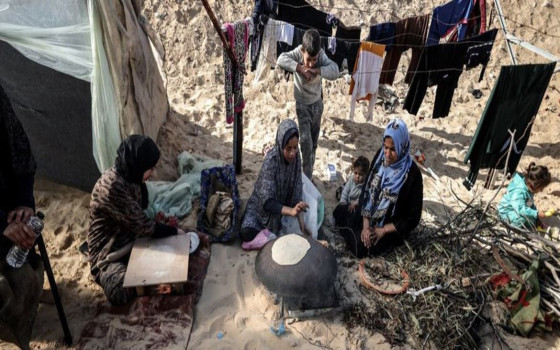
The UN official revealed a survey conducted by the World Food Program during the seven-day truce period. The survey concluded that half of the population of the Gaza Strip suffers from acute hunger - and in some areas, nine out of ten people spend an entire day and night without eating any food. 18% of those families experienced these conditions on more than 10 days during the past month.
He said that the program is working with other partners to prepare a report on interim food security, which is expected to be released in the middle of next week. He explained that the report is based on these surveys that we were able to conduct in the past two weeks. The program also conducts a forward-looking assessment if the current situation continues.
For his part, the Commissioner-General of UNRWA, Philippe Lazzarini, warned that many residents of the Gaza Strip are in such dire need of food that they sometimes stop aid trucks and immediately eat what they find.
Speaking to reporters in Geneva yesterday, after his return from Rafah in southern Gaza, Philippe Lazzarini explained that people are “desperate, hungry and terrified,” 69 days after the start of the Israeli military bombing in response to the attacks launched by Hamas on Israel on October 7.
Heavy rains exacerbated the difficult conditions in the Gaza Strip, while United Nations humanitarian workers expressed grave concern about the deteriorating health situation in the Strip in light of the continuing bombing and fighting.
The United Nations Office for the Coordination of Humanitarian Affairs said that many areas in the Gaza Strip were flooded with water, making the situation of the displaced more difficult. About 1.9 million people in Gaza were forced to flee their homes, and more than half of them headed to Rafah in the south to seek safety.
UNRWA shelters are overcrowded, with more than 9 times their capacity staying. Many live outdoors, where they are exposed to difficult weather conditions, or in ill-equipped shelters.
The United Nations Office for the Coordination of Humanitarian Affairs warned of the difficulty of managing sanitation conditions in overcrowded shelters. Combined with floods and the accumulation of waste, these conditions lead to the spread of insects, mosquitoes and mice, which exacerbates the risk of the spread of diseases.
Earlier this week, Gaza health authorities said they had documented 360,000 cases of infectious diseases in shelters and that the actual numbers may be higher.







No Comments Found