

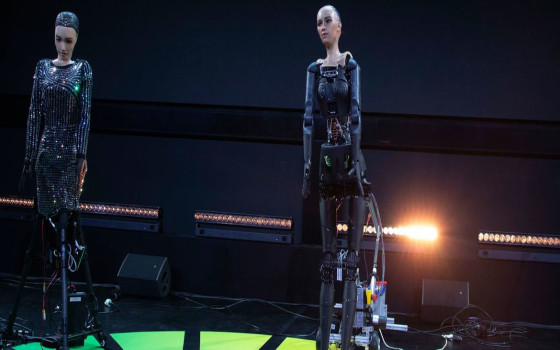
Europe wants to break free from its dependence on American tech giants in the field of artificial intelligence.

- Europe and Arabs
- Monday , 1 December 2025 10:6 AM GMT
Brussels: Europe and the Arabs
Three years after OpenAI launched its ChatGPT chatbot and brought artificial intelligence (AI) into the mainstream, several European countries are working to build their own sovereign AI systems.
Sovereign AI is the ability of a country to develop, host, deploy, and govern AI systems created within its borders for its citizens, rather than relying on foreign systems or foreign cloud computing expertise. According to a report by the European News Network in Brussels, the European Parliament acknowledged in a June report that it "is currently heavily reliant on foreign technologies," particularly American ones, preventing the EU from developing its own technological leadership. The report added that this reliance is "likely to continue" due to the recent $500 billion (€432.9 billion) US investment in artificial intelligence. The EU stressed that to regain its competitive edge, it must invest in research and development of new systems. National governments can play a pivotal role in this. Several countries across Europe are building their own sovereign AI systems. Euronews Next reviews what has been achieved so far.
Germany: Germany is the latest country to announce an AI plan known as Sovereign Open Source Enterprise Models (SOOFI). According to the German government, SOOFI is an attempt to build a basic open-source model of "advanced AI" that other companies developing AI products can adapt. This technology will be used for highly complex tasks, such as AI-controlled robots. Artificial intelligence, according to a statement from the German government.
"With SOOFI, we are laying the foundation for the next generation of European AI models—sovereign, robust, and entirely in European hands," said Wolfgang Niedel, a professor at Leibniz University Hannover, one of the universities participating in the project.
"Large AI models that respect European values are essential for building trust in AI, particularly in sensitive areas such as education, medicine, management, and manufacturing," he added. Deutsche Telekom and T-Systems said the goal is for SOOFI to have 100 billion parameters, or settings, that control the model's behavior.
The two companies are providing technical support for the large language model at one of their AI factories. To train the model, Deutsche Telekom will use around 130 NVIDIA chips and more than 1,000 GPUs, which will be ready by next March.
TU Darmstadt, another German university, said... Participating in the project, SOOFI will also define the requirements for building expertise in all aspects of developing large AI models, from data collection and preparation to software development and training.
Switzerland
In September, the Swiss AI Initiative launched Apertus, the country's first multilingual linguistic model.
Apertus, a Latin word meaning "open," allows researchers, professionals, and the public to customize the model to their specific needs.
The developers say that everything about the model is available for use, including the training architecture, datasets, source code, and model weights—the parameters that guide the large linguistic model in how to interpret data.
ETH Zurich, one of the collaborating universities, said that Apertus has been trained on 15 trillion tokens or pieces of information across more than 1,000 languages, such as Swiss German and Romansh.
Apertus has been uploaded to Public AI, an online portal for sovereign models, so that people around the world can access the model.
The Swiss AI Initiative said that Specialized models will be explored in the fields of law, climate, health, and education.
“This release is not a final step, it’s a beginning,” said Antoine Bosillo, co-leader of the Swiss AI initiative, via Public AI. “We are moving toward a long-term commitment to the foundations of sovereign and open AI that serves the global public good.”
Poland
In February, Poland launched its own large-scale local language model, the Polish Large Language Model (PLLuM).
A government statement at the time of the launch said that PLLuM is “designed to the specifics of the Polish language,” so that any AI-powered speech or writing projects can “handle perfectly with the challenges of conjugation and complex syntax.”
The government notes that PLLuM models can be turned into AI applications that help with writing texts and emails, summarizing documents, helping students prepare for lessons, generating chatbot content, planning trips, or creating charts.
Dariusz Standerski, Poland’s deputy minister for digital affairs at the time, said that PLLuM is “an investment In the digital state.”
Standerski added during the model’s launch that it will expand to become “Hive AI”: a system that will eventually be integrated into government public administration processes and help develop a “national AI ecosystem.” For example, the public will have access to a virtual assistant to help them obtain public information, and an “intelligent” office assistant that automates document processing and information retrieval. Later, “PLLuM” will also be used to help teachers “conduct engaging lessons” using the latest technologies in classrooms.
Spain
In January, Alia launched the Barcelona Supercomputing Center (BSC), “Europe’s first open and multilingual infrastructure,” which will develop “responsible AI in service of people.” The BSC developed the Alia project with the help of MareNostrum 5, a supercomputer capable of performing 314 quadrillion calculations per second.
Alia provides an open database of resources, such as datasets, language models, and integration tools in Spanish, Basque, Catalan, and Galician, to help startups build their own local models.
Ultimately, the Spanish Agency for the Supervision of Artificial Intelligence (AESIA) said that Alia would later be transformed into a chatbot for the tax agency and integrated into an application capable of easily diagnosing heart failure.
The Alia project also builds on Ilena, another Spanish government initiative that created more than 100 AI resources in Spanish, Basque, Catalan, and Galician for use by local businesses.
In 2020, the Catalan government launched Aina, a pilot project that produces computer models in Catalan for other companies wanting to build AI products such as voice assistants, machine translators, or conversational agents.
The government trained this model on an initial Catalan database of 1.7 million words compiled into 95 million sentences. The Netherlands
In 2023, three non-profit organizations began developing an open-source, Dutch-speaking AI model called GPT-NL.
A website dedicated to the project describes GPT-NL as a model of "the Dutch language and culture: reliable, transparent, interdependent, and sovereign."
The consortium is working with a combination of copyrighted data from high-quality sources, public data, and its own artificial intelligence.
The consortium recently signed an agreement with Dutch publishers NDP Nieuwsmedia and the ANP news agency to use their articles in training GPT-NL. In return, the publishers will receive a share of the profits from the large language model when it is eventually launched.
The project will also be open-source, meaning that academic institutions, researchers, and the government can test its applications in the health, education, and service sectors. Users who do not use the large language model for professional purposes may have to pay a small fee to access it when it becomes available. Researchers began training the model in June 2025 and expect the first version to be available before the end of the year, according to a recent update.
Portugal
Since 2024, a consortium of Portuguese universities has been working on a sovereign AI model called "Amalia."
The Nova School of Science and Technology, one of the research institutions behind Amalia, says it is capable of answering questions, generating code, explaining concepts, summarizing texts, and interpreting information in Portuguese and within a local context. Researchers tested a beta version of Amalia in September and are working toward a public rollout of the AI in mid-2026. The government already plans to use this large language model in public administration services through its online portal and in the scientific field to aid in analysis.
Local reports indicate that Amalia will not be available to the general public when developed as a chatbot, but the large language model's code will be open source so that other Portuguese companies can use it in their AI models.


No Comments Found