

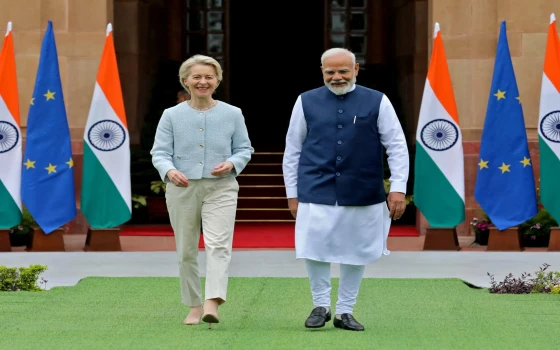
Brussels described it as a historic achievement: The EU-India summit aims to elevate the partnership to a new level, with agreements encompassing defense industries, maritime security, and space.

- Europe and Arabs
- Monday , 26 January 2026 7:8 AM GMT
Brussels: Europe and the Arabs
European Commission President Ursula von der Leyen has begun a visit to India to bolster trade and defense cooperation and deepen ties between the world's two largest democracies. According to a statement issued by the Commission in Brussels, von der Leyen arrived in New Delhi on Monday, accompanied by European Council President António Costa. They will participate as guests of honor in India's 77th Republic Day celebrations, hosted by Indian President Dr. Dhrubadi Murmo.
The two leaders will participate on Tuesday in a bilateral summit aimed at elevating the unique partnership between the European Union and India to a new level. Negotiations are currently in their final stages on a free trade agreement, which, if concluded, would create a common market of two billion people, reduce annual tariffs for exporters of all sizes by €4 billion, and guarantee the supply of essential materials and products. The two leaders are also expected to sign a security and defense partnership agreement to expand cooperation in the areas of defense industries, maritime security, secure connectivity, and space. According to Playbook, the European edition of Politico, "The two sides are poised to reach a political agreement on a new EU-India trade deal. In remarks made ahead of the visit, von der Leyen said that she and Costa are the first heads of EU institutions to be invited as chief guests of honor to national celebrations."
The European Commission president hailed the EU-India summit as a "historic achievement," as the EU is expected to gain "the highest level of access ever granted to a trading partner in the long-protected Indian market" and "a significant competitive advantage in key industrial and agri-food sectors." Also in New Delhi is Kaja Kallas, the EU's top diplomat, who will sign a defense and security partnership agreement focused on maritime security, counterterrorism, and cyber defense—another key pillar of a series of agreements described by Indian media as a "mega-deal." Speaking to the Times of India ahead of the visit, von der Leyen described close cooperation with India as a bulwark against "an increasingly turbulent world, from the battlefields of The fighting in Ukraine has spilled over into the turbulent waters of the Indian and Pacific Oceans,” she said, while avoiding any direct comment on India’s neutrality in the Russian-Ukrainian conflict. Following a formal reception on Sunday that included traditional dance performances, images adorning the main city streets, and a performance of “Ode to Joy” – the EU’s national anthem – by an Indian military band, von der Leyen and Costa traveled to New Delhi under tight security, according to the Camel newspaper. The EU is seeking to diversify its trade and defense ties amid strained relations with the Trump administration and Beijing, according to Playbook. A deal with New Delhi would bolster the EU’s trade and defense relations with a nation of 1.4 billion people that has historically leaned toward Russia. It would also provide a much-needed boost to the EU’s export-hungry defense manufacturers. The Trump administration blocked its trade agreement with India, imposing 50% tariffs last August. The two sides are still negotiating. An agreement is in place, but it still seems far off.
Key sticking points: The EU is demanding India reduce tariffs on cars, while New Delhi is seeking assurances that its steel exports will not be affected by the EU's anticipated steel tariffs, as well as the EU's border carbon tax. Negotiators were still discussing these sticking points on Sunday, but a resolution is expected by Tuesday, with India set to reduce tariffs on cars and the EU to offer additional support to Indian companies in reducing carbon emissions, according to a Camille report.
The most complicated aspect: Agriculture is a sensitive issue for both sides, as products such as beef, poultry, rice, and sugar will be excluded from the tariff reductions. Tariffs on European wine, spirits, and olive oil are expected to be significantly reduced upon entering the Indian market, which likely explains why agricultural countries like France and Ireland have agreed to this approach.
One of the most important outcomes of the visit is the strengthening of the EU-India security and defense partnership, which focuses on integrating the European and Indian defense industries, according to an EU official. India, which used to buy weapons from Russia, is expected to double down on its recent arms purchases from Europe, including the purchase of Dassault Rafale fighter jets from France.



No Comments Found