

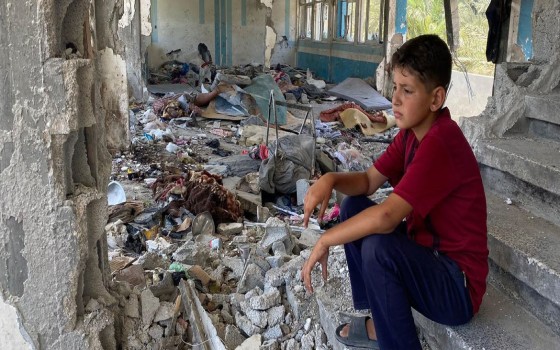
United Nations: Israeli practices must stop, and conditions must be created for Gaza and the West Bank, including East Jerusalem, to become the future State of Palestine. Efforts continue to meet humanitarian needs.

- Europe and Arabs
- Friday , 30 January 2026 7:47 AM GMT
Gaza – New York: Europe and the Arabs
Secretary-General António Guterres, whose term ends at the end of this year, said that 2026 – even in its early days – is shaping up to be “a year of chaos and continuous surprises.” This came during a press conference, as reported in the UN daily news bulletin. In response to a question about “President Trump’s Peace Council charter and its omission of the Gaza Strip,” the Secretary-General referred to Security Council Resolution 2803 concerning Gaza and its reference to the Peace Council and other institutions.
In response to another question about the two-state solution, the UN Secretary-General reiterated his strong opposition to all efforts by Israel to undermine the two-state solution, particularly in the West Bank, through settlement construction, demolitions, expulsions, and settler violence.
He stressed the necessity of halting these practices and creating the conditions for Gaza and the West Bank, including East Jerusalem, to become the future State of Palestine.
Despite ongoing obstacles, the United Nations and its humanitarian partners continue to intensify their efforts to save lives and meet needs in the Gaza Strip. The Office for the Coordination of Humanitarian Affairs (OCHA) reported that cash assistance partners are continuing to expand their support to help families improve their food consumption and diversify their diets.
However, OCHA noted that nearly 97% of children aged 6 to 23 months still lack sufficient dietary diversity, indicating continued micronutrient deficiencies.
Regarding health, the World Health Organization (WHO) facilitated the medical evacuation of 24 children from Gaza to Jordan, accompanied by 36 caregivers, on January 26. This brings the total number of patients evacuated since the October 2015 ceasefire to 377, including 310 children, along with 1,032 caregivers.
Nevertheless, more than 18,500 people, including 4,000 children, remain in urgent need of medical evacuation to receive care unavailable in Gaza. Health partners conducted nearly 500,000 medical consultations between January 4 and 17. These consultations included more than 88,600 cases of acute respiratory infections and approximately 11,000 cases of acute watery diarrhea, 80% of which were among children.
In the education sector, UNICEF successfully secured the entry of vital school supplies into Gaza this week, including notebooks, writing materials, chalk, teaching aids, and other supplies.
Thousands more supplies have been approved and are ready for entry. OCHA confirmed that these supplies will help restore the quality of education, which has been severely impacted by the ongoing shortage of essential materials.
Returning to the Secretary-General's press conference, the daily news bulletin noted that the main theme of his opening remarks was related to his study of physics, specifically Newton's Third Law of Motion: "For every action, there is an equal and opposite reaction." In physics, this law is a principle of stability, but in a geopolitical context, it is a destabilizing factor. In this context, the Secretary-General stated, "We live in a world where actions—especially reckless ones—provoke dangerous reactions."
Key points from the Secretary-General's press conference included:
The rule of law versus the law of force.
Reducing funding for humanitarian work leads to death, despair, and displacement.
The need to strengthen climate action.
The importance of establishing regulations for technology and artificial intelligence.
Reforming the outdated multilateral system.
Lasting peace cannot be achieved without development.
Despite the obstacles, the United Nations continues to work to translate shared values into reality.
Impunity
Secretary-General António Guterres stated that impunity fuels conflict and escalation, deepens mistrust, and opens the door wide for "powerful spoilers" from all sides.
He added, "Reducing humanitarian aid generates a chain reaction of despair, displacement, and death." Climate Change
On climate change, the Secretary-General said that every action that increases the Earth's temperature leads to dire consequences, including storms, wildfires, hurricanes, droughts, and rising sea levels.
He stressed the importance of reducing greenhouse gas emissions and a just and orderly transition from fossil fuels (such as oil) to renewable energy.
The Secretary-General also called for increased support for countries already facing climate disasters, expanding early warning systems, and enabling countries rich in vital minerals to benefit from value chains.
Artificial Intelligence
Guterres then turned to technology, saying, "We are seeing what could be the greatest transfer of power of our time, not from governments to the people, but from governments to private technology companies."
He warned that technology is being allowed to shape behaviors, elections, markets, and even conflicts without regulation. This, he said, will not lead to innovation, but rather to instability.
He stated that the United Nations is working to urgently help develop a governance framework through international dialogue within the organization and the new International Scientific Committee on Artificial Intelligence. He announced that he would soon submit to the General Assembly a list of 40 proposed names for membership on the committee. He also called for the establishment of an international fund to develop artificial intelligence capabilities in developing countries, with the goal of raising $3 billion.
An Outdated System
The Secretary-General also spoke about the need to reform the multilateral system established 80 years ago after World War II, saying that this system, intended to solve problems, faces major challenges.
He added: “These systems are outdated. They still reflect the economic and power structures that existed 80 years ago, but the world is changing… International problems will not be solved by a single power making all the decisions, or even by two powers dividing the world into competing spheres of influence.”
He stressed the importance of accelerating the establishment of an inclusive multilateral system capable of achieving balance through partnerships in trade, technology, and international cooperation.
However, a multilateral system in itself does not guarantee stability or peace. Europe before World War I was multipolar, but the absence of effective multilateral institutions led to confrontations and war.
The Secretary-General emphasized the need for strong multilateral institutions where legitimacy is based on responsibility and shared values. Guterres said the UN Charter was written by people affected by World War II who understood that the values enshrined in the organization's founding documents were essential for lasting peace and justice.
Transforming Shared Values into Reality
The Secretary-General affirmed that the UN is working – despite all obstacles – to translate shared values into reality and will never give up on this endeavor.
He said: “We strive for a just and lasting peace rooted in international law, a peace that addresses the root causes and extends beyond the signing of agreements. We seek to reform and strengthen the Security Council, the only body with a Charter mandate to act on behalf of all nations on the path to peace and security.”
Guterres stressed that peace cannot be achieved without development and said the UN is working to accelerate progress towards the Sustainable Development Goals while insisting on reforming the international financial system.
This includes ending the destructive debt cycle, tripling the lending capacity of multilateral development banks, and ensuring the equitable participation of developing countries in international financial institutions. Guterres stressed the need to implement this resolution, stating that the ceasefire in Gaza is merely a "reduction in the fighting" without a true cessation of hostilities. He emphasized the necessity of moving to the second phase, which entails the complete withdrawal of Israeli forces, the dismantling of armed groups, and paving the way for the realization of the two-state solution. The Secretary-General stated that the primary responsibility for international peace and security rests with the Security Council, the only body authorized to adopt binding resolutions and to authorize the use of force in accordance with international law.
In this context, he underscored the importance of Security Council reform, saying, "It is ironic that some of those who criticize the United Nations and claim it is ineffective are the very ones who oppose Security Council reform, which is sometimes the reason why the UN is not as effective as we would like it to be."






No Comments Found