

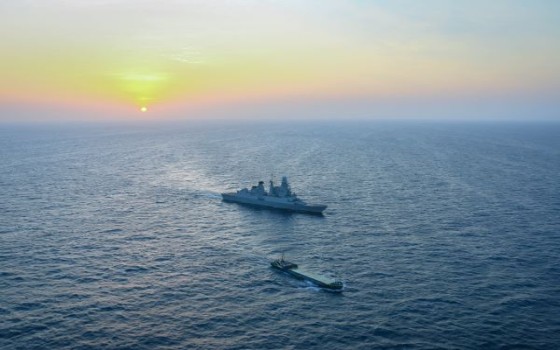
Concurrently with the downing of an Iranian drone in the Arabian Sea and the pursuit of a US oil tanker by boats, disagreements have arisen between Washington and Tehran regarding the venue and format of negotiations. Consultations are also underway with Turkey and the Gulf states.

- Europe and Arabs
- Wednesday , 4 February 2026 6:0 AM GMT
Tehran – Washington: Europe and the Arabs – Agencies
In a move aimed at unifying the regional stance ahead of a critical round of nuclear negotiations, Iranian Foreign Minister Abbas Araqchi held a series of separate telephone conversations with his counterparts in Kuwait, Qatar, Turkey, and Oman.
According to a statement from the Iranian Foreign Ministry, the talks focused on the latest regional developments and emphasized the need to strengthen bilateral relations, continue political consultations, and develop regional cooperation and close coordination to maintain security and stability. According to the Brussels-based European news network Euronews, Tehran's regional diplomatic efforts are running up against direct disagreements with Washington over the venue and format of the upcoming nuclear negotiations. Iranian Foreign Minister Abbas Araqchi was scheduled to meet with US Special Envoy Steve Wittkopf – accompanied by Jared Kushner, son-in-law of US President Donald Trump – on Friday, February 6, in Istanbul. However, Iranian officials threatened on Tuesday to withdraw from the meeting, according to the Wall Street Journal. It remains unclear what prompted Tehran to issue these threats. Iran Demands Change of Venue and Format of Talks
In an attempt to explain this shift, Axios, citing sources, reported that the Iranian side wants to change the venue and format of the nuclear talks with the United States, hoping to move them from Istanbul to Oman, with participation limited to the two parties only. Muscat has previously hosted rounds of indirect negotiations between the two sides, making it a familiar diplomatic option. Presidential Conditions for "Fair and Equitable" Negotiations
This approach appears to be This aligns with a more stringent official stance expressed by Iranian President Masoud Pezeshkian, who announced the appointment of Araqchi to represent the country in the negotiations, but with clear conditions: "a suitable environment free from threats and unrealistic expectations," and within the framework of "fair and equitable negotiations" that serve Iran's "national interests."
The Iranian news agency Tasnim did not reveal any new details regarding the timing or location of the meeting, although it confirmed that Araqchi would meet with Witkov.
While Iranian sources reject what they consider American "political games" regarding minor details such as the meeting's location or timing—according to the Iran News website, which is close to the Foreign Ministry—tensions are escalating with Israeli reports indicating that Tel Aviv is "exerting intensive efforts" to obstruct any potential agreement between Tehran and Washington.
In a parallel development reflecting an Iranian attempt to reassure its allies, The New York Times revealed that Iranian officials stated that Ali Larijani, during a recent visit to Moscow, carried a message from Supreme Leader Ali Khamenei to Russian President Vladimir Putin, affirming Tehran's readiness for de-escalation measures, which might include relocating Iran could send enriched uranium to Russia—as it did in 2015—or even temporarily suspend its nuclear program.
In the same vein, White House spokeswoman Carolyn Leavitt said that U.S. Central Command (CENTCOM) "made the decision to shoot down the Iranian drone. The drone was unmanned and acting aggressively toward the USS Abraham Lincoln." Speaking on Fox News, she concluded, "President Trump remains committed to always pursuing diplomacy first, but for diplomacy to succeed, it obviously requires cooperation from both sides." According to the European news site Nova News, a U.S. fighter jet shot down an Iranian drone in the Arabian Sea after it approached a U.S. aircraft carrier "in a hostile manner." The U.S. military announced the incident, explaining that it occurred while the USS Abraham Lincoln was transiting the Arabian Sea, about 800 kilometers (500 miles) off the southern coast of Iran. Captain Tim Hawkins, a spokesman for U.S. Central Command (CENTCOM), said, "The aircraft carrier USS Abraham Lincoln was transiting the Arabian Sea approximately 800 kilometers (500 miles) off the southern coast of Iran when an Iranian Shahed-139 drone attempted to maneuver toward the ship. The Iranian drone continued to fly toward the ship despite de-escalation measures taken by U.S. forces operating in international waters." According to Hawkins, an F-35C fighter jet shot down the Iranian drone in self-defense to protect the ship and its crew. No U.S. personnel were injured, and no equipment was damaged. Hawkins added, "U.S. Central Command forces operate at the highest levels of professionalism and ensure the safety of U.S. personnel, ships, and aircraft in the Middle East. Continued Iranian harassment and threats in international waters and airspace will not be tolerated. Unprovoked Iranian aggression near U.S. forces, regional partners, and commercial vessels increases the risk of collision, miscalculation, and regional instability." This came after at least six Iranian patrol boats, equipped with .50 caliber machine guns, approached a U.S. oil tanker in the Strait of Hormuz and ordered it to shut down its engines and prepare to board. The Wall Street Journal, citing maritime security firm Vanguard Tech, reported that the ship instead increased speed and was then escorted by a U.S. warship.
U.S. officials confirmed that armed Iranian vessels attempted to intercept a U.S.-flagged ship, which was safely escorted to shore. Vanguard said in a statement: "In light of heightened military activity and regional tensions, the possibility of miscalculation cannot be ruled out." According to Kpler, a commodities data company, the tanker identified by Vanguard had departed from the United Arab Emirates and was headed to Bahrain, home to a major U.S. naval base.




No Comments Found