

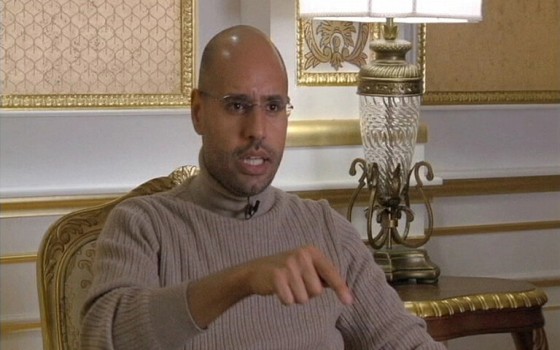
Who killed Saif al-Islam Gaddafi? A question that may take a long time to answer.

- Europe and Arabs
- Wednesday , 4 February 2026 6:29 AM GMT
Tripoli: Europe and the Arabs – Agencies
Libyan media outlets confirmed the killing of Saif al-Islam Gaddafi by four individuals near the city of Zintan in western Libya. Meanwhile, Brigade 444, a military unit affiliated with the Government of National Accord, quickly denied any involvement in Gaddafi's assassination.
According to the European news network Euronews in Brussels, the official Libyan news agency announced on Tuesday the death of Saif al-Islam Gaddafi, son of the late Libyan leader Muammar Gaddafi.
After years of detention, he was released, and his name began to resurface with reports of his efforts to re-engage in the political arena and his attempts to run in the repeatedly postponed presidential elections, which re-established him as a controversial figure in Libya.
Since the fall of Muammar Gaddafi's regime and his death in 2011, Libya has been plagued by a sharp political and security divide, pulled in two directions by two rival authorities: the internationally recognized government of Abdul Hamid Dbeibah, based in Tripoli, and a parallel authority in the east supported by General Khalifa Haftar.
A source close to the Gaddafi family told Al Arabiya that Saif al-Islam Gaddafi was killed in his home by four assassins near the city of Zintan in western Libya. Reports indicated that the attackers entered the house after disabling the security cameras and then fled quickly. The source also stated that efforts are underway to form a committee to recover Saif al-Islam's body. The identity of the killers of the late Libyan leader's son remains unknown. According to the European news site Nova News, Khaled al-Zaidi, Saif al-Islam Gaddafi's veteran lawyer, posted a message on social media stating: "The assassination of Saif al-Islam Gaddafi, the son of former Libyan leader Muammar Gaddafi, is a grave act of treason, committed with the intent to silence the will of the Libyan people." Zaidi offered his condolences "to all the free people of Libya" on "the martyrdom of the fighter, Dr. Saif al-Islam Gaddafi, who fell victim to treachery because he refused to compromise, refused to remain silent, and refused to bow down."
According to the lawyer, "They were mistaken if they thought that killing this man would silence the issues, or that silencing a voice would kill an idea." He continued, saying that what happened represents "a direct attack on the will of a people, and a desperate attempt to silence the voice of freedom," but an attempt doomed to failure. The lawyer concluded by calling for Muammar Gaddafi's second son to be made "an unforgettable symbol, an unyielding banner," emphasizing that "free voices cannot be killed, and that truth is stronger than treachery." Under the headline "On X, there's an audio recording containing accusations against the US and the UN," Nova News reported that an audio message attributed to Saif al-Islam Gaddafi, dated February 1st, was published on the X platform in the past few hours. The voice attributed to Saif al-Islam in the message claims that the former UN Special Representative to Libya, Stephanie Williams, played a pivotal role in the management of power in Libya, denouncing alleged US and Western interference in the country's political structure.
The message links these dynamics to the events of 2011, claiming that many people "died as martyrs" and accusing foreign entities of contributing to the plundering of Libyan resources and the collapse of institutions. The recording, whose authenticity cannot be independently verified, includes references to the loss of financial resources, the deterioration of social conditions, and the increasing number of orphans and widows as direct consequences of the conflict and the post-revolution period.
According to Euronews, Gaddafi's political advisor, Abdullah Othman, confirmed his death in a brief post on his Facebook page, without revealing any details about the incident or the perpetrators.
Al-Masar TV quoted Othman as saying that the perpetrators remain unknown, noting that Gaddafi was ambushed around 2:00 PM inside his compound on the outskirts of Zintan, after security cameras were disabled and clashes broke out between an armed group and his entourage.
For its part, Saif al-Islam Gaddafi's political team officially mourned the son of the late Libyan leader, writing, "Arrangements are underway to recover Saif al-Islam's body."
Brigade 444 Denies Involvement
Brigade 444, a military formation affiliated with the Government of National Unity, denied any involvement in the assassination of Saif al-Islam Gaddafi, asserting in an official statement that it was not involved in the clashes that took place in Zintan. The statement clarified that "there are no military forces or field deployments belonging to the brigade within the city of Zintan or its geographical boundaries," emphasizing that the brigade has no connection, direct or indirect, to the events that occurred there.
The brigade confirmed that it had not received any instructions or orders regarding the pursuit of Saif al-Islam Gaddafi, explaining that this matter does not fall within its military or security responsibilities.
It called on media outlets and social media users to be accurate in disseminating information, to rely on official statements, and not to be swayed by rumors intended to mislead, sow confusion, and create chaos.
Who is Saif al-Islam Gaddafi?
Saif al-Islam Gaddafi, born in 1972, is the son of the late Libyan leader Muammar Gaddafi. He graduated from the Faculty of Engineering at the University of Tripoli before pursuing further studies at several European universities, an academic path that paved the way for his early emergence in the public sphere.
He assumed the presidency of the Gaddafi International Foundation for Charity and Development. He later emerged as a key player in Libyan political life, assuming pivotal roles and leading negotiations with foreign parties and entities. This solidified his position as the political face of the regime during critical junctures, making him one of the most prominent figures of the former regime before its fall in 2011.
In 2006, he launched a reform project under the slogan "Libya of Tomorrow," presented at the time as a path to openness. However, the regime's opponents viewed it as a deliberate attempt to pave the way for his ascension to power. He did indeed emerge during that period as one of the potential successors.
After the fall of the capital, armed factions halted his advance, and he was subsequently sentenced to death in Libya for crimes committed against Libyans. Simultaneously, he was wanted by the International Criminal Court on charges of crimes against humanity.






No Comments Found