

EU Leaders' Summit: Agreement on Four Goals – Economic Growth, Industrial Innovation, Good Jobs, and Affordability – to Ensure Competitiveness and a Single Market for One Europe

- Europe and Arabs
- Friday , 13 February 2026 7:45 AM GMT
Brussels: Europe and the Arabs
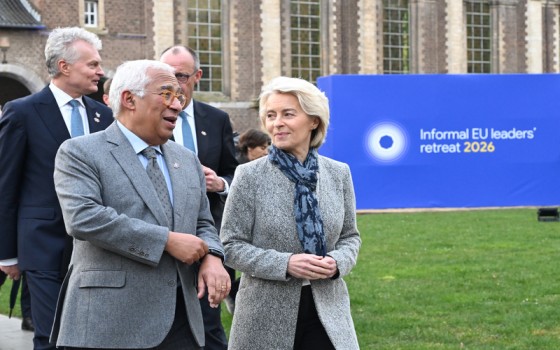
A European statement distributed in Brussels last night relayed remarks by European Council President Antonio Costa following the conclusion of discussions among the leaders of the member states. The statement read: "The leaders held an important and strategic discussion on Europe's competitiveness and how to build a more competitive and resilient economy that enhances our prosperity, creates high-quality jobs, and ensures affordability. The discussions, held at the Alden Besen in Belgium, injected new dynamism and a shared sense of the need to achieve this goal. Most importantly, we have paved the way today for agreement on concrete actions at the European Council meeting in March. First, there is unanimous agreement to continue pushing forward with our ambitious program to simplify procedures, as outlined in Ursula von der Leyton's recent letter to the leaders. Second, the leaders accept Enrico Letta's challenge to move from an incomplete single market to 'one market for one Europe.' This is urgent and must be accomplished in 2026 and 2027. We also all agree on the importance of moving quickly this year to implement Regulation 28, to ensure that our companies can operate seamlessly in all our 500 member states." There are 27 member states, and this is achieved through a simple and standardized set of corporate rules.
Third, I heard agreement that in some sectors, such as telecommunications, a degree of merger should be permitted to achieve the necessary levels of investment and innovation. This should be part of a kind of social contract, to ensure that merged companies invest more and innovate more broadly. Leaders want to see truly leading European companies emerge in strategic sectors. The ongoing review of the merger guidelines plays an important role in this regard.
Fourth, regarding electricity prices, the energy transition remains Europe’s best long-term strategy for achieving strategic self-sufficiency and lowering prices. But right now, we need practical, concrete solutions that address the specific challenges of member states and certain industries. We will work closely with the European Commission and will consider concrete measures at the next European Council meeting in March.
Fifth, regarding the protection of strategic industries and reducing dependence on outsourcing, there is a widespread recognition of the strategic importance of protecting and strengthening certain sectors for Europe. I heard mention of defense, space, clean technology, quantum computing, artificial intelligence, and systems. Payment. We will map and define our credits, and then address them through a diversification strategy.
Regarding European preference, I believe there is broad agreement that it should be used in selected strategic sectors in a proportionate and targeted manner, following a thorough analysis to determine where it is needed and how it is effective.
Sixth, there is a consensus that Europe is open to trade, and that an ambitious and pragmatic trade policy, focused on diversification, is in our collective interest. We must continue to support the excellent work being done by the European Commission.
Finally, there is no doubt that Europe lacks investment. There will be no competitiveness without more investment. Our focus today has been largely on how to mobilize private investment, and I was pleased to hear unanimous support for accelerating the creation of a savings and investment union.
Europe needs a single and effective financial system, capable of better channeling European savings into investment in Europe. But public investment will also play a crucial role. Here, we need to discuss the role of European instruments, in the context of the Multiannual Financial Framework negotiations.
I conclude by reiterating the ultimate goals of all our efforts:
Growth Economic;
Industrial innovation;
Good jobs;
Affordability.
Now, we will translate the results of today's discussions into concrete commitments and timetables at the European Council in March. Then, we will focus on implementation.
And I want to emphasize clearly: in 2026, Europe will deliver on its promises. We did so in the area of defense last year, and we will do so in the area of competitiveness this year.



No Comments Found