

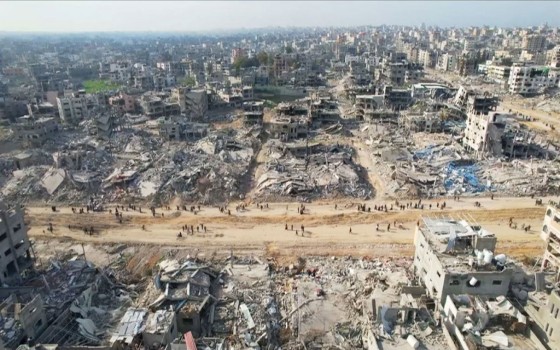
Coinciding with the Peace Council meeting... Document: EU considers supporting the National Committee for the Administration of Gaza... UN confirms that the Middle East is at a pivotal moment

- Europe and Arabs
- Thursday , 19 February 2026 4:45 AM GMT
Brussels – New York: Europe and the Arabs
A document seen by Reuters from the European External Action Service (EEAS) reveals that the European Union is considering providing support to the National Committee for the Administration of the Gaza Strip.
The document, distributed to member states on Tuesday, states that "the EU is in contact with the newly established transitional governing structures in Gaza."
The document continues, "The EU is also considering providing support to the National Committee for the Administration of Gaza." Foreign ministers will discuss the situation in Gaza at a meeting in Brussels on February 23.
Most European governments have opted not to join the US-led Peace Council, but a member of the European Commission is scheduled to travel to Washington to attend the Council's meeting on Thursday.
The National Committee for the Administration of Gaza officially began its work on January 17, headed by Commissioner-General Ali Shaath, following its inaugural meeting in Cairo. This move was described as "pivotal" towards stabilizing and rebuilding the Gaza Strip.
The EU document asserts that "the decision not to join the Peace Council as a member does not affect our continued commitment to the success of the peace plan." She added that the European Commissioner for the Mediterranean, Dubravka Šujča, would participate as an observer in the Peace Council meeting, and that the EU Police Support Mission would contribute to the international stabilization force by training and equipping Palestinian civilian police and criminal justice institutions.
Delegations from at least 20 countries, including heads of state and government, are expected to attend the meeting of the council, which was established by the UN Security Council as part of Trump's plan to end the Gaza war.
US officials said earlier this week that Trump would announce a multi-billion-dollar plan to rebuild Gaza and details of plans to establish a UN-mandated stabilization force in the Palestinian territory during a meeting in Washington on February 19.
The US officials stated that the meeting would focus on Gaza, where the nearly two-year war left widespread destruction. Israel and Hamas agreed to Trump's plan last year, and a ceasefire went into effect in October 2025.
The National Committee for the Administration of Gaza has prepared a set of proposed plans, hoping that the Washington meeting of the Peace Council, chaired by Trump, will secure financial support to fund these plans for Gaza relief and to begin the first phase of reconstruction.
For her part, Rosemary DiCarlo, UN Under-Secretary-General for Political and Peacebuilding Affairs, said that the Middle East is at a pivotal moment and that there is an opportunity that could allow the region to move in a different direction after years of devastating conflict and immense human suffering.
She added: "But this window is not guaranteed or endless. The decisions that will be taken in the coming weeks by the parties and members of the Security Council will determine whether it is sustainable."
The UN official was speaking at a ministerial meeting of the Security Council on the situation in the Middle East, including the Palestinian question, chaired by Yvette Cooper, the UK Foreign Secretary, whose country holds the rotating presidency of the Council this month. Key points from the Under-Secretary-General for Political and Peacebuilding Affairs' remarks:
The Middle East is at a pivotal moment.
Decisions in the coming weeks will determine whether the opportunity for change can be sustained.
The Peace Council meeting in Washington is an important step.
Disarmament in Gaza and increased aid access to the Strip are essential.
We are witnessing a gradual de facto annexation of the West Bank.
Israeli settlements have no legal legitimacy and violate international law.
The plan must be fully implemented in Gaza, and urgent measures must be taken to de-escalate the situation and reverse the dangerous trajectory in the occupied West Bank.
"The Peace Council meeting is an important step."
The Under-Secretary-General for Political Affairs stressed the need for collective efforts to strengthen the ceasefire in Gaza and alleviate the suffering of the Strip's residents.
She said that the Peace Council meeting in Washington, D.C., on Thursday was an important step. She added: "We have a responsibility to work collectively to implement the second phase of the ceasefire agreement in Gaza and advance efforts toward a political process leading to a negotiated two-state solution." The UN official stressed that this must include the disarmament of the Gaza Strip, the removal of weapons from Hamas and other Palestinian armed groups, and the establishment of security measures that facilitate the transitional governance tasks of the National Committee for the Administration of Gaza.
At the same time, DiCarlo emphasized the need for a significant increase in humanitarian aid entering Gaza, stating that this is essential for the Palestinian-led recovery and reconstruction process.
The UN official said that Gaza is still not at peace, despite the ceasefire. She noted that the Israeli army has intensified its raids across Gaza in recent weeks, targeting densely populated areas and killing dozens of Palestinians.
She also pointed to the continued armed clashes between Palestinian armed groups and Israeli soldiers.
"We are witnessing a gradual de facto annexation of the West Bank," the UN official said, referring to the "rapid deterioration of the situation in the occupied West Bank." She said that Israeli forces have continued their large-scale operations throughout the West Bank, frequently using live ammunition, raising serious concerns about the use of lethal force. She said the large-scale raids were accompanied by house seizures, mass arrests, movement restrictions, and the repeated displacement of Palestinian families, particularly in the north. Attacks by Palestinians against Israelis and clashes between Palestinians and Israeli security forces also continued.
Rosemary DiCarlo noted the continued expansion of settlements, the increase in settler violence, and the pace of demolitions and evictions in East Jerusalem. She stated, "We are witnessing a gradual de facto annexation of the West Bank, as unilateral Israeli actions continually alter the landscape."
She reiterated the Secretary-General's grave concern regarding the reported decision by the Israeli Security Cabinet to authorize a series of executive measures and transfer powers in Areas A and B of the occupied West Bank.
She said that if implemented, these measures "would constitute a dangerous expansion of Israeli civil authority in the occupied West Bank, including sensitive areas such as Hebron."
She reiterated the Secretary-General's condemnation of the decision to resume land registration measures in Area C of the occupied West Bank. She said that the decision threatens to dispossess Palestinians of their property and expand Israeli control over land in the area.
She stressed that Israel must immediately reverse these measures. She stated that Israeli settlements in the occupied West Bank, including East Jerusalem, have no legal validity and violate international law and UN resolutions. She stressed the need for the full implementation of the comprehensive US-led plan, along with urgent measures to de-escalate tensions and reverse the dangerous trajectory in the occupied West Bank.
She said, "At the same time, this opportunity must be seized to restore a credible political horizon that leads to lasting peace in Gaza, ends the occupation, and achieves a two-state solution in accordance with international law and relevant UN resolutions."
Two representatives of civil society also addressed the meeting. After the fifteen members of the Security Council delivered their statements, representatives from Palestine, Israel, Jordan, Egypt, Indonesia, Saudi Arabia, Syria, Qatar, Turkey, and the United Arab Emirates spoke at the meeting.



No Comments Found