

The cost of restoring the Brussels courthouse exceeds €600 million. The opposition demands an investigation and criticizes the government's incompetence in managing infrastructure and historical projects.

- Europe and Arabs
- Tuesday , 10 March 2026 7:10 AM GMT
Brussels: Europe and the Arabs
The renovation project of the Brussels courthouse, known as the "Palace of Justice," has ballooned to over €600 million. In a statement we received, distributed by the far-right opposition party Vlaams Belang, MP Britt Houbrechts (Vlaams Belang), who requested these figures from the Minister for Buildings, Vanessa Matz (Les Ingages), said: "When a renovation takes more than half a century and costs so much, fundamental questions must be raised about the methodology and oversight of this project."
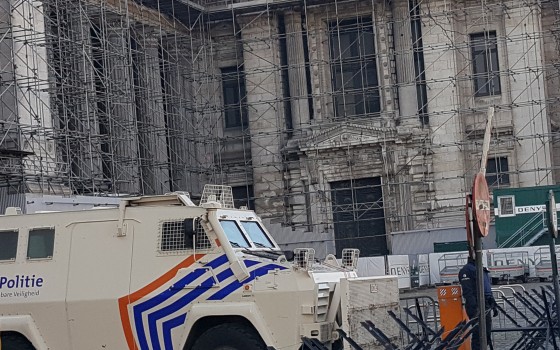
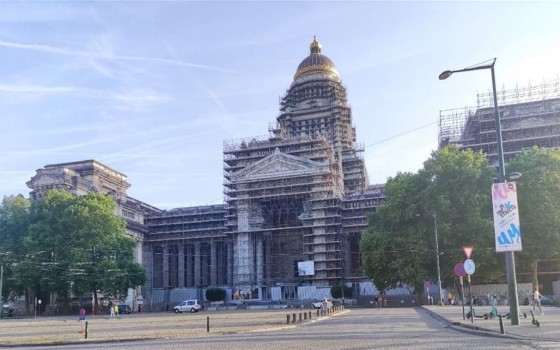
According to figures provided by the government itself, approximately €28.5 million has been spent since 2018 on studies, scaffolding, and initial restoration work on the Pollaert façade. An additional €100 million has been allocated for subsequent phases of the façade's restoration. Furthermore, an estimated €480 million has been earmarked for the renovation of the building's interior. Furthermore, it appears that enormous sums have been spent on the scaffolding surrounding the building in recent decades. Since the 1980s, nearly €5 million has been spent on rent, installation, purchase, maintenance, and reinforcement.
"An investigation is imperative."
"The Palace of Justice has become a symbol of a government that takes decades to renovate a single building," said Huybrechts. "The first safety measures date back to the 1980s. According to the current schedule, the exterior will not be fully renovated until 2035. There isn't even a clear deadline for the interior renovation."
According to the organization Vlaams Belang, this case exemplifies the federal government's incompetence in managing large-scale infrastructure and heritage projects efficiently. "Taxpayers' money has been wasted here on a massive scale," Huybrechts concluded. "There must be an investigation into all the mistakes made, both in the project's methodology and its execution." The Palace of Justice in Brussels is the building that houses the Supreme Court of Belgium. The Palace of Justice sits atop a hill with the modern name "Hanging Hill," offering a breathtaking panoramic view of the city.
The initiator of the Palace of Justice in Brussels was one of the early Belgian monarchs, King Leopold II. The architect was Joseph Bollart, also known for designing the Cathedral of Our Lady of Laeken. Construction of the Palace of Justice lasted over 20 years and was completed in 1883. Joseph Bollart did not live to see its completion for four years. The construction of the Palace of Justice in Brussels was accompanied from the outset by considerable controversy and discontent, which is unsurprising given the enormous sum of money (approximately $300 million) spent on the project and the demolition of over 3,000 homes.
Architecture of the Palace of Justice: The Palace of Justice in Brussels is a blend of eclectic and Assyrian-Babylonian styles—a gray building adorned with a golden dome. This imposing structure, three times the size of the Royal Palace, is impossible to miss in the city. The Palace of Justice, including its dome, stands 142 meters tall. The building measures 160 meters in length and 150 meters in width, with a total floor area of 52,464 square meters. The interior space exceeds 26,000 square meters.
The Palace of Justice in Brussels continues to serve its primary purpose—housing 27 courtrooms and the Court of Cassation of Belgium, in addition to 245 rooms used for other purposes and eight adjacent courtyards. It is the largest building of the 19th century to have survived to this day. Many tourists visiting Brussels include the Palace of Justice on their itinerary.


No Comments Found