

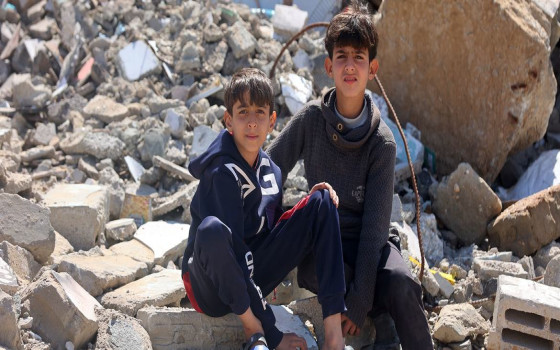
An Unprecedented Psychological Crisis Struck an Entire Generation of Children in Gaza: Shocking Figures in UN Reports

- Europe and Arabs
- Tuesday , 25 November 2025 9:1 AM GMT
Gaza: Europe and the Arab World
Two years after a devastating war, and as international efforts focus on rebuilding infrastructure in the Gaza Strip, another, deeper, and more silent crisis is unfolding: widespread psychological trauma affecting children and threatening an entire generation. The United Nations Children's Fund (UNICEF) estimates that more than one million children in Gaza urgently need psychosocial support, asserting that this assessment is "unprecedented globally." According to a report published by the Brussels-based European news network Euronews, titled "Children Living Under Constant Trauma," UN reports and field studies conducted in 2024 and 2025 by UNICEF, Save the Children, the Gaza Community Mental Health Programme, and the World Health Organization indicate that children in Gaza are living in a state of chronic trauma linked to repeated displacement, the loss of relatives, and the complete collapse of basic living conditions. These studies reveal alarming statistics:
• 96% of children feel that death is imminent.
• 79% suffer from recurring nightmares, and 87% exhibit acute fear.
• 73% display aggressive behaviors related to the trauma.
• 49% of children express a desire to “escape from life,” according to field psychological reports.
These disturbances manifest in various ways, including bedwetting, panic attacks, social withdrawal, and sudden outbursts of screaming. Experts warn against the “normalization of violence,” meaning the child's habituation to aggressive behavior as a result of continuous exposure to trauma.
Shattered Dreams and an Uncertain Future
Since the impact of the war is not limited to the present moment but extends to the children's future and aspirations, parents speak of a clear shift in their children's interests, with a decline in thinking about the future in favor of focusing on the basic necessities of life.
For example, Ahmed Ghabban (11 years old), who used to love drawing and dreamed of becoming an artist, now sees studying and art as unattainable.
Tasneem Abu Mahrouq, 10, expresses her fear that her life will collapse again and that her family will be forced to flee once more, as happened before. Sundus Mansour, 11, says she used to dream of becoming a doctor, but now her thoughts are consumed by finding clean food and a safe place to sleep.
Psychologist Samar Qwaider points out that the effects of the war may extend beyond the current generation, as parents themselves suffer trauma that limits their ability to provide emotional support to their children. With the destruction of mental health centers and the displacement of their staff, more than a million children find themselves without access to proper treatment.
When Fear Becomes Part of Childhood
In an interview with Euronews, Abeer Sharaf, displaced from the Jabalia refugee camp, describes what her children are going through: “My children have started wetting the bed. They wake up terrified and don’t want to sleep in the tent. Once, my daughter saw a child who had been killed and had no head, and she still asks me: ‘Mommy, is this how people die?’” She adds that the repeated bombings and displacement have left clear marks on them, and that she herself has suffered severe psychological distress as a result of the constant fear and the repeated damage to her tent.
In another testimony, Samah al-Tanani, displaced from eastern Gaza, says that her children have lost the ability to sleep normally and refuse to leave the tent, exhibiting symptoms resembling autism. She explains that the trauma deepened after witnessing the killing of relatives firsthand, leading one of her children to be hospitalized in a state of hallucination.
Tamara Abu Auf, displaced from the Zeitoun neighborhood, points out that the lack of basic services in the camps has exacerbated the children's situation, and that her daughter suffers from frequent panic attacks, high fever, and skin diseases. She adds that "the absence of specialists makes any psychological intervention inconsistent."
Services Nearly Collapsed
Before the war, the Gaza Strip had several mental health centers, but most of them have been destroyed or rendered inoperable. The World Health Organization indicates that the psychological needs in Gaza "will not disappear simply because of the ceasefire," calling for the integration of mental health services within the education, protection, water, and sanitation sectors.
In this context, Dr. Khaled Saeed, Regional Mental Health Advisor at the World Health Organization, says that “mental health is a collective responsibility,” emphasizing the importance of empowering individuals to regain their resilience in the face of an uncertain future.
A Generation on the Brink
UNICEF also warns that accumulated psychological trauma can have long-lasting effects on children’s cognitive and social development, making them vulnerable to depression and behavioral disorders later in life.
With education still disrupted, safe spaces unavailable, and the care system collapsing, the sector faces the risk of creating a generation with deep psychological scars. The organization adds that the lack of shelter, food shortages, deteriorating sanitation, and the harsh winter exacerbate the risks to children’s lives.
UNICEF stresses that “restoring children’s sense of security and normalcy requires a long-term and comprehensive intervention,” warning that ignoring this crisis “will have devastating consequences for the future of the entire region.”






No Comments Found