

Statement from the Iranian Resistance: Human Rights Conference in The Hague Exposes Tehran's Crimes... Public Executions Face International Outrage

- Europe and Arabs
- Wednesday , 26 November 2025 9:43 AM GMT
The Hague: Europe and the Arabs
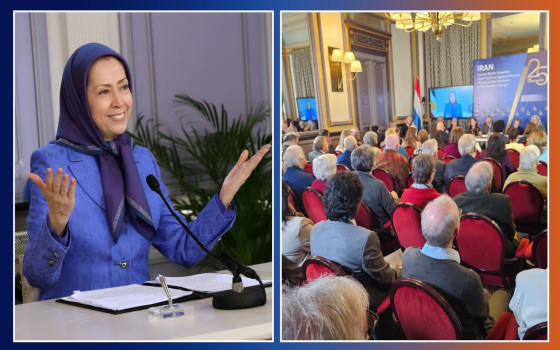
Under the title of a special report, the Iranian Resistance issued a statement, a copy of which we received, stating that in an unprecedented display of European political and human rights presence, The Hague, Netherlands, became a global platform for condemning the crimes of the Iranian regime. Dozens of international figures and members of the Dutch Senate convened at an emergency human rights conference calling for immediate action to halt the escalating wave of executions, particularly those targeting women and political prisoners.
The conference, held on November 25, 2025, coinciding with the International Day for the Elimination of Violence against Women, highlighted what participants described as the "systematic and deliberate nature" of the violence perpetrated by the Iranian regime against women. This violence is part of its repressive policies, which have made execution a tool of mass intimidation to silence society and suppress any dissenting voices.
Maryam Rajavi: Overthrowing the Regime is a Prerequisite for Ending Violence Against Women
In a key online address, Mrs. Maryam Rajavi, President-elect of the National Council of Resistance of Iran (NCRI), emphasized that the continuation of violence against women is fundamentally linked to the structure of the Velayat-e Faqih regime. She asserted that “the practice of violence against women, their humiliation, and the imposition of all forms of inequality are essential elements of extremism perpetrated in the name of Islam.”
Rajavi added that the Iranian Resistance has made women’s liberation a central focus of its struggle, considering women’s participation in leadership positions not merely a rights-based demand, but a guarantee for any genuine democratic transformation. She stressed that overthrowing the regime is the decisive step to confronting violence against women and ending the cycle of oppression, calling on the Dutch government to link its relations with Tehran to a halt to executions and the designation of the Islamic Revolutionary Guard Corps (IRGC) as a terrorist organization. A Bloody Record in Numbers
Data presented at the conference revealed a dangerous escalation in the pace of executions, with at least 304 people executed in just one month (October 23 – November 21), including 63 prisoners in four days. The number of women executed since President Masoud Pezeshkian took office has reached 73, a record high not seen in three decades.
Speakers pointed out that the Iranian regime tops the list of countries worldwide in the number of women executed, emphasizing that these acts constitute crimes against humanity that warrant international accountability, not merely fleeting political condemnations.
The Failure of Appeasement
The European speakers unanimously agreed that the West's policy of appeasement towards Tehran has only enabled the regime to escalate repression and reinforce a culture of impunity. Former German Justice Minister Herta Gmelin criticized the inaction of Western governments in taking decisive steps, stressing that human rights cannot be subject to political or economic bargaining. Dutch Senator Boris Dietrich emphasized that the Iranian regime not only practices repression internally but also exports terrorism abroad, warning of its expanding influence within Europe, including on Dutch soil.
Women at the Heart of the Resistance
Testimonies from representatives of the Iranian diaspora in Europe, such as Sepideh Orava and Nahal Safa, highlighted the leading role of women in confronting the regime, not only inside Iran but also in exile. They affirmed that the demand for freedom has transcended the issue of the hijab to encompass political rights, human dignity, and the right to self-determination.
Several relatives of execution victims gave harrowing testimonies about their family members who were executed without fair trials, amidst a palpable sense of shock that permeated the hall, yet did not stifle a rising tide of hope and defiance. The Case of Zahra Tabari: An Example of Sham Justice
One of the most prominent cases raised was that of political prisoner Zahra Tabari, who was sentenced to death after a trial that lasted no more than ten minutes via video conference, without being allowed to appoint a lawyer of her choosing, simply for being accused of collaborating with the People's Mojahedin Organization of Iran (PMOI/MEK).
This case, as the participants emphasized, encapsulates the reality of the judiciary in Iran, which has been transformed into a tool of repression instead of an institution of justice.
European and International Responsibility
The conference concluded with a clear call for the European Union to take concrete steps, including:
• Designating the Iranian Revolutionary Guard Corps (IRGC) as a terrorist organization.
• Suspending economic and diplomatic relations with Tehran.
• Supporting the democratic alternative led by the Iranian Resistance.
• Launching an international investigation into the mass executions.
The speakers also stressed that supporting the Iranian people is no longer a domestic matter, but rather an international moral responsibility in the face of a regime that defies universal humanitarian principles. In summary, the Hague conference was not just an ordinary human rights event, but a pivotal moment in the process of internationalizing the issue of executions in Iran, where the voices of the victims converged with European positions in one clear message:
There is no stability with a regime based on executions, no dignity for women under the rule of the Supreme Leader, and no democracy without overthrowing this regime.





No Comments Found