

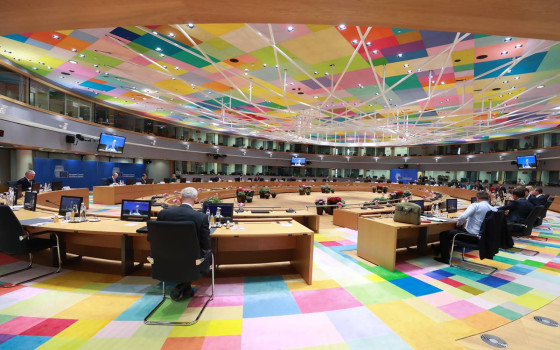
European Ministerial Meeting to Discuss Military Support for Ukraine Amid Growing Belgian Objections to the Use of Frozen Russian Assets

- Europe and Arabs
- Monday , 1 December 2025 9:21 AM GMT
Brussels: Europe and the Arabs
EU foreign ministers are meeting today, Monday, in Brussels. The meeting is being chaired by Kaja Kallas, the High Representative of the European Union for Foreign Affairs and Security Policy. According to EU institutions, the ministers will exchange views on EU military support for Ukraine, with an informal exchange of views with Denys Shmyhal, the Ukrainian Minister of Defense, and Mark Rutte, the Secretary General of NATO. They will also discuss defense readiness and be briefed on the latest developments. Meanwhile, Playbook, the Brussels-based European edition of Politico, reported that EU leaders are preparing to review legal proposals on how to stabilize Ukraine's finances by midweek. However, the path ahead appears more difficult than ever, with Belgium increasingly objecting to the use of frozen Russian assets. In comments to Playbook, Belgian Foreign Minister Maxime Prévost reiterated his boss, Prime Minister Bart De Wever's, objections to the so-called compensation loan, targeting leaders and officials who insist that using Russian assets is the only credible way forward. Prévost said the EU's failure to find a clear way to financially support Ukraine so far is not Belgium's fault, but rather the result of the EU's "stubbornness" in insisting on using Russian assets "without knowing how to do it or understanding the risks involved." Prévost went on to describe the compensation loan as a problem for the ongoing peace talks aimed at ending the war in Ukraine: "It is now clear that assets could play an important role in the peace plan... Our actions should not hinder the peace plan."
When asked whether The Commission was still working on the compensation loan, despite Belgium's objections. A Commission spokesperson said: "Yes – as one of the options in the options paper presented by President Ursula von der Leyen." The spokesperson added that Brussels was continuing consultations on the loan with member states, including Belgium.
This aligns with comments from German Chancellor Friedrich Merz, who said at a press conference on Friday that he "understands [Belgian] concerns... but we also have good arguments for a common goal of putting as much pressure as possible on Russia to end this war."
However, EU diplomats and officials who spoke to Playbook over the weekend expressed concern about the tone, timing, and nature of De Wever's public message, as well as his insistence that the compensation loan could be an obstacle to peace. "He certainly had a final tone," one diplomat said.
The diplomats said this last argument was particularly worrying because it contradicts the EU's strategy of increasing pressure on Russia and appears to align with US President Donald Trump's more conciliatory stance toward Russia. Moscow. An EU official said: "There are members of the US administration who want to deal with Russia." The issue of assets doesn't suit them.” When asked whether Belgium had been in contact with the Trump White House about the loan, a Foreign Ministry spokesman said they had “no information about such contacts.” Nevertheless, tensions are expected to worsen. A Politico report, citing five diplomats who questioned how Belgium would use the tax revenue from these assets, has been the talk of the town in recent days. “Every diplomat, except the Belgians, is talking about the money they’re making from it,” said the same European official. These murmurs are expected to cast a shadow over Monday’s defense ministerial meeting.
EU leaders are now bracing for a daunting task in the coming weeks as they carefully examine the Commission’s legal proposal and race to reach a solution in time for the next European Council meeting on December 18 and 19. All the options on the table—increasing Ukraine’s debt; using the EU budget; or tapping into Russia’s assets—have their drawbacks. But failure is not an option. “It will be very difficult,” said one diplomat. “There is no easy way out,” the same diplomat added, noting that European Council President Antonio Costa would ultimately be responsible for ensuring a solution is reached in December. “Costa will be tasked with putting the ball in the EU’s court,” he said. “We are closing the doors and saying, ‘You are not leaving until you find a solution.’” US Secretary of State Marco Rubio stated that “more work needs to be done” to reach a peace agreement between Ukraine and Russia, despite constructive talks with Kyiv’s new chief negotiator, Rustam Umarov, in Florida on Sunday. Trump’s special envoy, Steve Witkopf, is traveling to Moscow for talks with the Kremlin, while Ukrainian President Volodymyr Zelensky (who spoke with von der Leyen over the weekend, according to her spokesperson) is heading to Ireland for his first official visit, according to Sky News.



No Comments Found