

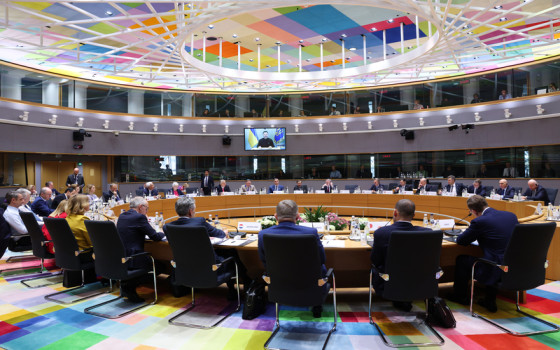
A decisive week for EU leaders to confront the biggest geopolitical crisis... Starting today with the Berlin meeting on Ukraine... and crucial decisions at the Brussels summit

- Europe and Arabs
- Monday , 15 December 2025 9:25 AM GMT
Brussels: Europe and the Arabs
The European Union faces a crucial geopolitical moment this week as its leaders make pivotal decisions regarding peace in Ukraine and how to finance its war against Russia. This week is also critical for the fate of a trade agreement with South America that has been in the works for 25 years.
According to a report by Playbook, the European edition of Politico: In response to Trump: After US President Donald Trump attacked them, calling them "weak" and "lost," EU leaders, including Merkel and Macron, have an opportunity to demonstrate Europe's readiness to take control of its own destiny.
In what the report describes as a first step: Last week's decision to use emergency powers to freeze Russian assets held in Belgium represents a first step toward greater EU independence, according to several European diplomats who spoke to Playbook over the weekend.
While awaiting a decisive move, the significant developments concerning Mercosur and financing Ukraine will underscore the importance of Europe's geopolitical position. A European diplomat said: “We had an American president who said that leaders couldn’t make decisions. Now it’s their chance to prove they can.”
The first decision – peace in Ukraine: Berlin will be the stage for the first crucial moments today, as Ukrainian President Volodymyr Zelenskyy meets with Merz before convening with the following European leaders starting at 6:30 p.m.: Macron, Keir Starmer, Alexander Stubb, Mette Frederiksen, Donald Tusk, Ulf Kristersson, Dick Schöf, Jonas Gahr Støre, Ursula von der Leyen, and António Costa. NATO Secretary General Mark Rutte will also be in attendance.
The importance of this meeting: The Berlin meeting represents a crucial opportunity for Europe to influence the peace agreement, weeks after the United States and Russia presented a preliminary 28-point plan that sparked widespread anger within the bloc.
A step closer to peace: Finnish Foreign Minister Stubb told a Dutch broadcaster on Sunday, "We are perhaps closer to a peace agreement than we have been at any time in the past four years."
What's at stake: The fate of the Ukrainian territories claimed by Russia, as well as the security guarantees Kyiv is seeking.
The second decision – funding Ukraine: While leaders meet in Berlin, EU foreign ministers and ambassadors will make a final push in Brussels to reach an agreement on a €210 billion loan to Ukraine using frozen Russian assets, ahead of the leaders' meeting later this week.
A pivotal decision: A German official wrote on the Playbook website, "The decision on the frozen assets will determine whether the EU remains a relevant player. There is no other option." However, plans to tap into billions of dollars of frozen Russian assets are facing obstacles after Italy, along with Malta and Bulgaria, opposed the plan last week. Hungary and Slovakia are also likely to oppose the proposal. Two diplomats stated that Budapest's opposition to using the EU budget margin to finance Ukraine has paradoxically made a compensation loan the primary option.
Meanwhile, the new Czech Prime Minister, Andrej Babiš, opposed the Russian assets proposal over the weekend, stating that his country was not prepared to provide financial guarantees to Belgium.
In this context, Belgian Prime Minister Bart De Wever received some support from European leaders, who attempted to allay his concerns. On Sunday, the Danish Presidency of the EU was finalizing a legal draft from the Commission before a meeting of the Committee of Permanent Representatives (Corber) that evening, according to a European diplomat. The meeting, originally scheduled for Sunday, was postponed to allow time for this.
Finally, this week could see the conclusion of the long-awaited trade agreement between Mercosur countries, which many officials describe as a geopolitical maneuver by Europe to offset its dependence on the United States.
The meeting of EU leaders later this week is likely to mark the beginning of a new era for Europe. But it will be anything but easy: One diplomat said he was preparing "several shirts" for the summit, suggesting that the European Council meeting will be long and arduous. Prepare yourself: the road to Christmas will be bumpy.
Mercosur on the line
Last-minute call to postpone Mercosur: As the European free trade countries pressed forward with their trade agreement with South America, France thwarted the efforts on Sunday evening by calling for a postponement of the decision to allow more time to address Paris's concerns, according to a report by Camille Geiss.
The importance of the matter: Several countries warn that this delay ultimately threatens to derail the trade agreement, which has been in the works for decades, and which would create a free trade area encompassing 700 million people.
Further delays could embolden opposition in the European Parliament or complicate subsequent steps when Paraguay, a critic of the agreement, takes over the Mercosur presidency from Brazil.
Denmark has vowed to stand firm and proceed with setting a date for the vote in time for European Commission President Ursula von der Leyen to travel to Brazil on December 20, despite France's push to postpone the decision.
But final negotiations are unlikely to conclude before the European leaders' summit this Thursday and Friday. Adding to the complexity, a farmers' protest is expected in Brussels on Thursday. Diplomats said multiple sensitive issues—from frozen Russian assets to the Mercosur agreement—are being linked at the highest levels to extract concessions.
Three diplomats described Italy as having the final say. Two of them said it was unclear whether Rome was seeking concessions on other issues, one pointing to guarantees related to the Multiannual Financial Framework currently being negotiated, or whether it was more a matter of domestic politics. Italy’s Agriculture Minister, Francesco Lollobrigida, remained vague during his press briefing on the sidelines of the Agriculture Council meeting last Friday.
Along with France, Italy, Poland, Ireland, and Austria are among the most skeptical countries about the agreement. In contrast, Mercosur-supporting countries such as Germany, Spain, and Sweden argue that France has already secured some concessions, including a proposal for additional safeguards to protect European farmers should Latin American beef or poultry flood EU markets. The texts, published last week, include an enhanced interim guarantee—a key condition for Paris’s approval of the agreement. The European Parliament will vote on the guarantee text tomorrow, which will open the door to final negotiations between the Council of the European Union and the Parliament. But the timeframe appears tight.



No Comments Found