

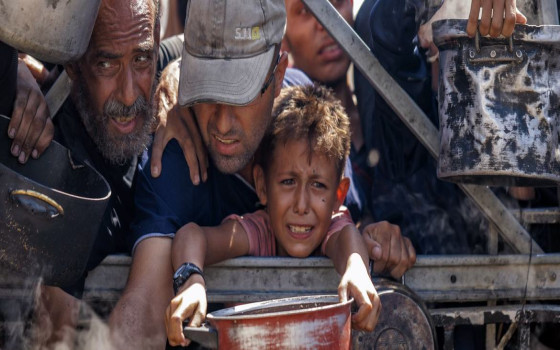
Relief efforts in the Gaza Strip have been unable to keep pace with the scale of needs due to restrictions imposed by the occupying authorities. Belgium officially joins South Africa's case against Israel at the International Court of Justice

- Europe and Arabs
- Wednesday , 24 December 2025 8:44 AM GMT
Gaza – The Hague: Europe and the Arabs
The International Court of Justice (ICJ) announced on Tuesday that Belgium has formally submitted a declaration of intervention in the case brought by South Africa against Israel, which accuses Tel Aviv of violating its obligations under the 1948 Genocide Convention in the context of its military campaign in the Gaza Strip.
Belgium's intervention, dated December 23, 2025, is based on Article 63 of the ICJ's Statute, which grants States Parties to the treaty the right to intervene in the interpretation of its provisions.
According to the Brussels-based news network Euronews, the Belgian declaration focused on Articles 1-6 of the Convention, with particular emphasis on the "specific intent" required for the crime of genocide, as defined in Article 2.
The Court formally requested that South Africa and Israel submit written observations on Belgium's intervention, in accordance with Rule 83 of its Rules of Procedure. This step is part of standard legal procedures when a new state joins an ongoing case. Belgium's intervention follows its official recognition of the State of Palestine in September, joining a number of other countries that have taken a similar step. It is estimated that around 80% of UN member states recognize the State of Palestine.
South Africa filed the case on December 29, 2023, two months after the October 7 attack by Hamas militants on southern Israel, which resulted in the deaths of approximately 1,200 people and the abduction of 251 hostages.
Since then, countries including Brazil, Colombia, Ireland, Mexico, Spain, Libya, Bolivia, and Turkey have joined the case. Nicaragua initially requested to join but withdrew its request two months later without explanation.
In January 2024, four months after the outbreak of the war, the court called on Israel to refrain from committing any act that could be classified as genocide, warning of a "real and imminent risk" of "irreparable harm" to Palestinians.
This call was followed by provisional orders in March and May requiring Israel to facilitate humanitarian access, prevent incitement to genocide, and punish those responsible. Although these orders are legally binding, the court lacks effective enforcement power.
Israel denied the accusations, describing the lawsuit as South Africa "adopting Hamas's position," and emphasizing that it makes "every effort to avoid harming civilians."
The Israeli government blamed Hamas for the casualties, stating that the group's fighters operate from within populated residential areas.
The Hamas-run Ministry of Health in Gaza reports that more than 79,000 people have been killed since the start of the war. This figure does not distinguish between civilians and combatants and cannot be independently verified, although the UN generally considers its figures reliable. Since the ceasefire came into effect on October 10, at least 395 people have been killed.
In the same vein, according to the UN daily news bulletin, the UN Office for the Coordination of Humanitarian Affairs (OCHA) reported that relief efforts in the Gaza Strip have been unable to keep pace with the scale of the needs due to ongoing restrictions imposed by Israeli authorities, including restrictions on the entry of supplies into the Strip. OCHA cited the efforts to maintain and repair sewage networks in Gaza City as an example of these constraints, noting that they are hampered by a shortage of new materials, forcing teams to use outdated components.
Despite these obstacles, the UN and its partners continue to respond to the growing needs of displaced families and mitigate the effects of recent winter storms, which have exacerbated the already dire situation for thousands of people across the Gaza Strip.
UN water and sanitation partners reported that efforts are underway to improve water purification at the Al-Bassa desalination plant in Deir al-Balah by transferring specialized equipment to the facility, and that installation has begun at the Al-Manshiya desalination plant in Gaza City.
Killings and Displacement in the West Bank
Regarding the West Bank, OCHA reported documenting further incidents of Palestinian deaths and injuries. Ongoing Israeli military operations and settler violence continue to endanger the population and increase humanitarian needs.
In the past two weeks, six Palestinians, including four children, have been killed, while three Israelis have been injured by Palestinians. OCHA expressed grave concern over the continued displacement of Palestinians throughout the West Bank, where more than 100 Palestinians were displaced by demolitions and evictions during the same period, including 63 in East Jerusalem.
On Monday, Israel demolished a four-story building in the Silwan neighborhood of East Jerusalem, claiming it lacked a building permit issued by Israeli authorities—a permit virtually impossible for Palestinians to obtain—displacing 50 people, including 21 children.






No Comments Found