

Europe responds to Trump on the issues of Greenland and tariff increases, warning of undermining transatlantic relations and a serious

- Europe and Arabs
- Sunday , 18 January 2026 8:39 AM GMT
Brussels: Europe and the Arabs
Territorial integrity and sovereignty are fundamental principles of international law, essential for Europe and the international community as a whole. This was stated at the beginning of the European statement issued in Brussels regarding the Danish Greenland issue, which also addressed the US tariff increase. The statement, issued by European Council President António Costa and Commission President Ursula von der Leyen, added: "We have repeatedly emphasized our shared transatlantic interest in peace and security in the Arctic, including through NATO. The pre-coordinated Danish exercise, conducted with allies, is a response to the need to strengthen security in the Arctic and poses no threat to any party.
The European Union expresses its full solidarity with Denmark and the people of Greenland. Dialogue remains essential, and we are committed to building on the process that began last week between the Kingdom of Denmark and the United States.
The imposition of tariffs would undermine transatlantic relations and threatens a serious deterioration. Europe will remain united, coordinated, and committed to preserving its sovereignty." In a new escalation, US President Donald Trump announced Trump's intention to impose additional tariffs on several European countries and the United Kingdom, a move he directly linked to the Greenland issue, prompted swift European reactions expressing widespread rejection and growing concern about the decision's repercussions. According to the Brussels-based European news network Euronews, Trump announced his decision via his Truth Social platform. As stated in his post, Denmark, Norway, Sweden, France, Germany, the United Kingdom, the Netherlands, and Finland will be subject to a 10% tariff on all products exported to the United States, effective February 1st.
By June 1st, these tariffs will increase to 25% and will remain "due and payable until an agreement is reached to purchase Greenland in its entirety." The US president justified this move by accusing the countries involved of "playing a very dangerous game" and pursuing "an unacceptable and unsustainable level of risk."
He asserted that the current situation is "likely to become dangerous" unless action is taken. "Strong" and swift measures to protect global peace and security. At the same time, Trump affirmed that he is "open to negotiations immediately with Denmark and/or any of these countries."
This announcement comes just months after the European Union and the United States reached an agreement on import tariffs in July, reigniting concerns about renewed trade disputes between the two sides.
European Rejection
In Denmark, Foreign Minister Lars Løkke Rasmussen said his country was surprised by the tariff announcement, explaining that the increased European military presence in Greenland, which Trump referenced, aims to "strengthen security in the Arctic." He confirmed that Copenhagen is in close contact with the European Commission and other partners on this matter.
France was among the first countries to express its rejection. French President Emmanuel Macron condemned Trump's announcement, writing in a post on the X platform that "threats of tariffs are unacceptable and have no place in this context." He added that Europeans "will respond in a united and coordinated manner if this is confirmed," emphasizing the commitment to "ensuring respect for European sovereignty."
As for Germany, Her government announced that it was coordinating closely with its European partners to respond to Washington's statements. Government spokesman Stephan Cornelius said that Berlin had taken note of the US president's comments and that consultations were underway at the European level.
In London, British Prime Minister Keir Starmer described Trump's threat as "completely wrong," emphasizing that his country's position on Greenland is clear: it is part of the Kingdom of Denmark, and its future will be decided by the people of Greenland and the Danes.
He added that Arctic security concerns the entire NATO alliance, and that imposing tariffs on allies for their pursuit of collective security is "completely wrong," indicating that his country would seek to address the matter directly with the US administration.
For his part, Swedish Prime Minister Ulf Kristersson rejected the tariff threats, writing on the X platform: "We will not be blackmailed," stressing that Denmark and Greenland alone decide on matters concerning them.
He affirmed his support for his country and its allied neighbors, noting that this is an issue for the European Union and affects far more countries than those currently targeted, and that intensive discussions are taking place to reach a solution. A collective response.
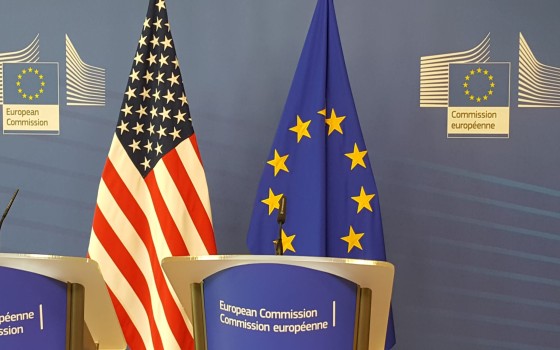
At the EU level, European Commission President Ursula von der Leyen and European Council President António Costa issued a joint statement declaring that the deployment of European military personnel was part of a "pre-coordinated Danish exercise with allies" and responded to the need to strengthen Arctic security without posing a threat to any party.
The statement warned that tariffs "would undermine transatlantic relations and risk a dangerous downward spiral."
It asserted that Trump's approach poses a threat to prosperity, arguing that "markets should be opened, not closed, and areas of economic integration should be created instead of increased tariffs."
The statement added that the EU "will always be very firm in defending international law," revealing that it is coordinating a joint response from EU member states following the signing of a historic trade agreement between the EU and South American countries in Paraguay.



No Comments Found